What happens when your car looks fine on the outside but feels completely off while driving? Maybe it pulls to one side, maybe the steering wheel tilts just slightly, or the alignment never really sits right. You might be dealing with something deeper, something under the surface. Car chassis repair is not just a cosmetic fix; it’s structural. If the chassis is bent, twisted, or cracked, everything else suffers, from suspension to safety. Ignoring it? That can turn a small issue into a dangerous one real fast.
What’s a Car Chassis?
Think of the chassis as the car’s backbone. It is the base frame everything’s built on, engine, suspension, wheels, even the body panels. If the chassis is out of shape, the whole structure goes wonky. It holds the weight, absorbs impact, and keeps all parts aligned. Most modern cars use a unibody design, where the body and frame are fused together. Others use a body-on-frame setup, especially larger SUVs and trucks. Either way, car chassis repair becomes non-negotiable when this structure is compromised. You mess with the frame, you mess with the car.
Why Chassis Damage Happens
It does not take a major accident to twist the frame. A bad hit from the side, jumping a speed bump too hard, or even lifting the car from the wrong point, all of it can mess with the chassis. Dubai’s road conditions might look smooth, but hidden potholes, steep ramps in underground parking lots, or careless tow truck handling can bend a frame without any visible damage. Here are the most common culprits behind chassis damage:
- Collision impacts
Front, rear, or side hits can shift or crumple the chassis, even low-speed ones. - Improper jacking
Ever seen someone lift a car using random underbody spots? That can deform the frame fast. - Overloading
Carrying more than your vehicle’s weight limit stresses the frame over time, especially in heat. - Off-road abuse
Sudden drops, rock hits, or uneven terrain twist and flex the chassis far more than city roads. - Repeated pothole strikes
A few ignored potholes might seem harmless, but they can bend the suspension mounting points, and that’s still chassis territory.
Most people do not realize it happened until weeks later, when tires wear unevenly or the car starts pulling. And by then, car chassis repair is already on the table. Collision impacts, front, rear, or side hits can shift or crumple the chassis, even low-speed ones. That’s why proper car accident repair in Dubai is essential to restore safety and alignment.”

How to Tell If Your Chassis Is Bent
A bent chassis does not always leave visible scars. Sometimes, the car just feels…off. You sense it when driving, cornering, or even when you shut a door and it sounds different. If you’re noticing odd behavior, do not ignore it. Below are some real red flags that could point toward symptoms of a bent chassis:
- Uneven panel gaps or door issues
Doors rubbing, clicking, or not closing flush usually mean something underneath is misaligned. - Car pulling to one side even after wheel alignment
If the car still drifts after fresh alignment, the problem runs deeper, likely a frame alignment issue. - Wobbly or uneven steering feel
Steering that feels loose or inconsistent often stems from a shifted chassis or distorted mounting points. - Squeaks or groans from under the body
These are not just age-related noises, they might come from stressed frame welds or cracked subframes. - Uneven tire wear patterns
Tread wear that’s uneven or unusual usually points to misalignment caused by frame irregularities. - Visible underbody distortion
A quick look underneath might reveal dips, warps, or ripple marks, clear signs the frame is not straight.
Not all signs scream for attention. Sometimes, the chassis is bent but the car still drives, until it doesn’t. If something feels off, get it on a frame machine.
Step-by-Step Diagnosis of a Bent Chassis
When a car does not drive the way it should, most people check tires or suspension first. But if everything seems fine and the issue lingers, you might be looking at a hidden frame alignment problem. That is where a proper car chassis repair diagnosis starts, slow, methodical, and precise. Here’s how professionals figure out if your frame’s bent or twisted:
- Start with a visual check
This is where it all begins. We scan the body lines, bumper fitments, and underbody for warps, buckles, or cracks. If you see waves or dents in places that should be flat, that is your first clue the chassis is no longer in spec. - Measure diagonally
Cross-measuring the distance between specific chassis points helps reveal distortion. The goal is symmetry, and if one side is longer than the other, even by a centimeter, something’s off. That’s usually the moment car chassis repair moves from suspicion to necessity. - Use digital or laser frame measuring systems
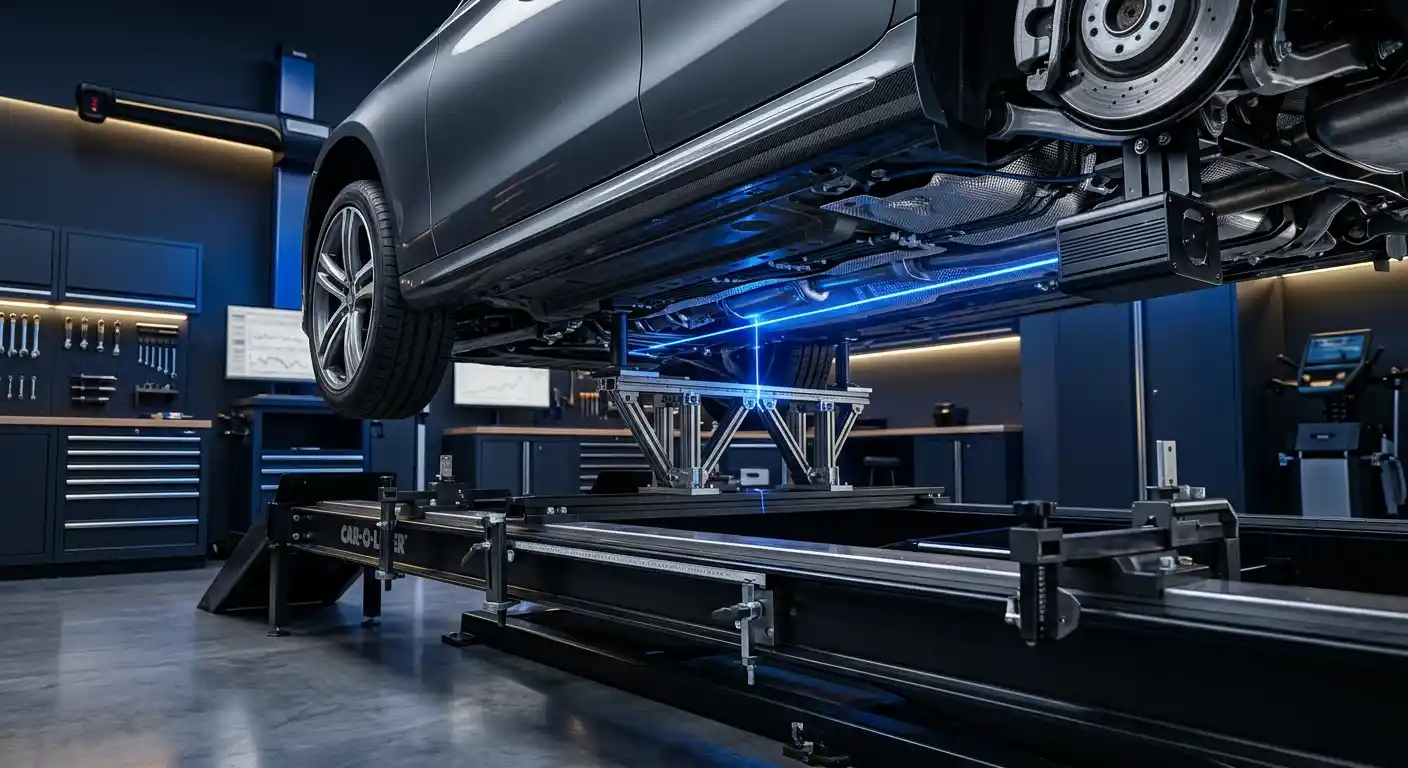
This is not guesswork. With tools like laser alignment or 3D measuring rigs, we can compare every point of your chassis to the original factory blueprint. A small deviation? Fixable. Major shifts? That needs immediate attention. - Check ride height on all four corners
A drop in one corner often gets blamed on a tired shock or coil spring. But if all suspension parts are new and the car still sits unevenly, it could mean the chassis has bent inward or collapsed slightly at that point. - Look at suspension mounting points
These are hard-mounted to the frame. If they sit at weird angles or show signs of stress, it tells us the problem is not the suspension; it is the frame alignment underneath it that is off. - Scan alignment data post-repair attempts
Ever realigned your wheels and still had issues days later? That is often because the chassis is out of shape, so even perfect alignment does not hold. It is a common mistake that leads to unnecessary part swaps when all you needed was proper car chassis repair.
Diagnosis is not about guessing. It is about connecting the dots between symptoms and structure, and once the frame is checked properly, everything else starts to make sense. If everything seems fine and the issue lingers, you might be looking at a hidden frame alignment problem. We’ve already broken down more in our detailed guide on car frame damage.

What Tools Are Used to Fix a Bent Car Chassis?
Bending steel back into shape is not something you can do with a wrench and muscle. Frame correction is a precision job, and the tools involved are big, loud, expensive, and brutal in the best way. If you have ever seen a hydraulic frame machine in action, you know car chassis repair is not just mechanical. It is industrial-level work. Here are the core tools that make this kind of repair possible:
- Hydraulic Frame Machine
This is the heart of any serious car chassis repair job. It clamps your vehicle in place and uses towers with hydraulic rams to pull the frame in multiple directions. Real-time force, millimeter-by-millimeter corrections. No hammering. Just controlled stretching of cold steel. - Pull Towers and Anchor Clamps
These towers are what actually apply the pulling force. You attach chains to specific points on the chassis and then anchor the car at opposite ends. One moves, the other holds, and slowly, the metal remembers where it is supposed to be. - Laser or Computerized Measuring Systems
It is not enough to eyeball a frame and call it straight. These systems map every angle, line, and point on the chassis and compare them to OEM specs. It shows what needs fixing before and after the pull, so nothing’s left to chance. - Heat Gun or Torch
Sometimes, especially with thicker or older frames, the metal needs heat before it will move. Controlled heat softens the section just enough to avoid cracking when pressure is applied. - Spot Welder or MIG Welder
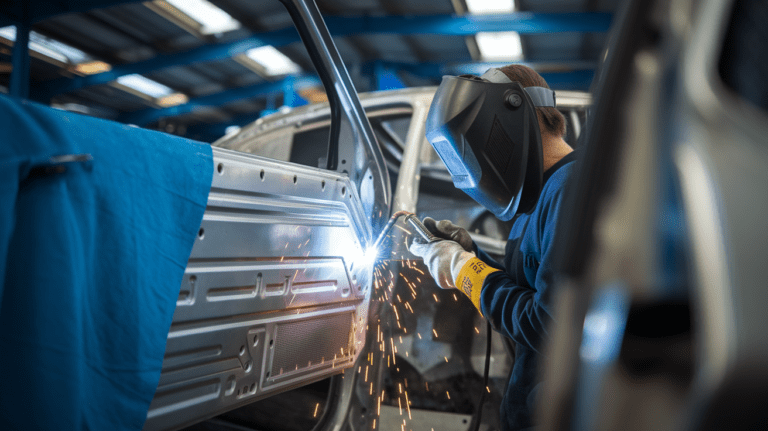
If the frame has cracks, stress points, or a section needs reinforcement, welding is non-negotiable. MIG welding gives control over thin metals, while spot welding is used where exact points need to be fused. - Angle Gauge and Measuring Rods
These small tools help confirm angles at key joints, especially near the suspension towers or cross members. If your frame is 2 degrees off at the wrong point, your tires will pay for it. - Frame Alignment Bench
Think of this as the surgery table. The vehicle stays perfectly flat while every correction happens. Without this, every measurement gets thrown off, so this is a must for proper frame alignment repair.
Every one of these tools plays a part. You cannot fix a bent chassis with guesswork or makeshift tools. That is why serious chassis straightening work only happens in properly equipped garages, not in driveways or parking lots. Spot Welder or MIG Welder. If the frame has cracks, stress points, or a section needs reinforcement, welding is non-negotiable. You can explore more about the role of car welding tools in precision repairs.

How Do Professionals Straighten a Bent Chassis?
Fixing a bent frame is not like fixing a dented fender. You do not just pop it back out. There is tension, stress, old welds, and mounting points, all needing to work in harmony again. One wrong pull and you could twist the structure even more. That is why car chassis repair always follows a method, not a shortcut. Here’s how it usually goes down inside a real shop:
- Secure the Car on a Frame Machine
First, the car is locked down tight on the chassis bench or hydraulic rack. This eliminates movement, so every pull or push affects only the damaged area. No floating. No wobble. Stability is key before any correction begins. - Identify Damage Points Using Measuring Systems
Next, the techs run a digital scan or laser measurement to find out exactly where the bends or twists are. Even small deviations get flagged. It is like giving the car an X-ray, frame misalignment shows up even when the body looks perfect. - Apply Force Using Pull Towers and Chains
This is where the heavy lifting happens. Pull towers attach to anchor points and slowly, we’re talking really slowly, apply hydraulic pressure to move the bent sections back into place. Pull, check, pull again. No rushing here. - Use Heat if Required to Relieve Metal Stress
Some bends refuse to move cold. In those cases, controlled heat is used to soften the metal slightly, so it flexes without cracking. But too much heat? That can ruin the metal. This is why only experienced techs handle this part. - Repair or Reinforce with Welding If Needed
If a section of the chassis is torn, split, or weakened, welding comes next. Depending on the car, this might be MIG welding, spot welding, or even adding reinforcement plates if the area needs extra strength. - Recheck Everything with Post-Pull Measurements
Once the pulls are done, everything is scanned again, from corner to corner. If any section is still off, the team makes micro-adjustments until the numbers match OEM specs down to the last millimeter.
This is not a quick fix. Chassis straightening requires patience, tools, and skill, and honestly, a bit of feel. A good tech knows when the metal is done moving. That instinct? You do not learn that from manuals. You learn it on the floor.
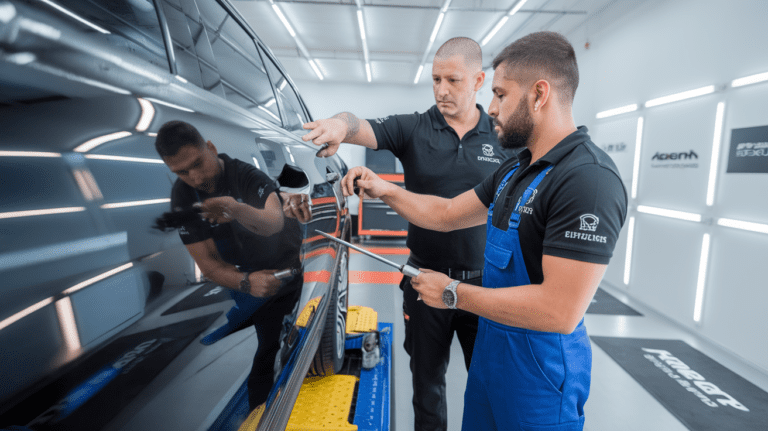
If you’re looking for experts who bring that level of experience to every repair, visit our car body shop in Dubai and see how we restore vehicles with precision and care.
Post-Repair | What Gets Checked After Straightening?
Once the chassis is pulled back into shape, the job is not done. Everything connected to that structure needs to be rechecked to confirm the car is safe, aligned, and driveable. Here is what professionals inspect after a car chassis repair:
- Suspension & Steering
Control arms, struts, and steering links must sit correctly. Any misalignment here affects handling and safety. - Panel and Door Fitment
Panels are checked for flushness. Doors, bonnet, and trunk should open and close smoothly, with no gaps or rubbing. - Ride Height
All four corners must sit evenly. Uneven height can signal unresolved frame tension. - Wheel Alignment
Alignment is redone from scratch. If angles are still off, the chassis may need fine-tuning. - Road Test
The car is tested on different surfaces to catch any steering pull, body flex, or unusual noise.
Every part mounted to the frame depends on accuracy. If one thing is out of spec, it shows up on the road, fast.

Why You Should Not Drive with a Bent Chassis
Some cars with bent frames still run. They start fine, roll straight-ish, and might even pass a quick glance. But underneath, things are working against each other, and that’s where the risk begins. Here is what driving with a bent frame actually does:
- Safety systems fail under impact
Crumple zones, airbags, seatbelt tension, they all rely on a straight frame. A bent chassis throws everything out of sync. - Tires and suspension wear unevenly
A misaligned frame causes unnatural stress on suspension points, which leads to fast tire wear and early part failure. - Braking becomes unstable
Brake force distribution relies on chassis balance. If the car pulls under braking or dives unevenly, that is not just annoying; it is dangerous. - Handling is unpredictable
Bent frames mess with geometry. You turn left, and the car delays. You corner hard, and the rear feels loose. - Frame stress keeps growing
The longer you drive with hidden frame alignment issues, the worse they get. Small bends often lead to cracks.
Fixing the chassis early costs less than fixing everything it damages later. Most of the real trouble shows up when it is too late to undo.
How to Prevent Chassis Damage in the Future
Once you have been through a car chassis repair, you probably never want to deal with it again. The good news? Most chassis damage is preventable, if you know what to avoid. Here are real ways to keep your frame straight and stress-free:
- Avoid potholes and steep parking ramps
In Dubai, some underground parking ramps are sharper than they look. Hitting them fast can twist the lower frame sections. - Drive slowly over speed bumps
Sounds obvious, but harsh hits bend suspension and frame mounts, especially when the car is loaded. - Do not overload the vehicle
Just because you can fit more people or gear does not mean the chassis can take it, especially in hot weather. - Use proper jack points
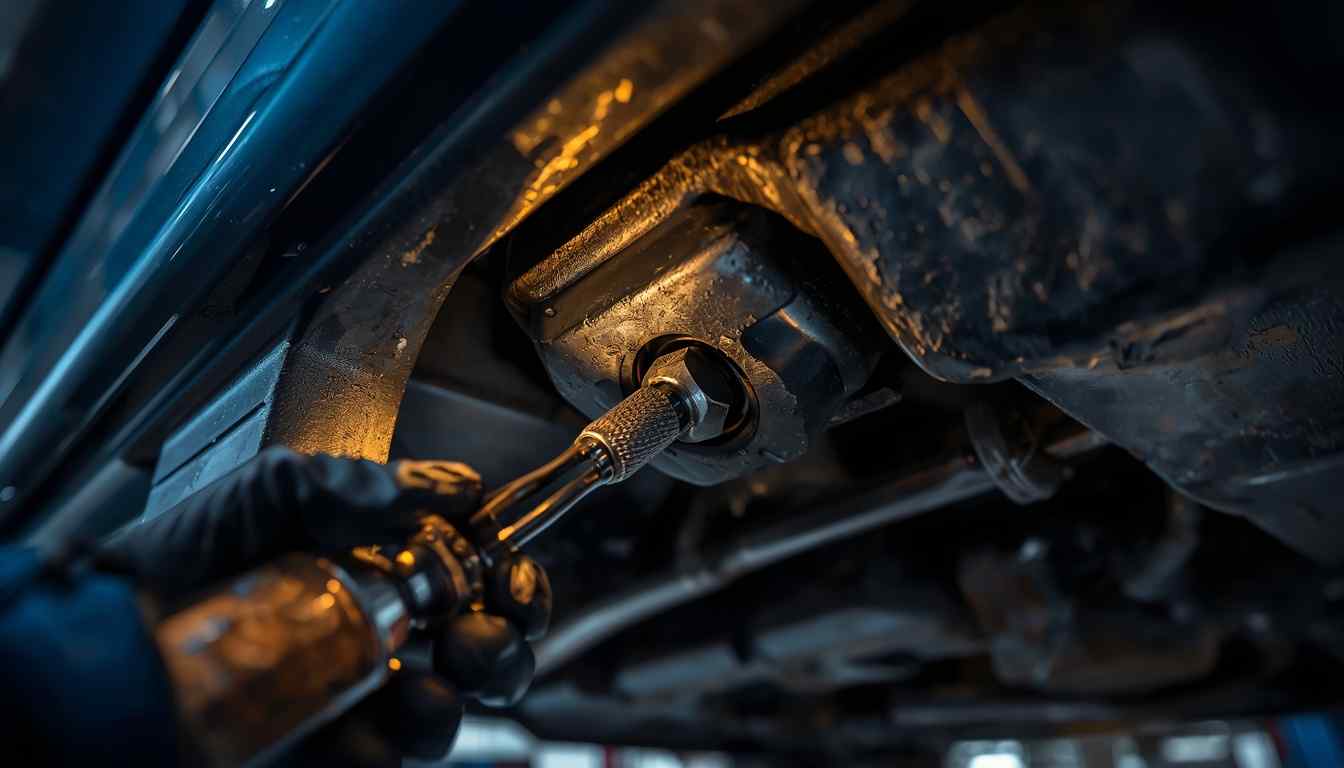
Lifting a car from the wrong spot can bend cross members or even punch into the chassis rails. - Inspect after any impact
Even a light bump or curb hit should be checked. A bent mount now is easier to fix than a twisted frame later.
Preventing frame damage is not about babying the car, it is about knowing where the real stress points are. Most people only learn that after a repair bill. Avoid potholes and steep parking ramps… Drive slowly over speed bumps. For long-term care, pairing structural checks with paint protection solutions helps preserve both looks and integrity.
A bent chassis is not always loud or obvious, but it always shows up somewhere. In how your car handles, in how fast your tires wear, or when a routine alignment just does not hold. If you are experiencing unusual behavior on the road and nothing else explains it, it is worth checking the frame. Car chassis repair might sound heavy, but catching it early keeps the damage and the cost, from piling up. In a city like Dubai, where the roads can be smooth one minute and brutal the next, keeping your chassis in check is not just smart, it is necessary.