
Dubai paintwork price guide
Car Painting Cost in Dubai
Understand the price of a scratch repair, panel repaint or full respray before you approve work. These are indicative AED ranges, with the preparation, paint type and hidden labour that can change the final scope.
Start with scope
A car-painting price only makes sense when you know what is being repaired
A bumper repaint, a repaired door, an exterior-only full respray and a complete colour change are different jobs. They require different preparation, materials, dismantling and quality checks, even when a quotation simply says “car painting”.
Use the figures below as a planning guide. The final quotation follows inspection of the existing coating, damage depth, panel material, paint code, finish type and the work needed around the painted area.
Cost ladder
Indicative car painting prices in Dubai
Compare the written inclusions as well as the number. A low panel price that excludes repair, blending or dismantling is not equivalent to one that includes those operations.
| Painting scope | Indicative price | Usually included | Can increase cost |
|---|---|---|---|
| Small scratch touch-up | From AED 450 | Local preparation and colour application for an eligible small area | Deep damage, blending, difficult access or dent repair |
| Bumper painting | AED 450 to 700 | Preparation and repainting where the bumper is repairable | Cracks, broken mounts, sensors, texture or replacement parts |
| Door or fender painting | AED 450 to 800 | One panel with ordinary preparation and a standard finish | Creases, aluminium, adjacent blending or dismantling |
| Bonnet painting | AED 700 to 1,200 | Refinishing of the larger horizontal panel | Stone chips, corrosion, clear-coat failure or pearl layers |
| Roof painting | AED 800 to 1,500 | Roof preparation and repainting with normal access | Roof hardware, headlining access or unstable old paint |
| Full sedan repaint | From AED 2,000 | Starting point for an agreed exterior repaint scope | Body repair, jambs, trim removal, colour change or premium paint |
| Full SUV repaint | From AED 3,500 | Starting point reflecting greater panel area and material use | Large panels, accessories, corrosion or custom work |
| Luxury or custom finish | Inspection required | Vehicle-specific plan for materials, dismantling and finish control | Multi-stage colour, matte sheen, composites, sensors and rare trim |
Prices are indicative. Inspection can identify body repair, corrosion, previous paint failure, parts, electronics or material requirements that photographs cannot confirm.
Full-car cost by finish
Full car paint cost changes sharply with the paint system
A full-car repaint is not one product. BodyShop.AE currently advertises starting points of AED 2,000 for an agreed sedan repaint scope and AED 3,500 for an agreed SUV repaint scope. Those are entry points, not promises that metallic, pearl, matte or luxury paint will cost the same. The planning bands below show how finish complexity can move a complete repaint in the Dubai market.
| Full repaint finish | Sedan planning range | SUV / larger vehicle planning range | Why the cost changes |
|---|---|---|---|
| Same-colour solid gloss | BodyShop from AED 2,000 | BodyShop from AED 3,500 | Simpler colour application when the existing coating is stable and the job remains an exterior same-colour repaint. |
| Metallic | About AED 3,000 to 4,500 | About AED 3,500 to 7,000 | Metallic orientation, spray-out testing and blending control add labour and material compared with a straightforward solid colour. |
| Pearl or three-stage | About AED 4,000 to 6,000 | About AED 5,000 to 8,000 | A ground coat, effect layer and clear coat must work together. Layer count and effect consistency make both application and later correction more demanding. |
| Matte or satin | About AED 3,500 to 5,000 | About AED 5,000 to 7,500 | Sheen must remain uniform across the whole vehicle. Ordinary polishing cannot be used to hide local texture or gloss variation. |
| Candy, chameleon or colour-shift | From about AED 6,500 | Often AED 7,500 to 12,000+ | Multiple effect or tinted layers increase material use, spray-out work, application time and the risk of having to repeat a large area if the effect is inconsistent. |
| Luxury or exotic-car repaint | Custom quotation | Custom quotation | Published Dubai examples for premium and exotic full repaints can reach roughly AED 8,000 to 18,000+ depending on model, finish, dismantling and restoration work. |
| Full colour change | Vehicle-specific | Vehicle-specific | Door jambs, apertures, inner returns, trim removal and the amount of original colour left visible can turn a normal exterior repaint into a much larger project. |
These are planning bands, not fixed BodyShop menu prices. Current paint condition, repair work, vehicle size, material prices, dismantling and the exact finish can move a quotation outside these ranges.
Solid gloss is normally the baseline
Fewer effect-control steps make a conventional solid finish the simplest full repaint to price when the body is already straight and the old coating is sound.
Metallic and pearl add colour-control labour
The extra cost is not only the pigment. Orientation, ground-coat colour, effect-layer thickness, spray-out approval and blending strategy all influence whether the finished car looks even from panel to panel.
Luxury paint can cost several times the entry repaint
Dubai market examples commonly put complex luxury and exotic refinishing around two to four times an entry-level standard repaint once premium materials, multi-stage finishes, careful dismantling and specialist substrate work are involved. For the workshop considerations behind those finishes, see our luxury car paint service.
What the headline price may exclude
Six additions can change a car painting quotation before colour is sprayed
Peeling clear coat, solvent reaction, excessive old material or weak previous paint may need to be removed back to a sound boundary. That adds labour before primer and colour begin.
Painting does not remove dents, corrosion or cracked filler. Metal repair, plastic repair, rust treatment and panel straightening should appear separately when they are required.
A metallic, pearl or aged colour may need colour blended into a neighbouring panel. The extra panel is not necessarily damaged; it is part of controlling the visible colour transition.
Handles, mouldings, lamps, badges, roof rails, weather seals and sometimes glazing edges may need removal or controlled masking. Replacement clips and one-time fasteners can add to the scope.
An exterior repaint normally does not mean every door opening, boot opening or engine-bay edge is repainted. Colour changes and restoration-level work require these areas to be priced explicitly.
Parking sensors, cameras, PPF, vinyl, stripes, emblems and model-specific trim may need removal, replacement, diagnostics or recalibration before the finished vehicle is complete.
What moves a quote
Preparation is usually the largest difference between two paint quotations
Paint is only the visible final layer. A good repair can include washing and decontamination, sanding, feathering damaged edges, dent or plastic correction, corrosion treatment, primer, sealer, masking or dismantling, spray-out testing, colour application, clear coat, curing and final inspection.
Skipping preparation can make an estimate look cheaper, but weak paint, old filler, rust or damaged clear coat can then show through as sink marks, edge failure, mapping or early peeling. The painted area may also be smaller than the preparation area and the colour-control area.
For metallic and pearl colours, an adjacent panel may need blending to avoid a visible shade boundary. That work should be explained before approval, not added as an unexplained surprise later.
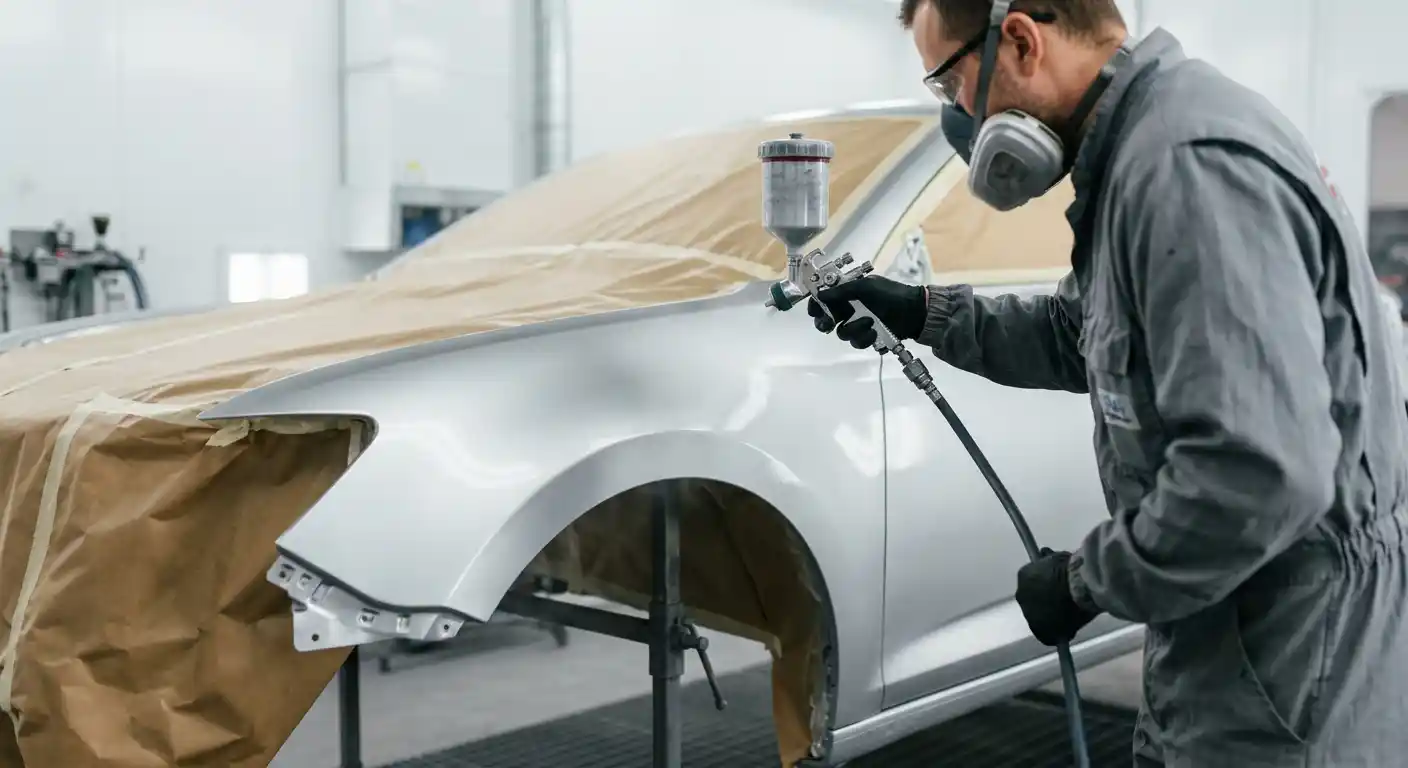
Repair decision
Choose the paint scope that fits the actual coating failure
The point is not to make every defect a full repaint. Start with the condition of the surrounding paint, then select the narrowest scope that can produce a durable, colour-consistent result.
- The mark is limited to clear coat or an isolated small area.
- The surrounding factory finish is stable and colour-consistent.
- A touch-up can protect a chip without requiring a large visual repair.
- The scratch reaches colour or primer, or a dent has broken the coating.
- One bumper, door, bonnet, roof or fender is the clear damaged area.
- Blending can preserve a natural transition into the adjacent paint.
- Clear-coat failure, fading, mismatch or repeated body repairs affect much of the car.
- The remaining paint is unlikely to match a fresh local panel repair.
- The purpose is a planned exterior refresh in the registered colour.
- Door jambs, inner edges, boot openings or engine-bay areas will show the old colour.
- Extra dismantling, materials and RTA requirements apply.
- The desired effect requires a multi-stage or controlled sheen system.
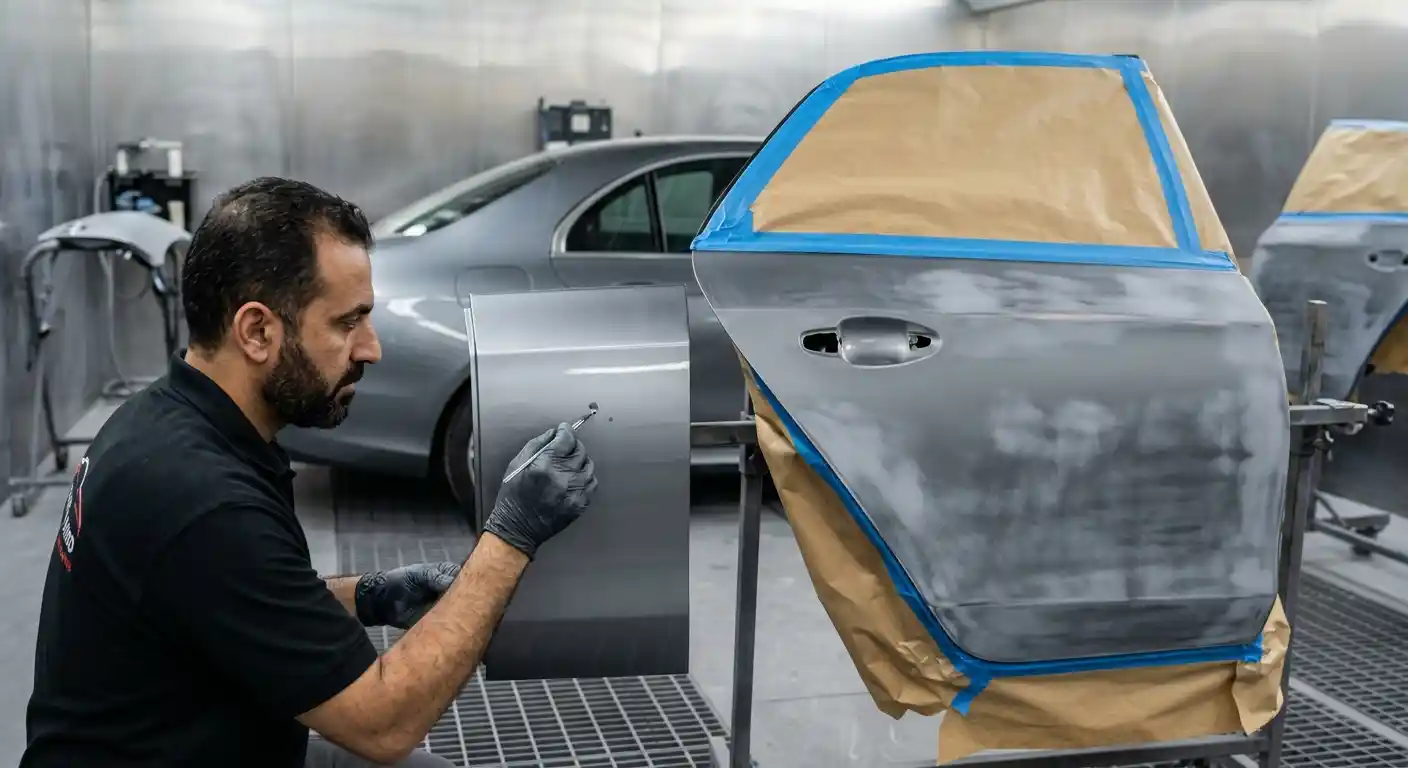
Panel by panel
Panel position changes the labour before spraying begins
A bumper can involve grilles, parking sensors, lamps, trims or mounting brackets. A door may need handles, mouldings and seals removed or masked. A roof can involve rails, aerials, glazing edges or headlining access. A bonnet is large enough for surface straightness and stone-chip correction to remain visible in strong Dubai light.
Ask the workshop to show which items are removed, which are masked and which clips or seals may require replacement. Removal takes more labour, but it can prevent hard tape lines, overspray and paint bridges. Masking is still suitable in some repair scopes, but the edge quality must support it.
For work involving more than a simple local repair, see our car painting service in Dubai for the workshop process and paint options.
More panel-cost differences
Quarter panels, tailgates, side skirts and small trim pieces do not price like a simple door
A quarter panel is a large fixed body surface rather than a simple bolt-on panel. Repair shape, wheel-opening edges, blending and access can make its refinishing scope larger than a straightforward door or fender.
Paint area may be moderate, but badges, trim, glass edges, cameras, lamps and powered tailgate hardware can increase dismantling and refitting time.
The part may be painted plastic, metal or a structural rocker cover. Stone damage, textured finishes, clips and low-level access affect whether it is locally repaired, fully refinished or replaced.
Small parts use less paint, but removal, tiny edges and pearl or metallic orientation can make them poor candidates for a crude spot repair.
Separate spoilers, arches and body-kit pieces may need individual preparation, flexible-material products and removal from the vehicle before painting.
Hatchbacks, coupes, sedans, large SUVs and vans have different painted surface areas and trim counts. Full-repaint cost should therefore be scoped by the actual vehicle, not only by the word “full”.
Finish selection
The paint finish can change the cost and the future repair plan
Solid gloss
Usually the simplest colour path, though it still needs the right paint variant, edge coverage and finish control.
Metallic and pearl
Effect layers change with angle and light. Spray-out cards and blending decisions are often more important than the formula alone.
Matte and satin
Sheen must be approved before painting. Later polishing or spot correction can leave an obvious glossy patch.
Custom effects
Candy, chameleon and tinted layers multiply material, film-build and repairability decisions. Agree the whole vehicle scope first.
Cost generally rises with finish complexity. Solid gloss is usually the simplest to reproduce. Metallic adds orientation and blending decisions. Pearl or three-stage systems add effect layers and spray-out work. Matte and satin require controlled sheen because polishing cannot be used to disguise small defects. Custom effects carry the greatest material and repeatability risk. For the underlying layer and finish differences, see our car paint types guide.
Before committing to paint
Sometimes the cheaper decision is correction, and sometimes repainting is the only durable answer
Paint correction can be enough
Light oxidation, wash marring, shallow clear-coat scratches and loss of gloss may improve without repainting when the coating still has safe thickness and adhesion. Paying for paint where correction can restore the finish adds unnecessary material and colour-matching work.
Repainting becomes necessary
Deep scratches through colour, peeling clear coat, exposed primer, failed previous paint, corrosion or widespread coating damage cannot be polished back into healthy paint. The repair must remove the failed material and rebuild the coating system.
Repaint versus wrap
A wrap changes appearance by covering sound paint; it does not repair rust, peeling clear coat, dents or unstable filler underneath. Repainting costs more preparation when the substrate needs restoration, but it renews the coating itself. A colour-change decision should compare the condition of the existing paint as well as the desired look.
Fading and clear-coat failure
Uniform fading may sometimes respond to correction if enough healthy clear coat remains. Patchy peeling, chalking or delamination usually needs panel or full-vehicle refinishing. Repainting one failed panel can also expose a colour difference against heavily aged neighbouring paint.
Get a paint scope from the evidence, not a guessed headline price
Send the make, model and year, a full-side or full-corner photo, close damage photos, the current colour and the finish you want. This allows a more useful provisional scope before inspection.
Compare properly
What a written car painting quotation should make clear
Every painted area
List bumpers, doors, roof, bonnet, spoilers, mirror caps, handles, jambs and inner edges separately. It stops an exterior repaint being confused with a colour change.
Existing defects
State whether dents, previous filler, rust, chips, peeling clear coat and unstable old paint are included, provisional or excluded.
Paint and quality control
Identify the colour, effect or sheen, blending need, dismantling level, paint-system work and final inspection standard.
Do not compare an exterior-only repaint with a colour-change quotation that includes jambs, dismantling and old-paint correction. The higher figure may simply describe more necessary work. Separate mandatory repairs, provisional findings and optional protection so every price change has a reason.
Complex vehicles and ownership decisions
Luxury materials, downtime and payment method can change the real cost of painting
Aluminium panels, carbon or composite parts, flush handles, complex lamps, rare mouldings and multi-stage finishes can increase dismantling, preparation and colour-control time. The higher cost should be explained by the actual material and process, not by the badge alone.
Exterior painting is still body and paint work, but model-specific trim, cameras, radar, charging-area parts or cooling openings can affect dismantling and system checks. The repair plan should follow the actual vehicle procedure.
A simple eligible panel repair can be much faster than a full repaint. Body repair, stripping, primer curing, multi-stage colour, dismantling, parts delays and reassembly add days. Ask for a workshop-approved timeline after the scope is known.
Private payment can make sense for isolated cosmetic paintwork when the total is comfortably below the policy excess and no third party or report requirement is involved. The repair standard should not change because the job is paid privately.
Insurance may be more appropriate when collision damage, several panels, replacement parts or hidden body work are involved. Confirm coverage, excess, approvals and accident-document requirements before authorising paintwork.
Confirm whether VAT is included and which findings remain provisional until trim or panels are removed. A written approval rule for additional work prevents the final invoice from becoming an unexplained surprise.
After approval
Handover checks and fresh-paint aftercare still protect the value of the job
- View colour indoors and in daylight, especially on metallic and pearl finishes.
- Look across the surface for waves, dust, runs, sanding marks, dry spray and texture changes.
- Check the agreed edges, panel gaps, seals, handles, trims, lamps and sensors.
- Collect the invoice, paint details, warranty terms and written aftercare guidance.
- Follow the stated cure window before washing, polishing, ceramic coating or PPF. Do not rely on a universal internet waiting period.
Matte and satin paint needs special care because conventional polishing can change the sheen. For any fresh finish, remove bird residue, tree sap and fuel carefully, avoid dry wiping a dusty hot panel and keep the repair photos and documents for future colour matching.
A registered colour change needs its own official process. Check the current RTA vehicle inspection guidance before work begins rather than relying on an old procedure or fee.
Common cost questions
Car painting cost FAQs
How much does it cost to paint one car panel in Dubai?
Eligible straightforward panel painting on this page starts from AED 450, while doors and fenders are shown around AED 450 to 800. Dent repair, rust, old-paint failure, blending, dismantling and complex finishes can increase the final scope.
How much does a full car repaint cost in Dubai?
For an agreed same-colour exterior scope, BodyShop.AE currently starts from AED 2,000 for a sedan and AED 3,500 for an SUV. Across the wider Dubai market, metallic full repaints commonly plan around AED 3,000 to 4,500 for a sedan and roughly AED 3,500 to 7,000 for an SUV or larger vehicle. Pearl, matte, custom effects, colour changes and luxury vehicles move above those entry bands because the paint system and strip-down become more complex.
Why can two panel-painting quotes be very different?
One quote may include only sanding and spraying, while another includes dent repair, removal of trim, primer, blending, clips, paint materials and final reassembly. Compare the written scope rather than the headline number.
Does metallic or pearl paint cost more?
Yes, usually. Metallic full repaints commonly plan around AED 3,000 to 4,500 for a sedan and about AED 3,500 to 7,000 for an SUV or larger vehicle. Pearl or three-stage work often moves higher, roughly around AED 4,000 to 6,000 for a sedan and AED 5,000 to 8,000 for a larger vehicle, because ground coat, effect layer, spray-out testing and clear-coat control all add work.
How much does a full matte or satin repaint cost in Dubai?
A full matte or satin finish commonly plans around AED 3,500 to 5,000 for a sedan and around AED 5,000 to 7,500 for an SUV or larger vehicle. The premium comes from strict sheen control and the fact that ordinary polishing cannot be used to disguise local texture or gloss variation.
How much does luxury or exotic car painting cost?
Luxury and exotic full repaints are normally custom quoted. Published Dubai pricing examples can reach roughly AED 8,000 to 18,000 or more depending on the vehicle, finish, dismantling, aluminium or composite panels, trim risk and whether the job uses pearl, matte, candy or colour-shift systems. The extra cost should come from the repair scope and materials, not simply the badge.
Does a full repaint include door jambs?
Not automatically. An exterior repaint normally covers the agreed exterior surfaces. Door openings, boot openings, inner edges and engine-bay areas should be listed separately, especially for a colour change.
How much extra does paint blending add?
There is no universal flat blending fee because the cost depends on the adjacent panel, colour, dismantling and clear-coat plan. Treat blending as an additional panel operation and require it to be identified in the written quotation.
Can paint correction save the cost of repainting?
Yes when the problem is limited to shallow clear-coat defects, oxidation or loss of gloss and enough healthy coating remains. Deep scratches, peeling clear coat, exposed primer, rust and unstable old paint require refinishing rather than polishing.
Is repainting better than wrapping for a colour change?
They solve different problems. Wrap is applied over sound existing paint and cannot repair peeling coating, rust or poor bodywork underneath. Repainting rebuilds the coating system but requires more preparation when the substrate is damaged.
How long does car painting take?
Timing depends on the repair scope. A straightforward panel can be much faster than a full repaint, while stripping, dent repair, primer curing, multi-stage colour, parts and reassembly add workshop time. Confirm the timeline after inspection.
Should I use insurance for car painting?
Insurance may make sense when paintwork is part of a collision repair, several panels or replacement parts are involved. Small isolated cosmetic paintwork may be simpler to pay privately when it is below or close to the policy excess, subject to the policy and accident-report requirements.
Practical next step
Approve the scope before approving the lowest number
The right car painting quotation identifies the panels, defects, preparation, finish, dismantling, colour-change coverage, quality checks and rule for additional work. Once those points match, the total can be compared honestly.