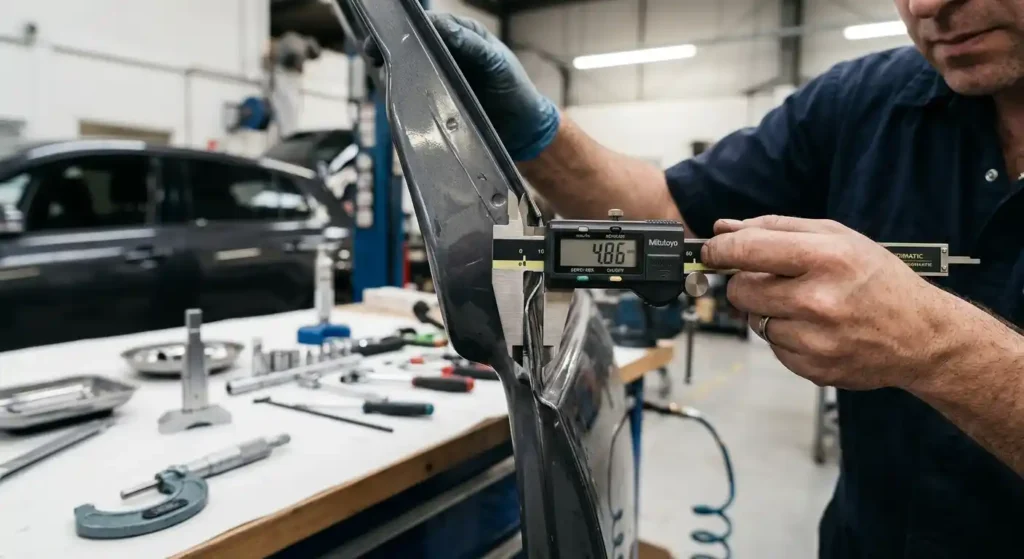
Digital calipers for body panel fitment help technicians compare local panel gaps, offsets, edge thickness and small dimensions during collision repair, restoration and final quality control. They are most useful when a visible alignment issue needs a repeatable measurement rather than a visual guess. In a professional workshop, digital calipers for body panel fitment are used as a local verification tool alongside vehicle-specific repair data and other measuring equipment.
Digital Calipers for Body Panel Fitment – What Do They Measure?
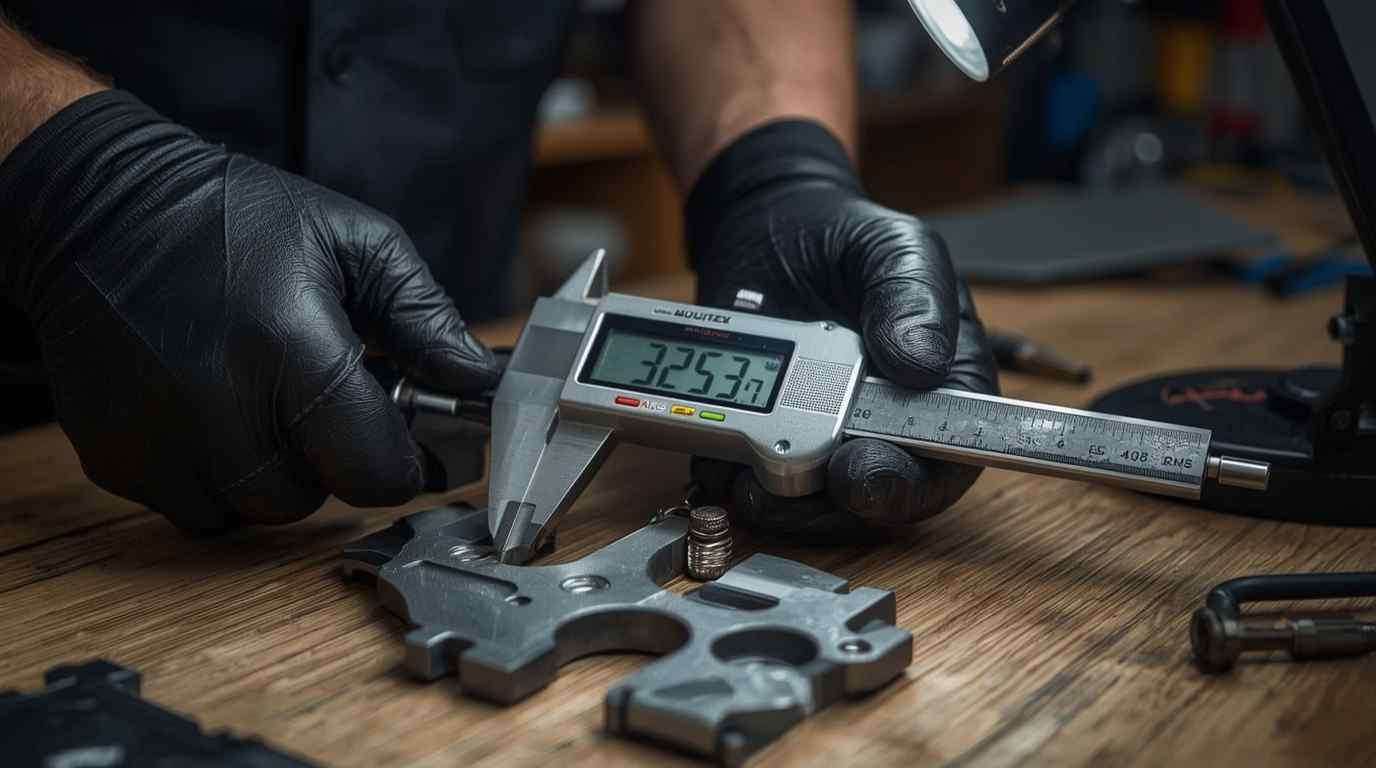
A digital caliper can measure outside dimensions, inside dimensions, depth and relative differences. In body repair, those functions are useful for checking whether a repaired edge, bracket or local gap matches the intended fit.
7 Essential Checks During Body Panel Fitment
- Door-to-fender gap consistency: compare the gap at several reference points instead of checking one location only.
- Bonnet and boot-lid offsets: check whether one edge sits higher or lower than the adjacent panel.
- Bumper and trim interfaces: compare local dimensions around clips, tabs and brackets where the caliper can make reliable contact.
- Left-to-right comparison: use the undamaged side as a reference only when the vehicle design is intended to be symmetrical.
- Before-and-after adjustment: record a measurement before moving a hinge, bracket or mounting point, then repeat it after the adjustment.
- Pre-paint fitment: confirm visible gaps and offsets before refinishing so alignment problems are not discovered after paint.
- Final quality control: repeat the same reference measurements before handover to confirm the repair stayed consistent through assembly.
Why Digital Calipers Matter After Collision Repair
After an impact, hinges, brackets, mounting points and outer panels can move relative to one another. A panel can look acceptable from one angle while the gap changes farther along the edge. Digital calipers for body panel fitment make those local differences easier to document and compare.
For wider collision geometry, a caliper is only one local tool. Structural dimensions should be checked with the correct manufacturer information and dedicated measuring equipment. See our car frame straightening page for the larger structural-measurement context.
Digital Calipers Do Not Define a Universal Panel Gap
There is no single panel-gap number that applies to every vehicle, panel or model. Door, bonnet, boot and bumper gaps vary by design and reference location. The correct comparison is the manufacturer repair information or a valid undamaged reference on the same vehicle.
That is why one universal tolerance should not be used as a repair standard. The tool gives a measurement; the vehicle-specific reference gives that measurement meaning.
Digital Caliper vs Feeler Gauge vs Structural Measuring System
| Tool | Best use | Not designed for |
|---|---|---|
| Digital caliper | Local gaps, offsets, thickness and repeat comparisons | Complete chassis geometry |
| Feeler gauge | Quick narrow-gap comparison | Large offsets or structural dimensions |
| Straight edge | Surface flow and local flushness | Precise numerical structural measurement |
| Electronic or mechanical structural measuring system | Body and chassis reference points | Simple local trim-gap checks |
The best workshop result often comes from using more than one tool. A caliper can quantify a local difference, while a straight edge or feeler gauge can confirm surface flow or narrow-gap consistency.
How to Take More Reliable Caliper Measurements
- Clean the measuring jaws and contact points.
- Check zero before taking a comparison measurement.
- Use light, consistent pressure rather than squeezing the tool against the surface.
- Measure the same reference points each time.
- Repeat the reading until it is consistent.
- Record both the number and the measurement location.
Mitutoyo’s technical guidance on caliper accuracy and calibration also emphasizes that tool condition, calibration and measuring technique affect the reliability of the result.
Common Body Panel Measurement Mistakes
- Wrong reference point: a precise reading is useless if the reference location is inconsistent.
- Measuring over dirt or damaged edges: contamination can change the reading.
- Assuming both sides must always match: symmetry is useful only when the vehicle design supports that comparison.
- Using a hand caliper for structural geometry: local measurements cannot replace a chassis measuring system.
- Treating display resolution as guaranteed repair accuracy: the tool, technique and access all affect the usable measurement.
Why Panel Fitment Should Be Checked Before Paint
Gaps, edge height and panel alignment should be checked before the refinishing stage. If a door, bonnet or bumper still needs mechanical adjustment after paint, the workshop risks extra handling, edge damage and unnecessary rework.
For general repair workflow, see our car body repair service. If the visible issue appeared after a collision, our guide to panel gaps after an accident explains why alignment changes can point to deeper mounting or geometry problems.
When a Digital Caliper Is Not the Right Tool
Digital calipers for body panel fitment are not suitable for every measurement. Deep structural points, large body dimensions, complex contours and inaccessible reference locations require other measuring equipment. A useful measurement must match both the repair question and the tool’s intended capability.
Final Quality-Control Checklist
- Panel gaps look consistent from multiple viewing angles.
- Measured reference points are repeatable.
- Opening panels latch and close normally.
- Adjacent surfaces sit at the intended height.
- Trim, bumper and lamp interfaces are seated correctly.
- Structural concerns have been checked with the appropriate measuring system.
- Fitment is confirmed before final paint inspection and handover.
Digital Calipers for Body Panel Fitment in Final Quality Control
Digital calipers for body panel fitment are valuable because they convert a small visual difference into a measurement that can be repeated before and after an adjustment. They do not create the repair standard themselves; they help technicians verify the standard more consistently.
Frequently Asked Questions
Can digital calipers measure every car body panel gap?
No. Access and panel shape determine whether a caliper, feeler gauge or another tool is more appropriate.
Can digital calipers replace a frame measuring system?
No. Calipers are useful for local measurements, while structural geometry requires dedicated equipment and manufacturer reference data.
Should panel gaps be identical on every car?
No. Gap targets vary by vehicle design and location, so the correct vehicle-specific reference should be used.
Why repeat the same measurement?
Repeated readings help identify inconsistent contact, technique or tool condition before a repair decision is made.
When should panel fitment be checked?
It should be checked during assembly and again before paint and final quality control, especially after collision repair.
Related repair guides