

BYD SEAL ELECTRIC SEDAN REPAIR
BYD Seal Body Repair Dubai
BYD Seal body repair in Dubai begins with a floor-and-sill decision, not the paint booth. BYD describes the Seal as using Cell-to-Body technology, in which the Blade Battery is integrated into the vehicle structure. Damage near the underbody, sill or floor therefore requires a different screening route from an ordinary door dent or bumper scuff.
The first question: cosmetic lane or CTB stop lane?
Cosmetic lane
Damage is isolated to an outer surface, openings remain stable, the floor area is clear and no new warning, odour, heat, leak or driving change is present.
CTB stop lane
Impact or scraping reaches the sill, jacking point or floor; a warning appears; the underbody is deformed; or the vehicle behaves differently after contact.
A vehicle in the stop lane is not moved, lifted, pulled, heated or dismantled according to a generic body-shop routine. The exact impact location, vehicle state and applicable BYD repair information must be established first. Where the evidence is outside the workshop’s verified scope, isolation and the appropriate technical referral take priority over cosmetic work.
CTB changes the information required before repair
BYD’s official model information states that CTB integrates the Blade Battery into the body as a structural component. That statement does not tell a workshop how to repair a particular impact. The technician still needs the vehicle identification, exact damaged zone, service information, safe-lifting points, permitted repair boundaries and any inspection or replacement criteria that apply.
We avoid two unsafe shortcuts. The first is assuming there is no concern because the car drives and shows no warning. The second is assuming every mark near the floor has damaged the battery. The correct response is evidence-led screening followed by the prescribed inspection path. The page links to BYD UAE’s Seal model information for the manufacturer’s product description, not as a substitute for current repair documentation.
A clean diagnostic screen cannot prove that a floor or sill has no physical damage. A scrape cannot prove that the battery is damaged. Location and documented inspection decide the next step.
Seal CTB screening rule
Sill, jacking-point and underbody evidence
The inspection records where the vehicle contacted the obstacle, the direction of the scrape, whether a wheel climbed or dropped, and whether lifting has occurred since the incident. Photographs cover the full side, both wheel openings, the sill from front to rear and the visible underbody without placing anyone beneath an unsupported vehicle.
- Stop movement for a new high-voltage or battery warning, heat, smoke, unusual odour, fluid, sparking or severe underbody deformation.
- Protect the evidence by avoiding pressure washing, grinding, filler or underseal over a fresh impact mark.
- Confirm lift points before raising the car; do not position pads by habit.
- Separate outer trim from the structural sill and floor in the estimate.
- Record escalation when specialist high-voltage or structural evaluation is required.
Material identification controls dent and joining methods
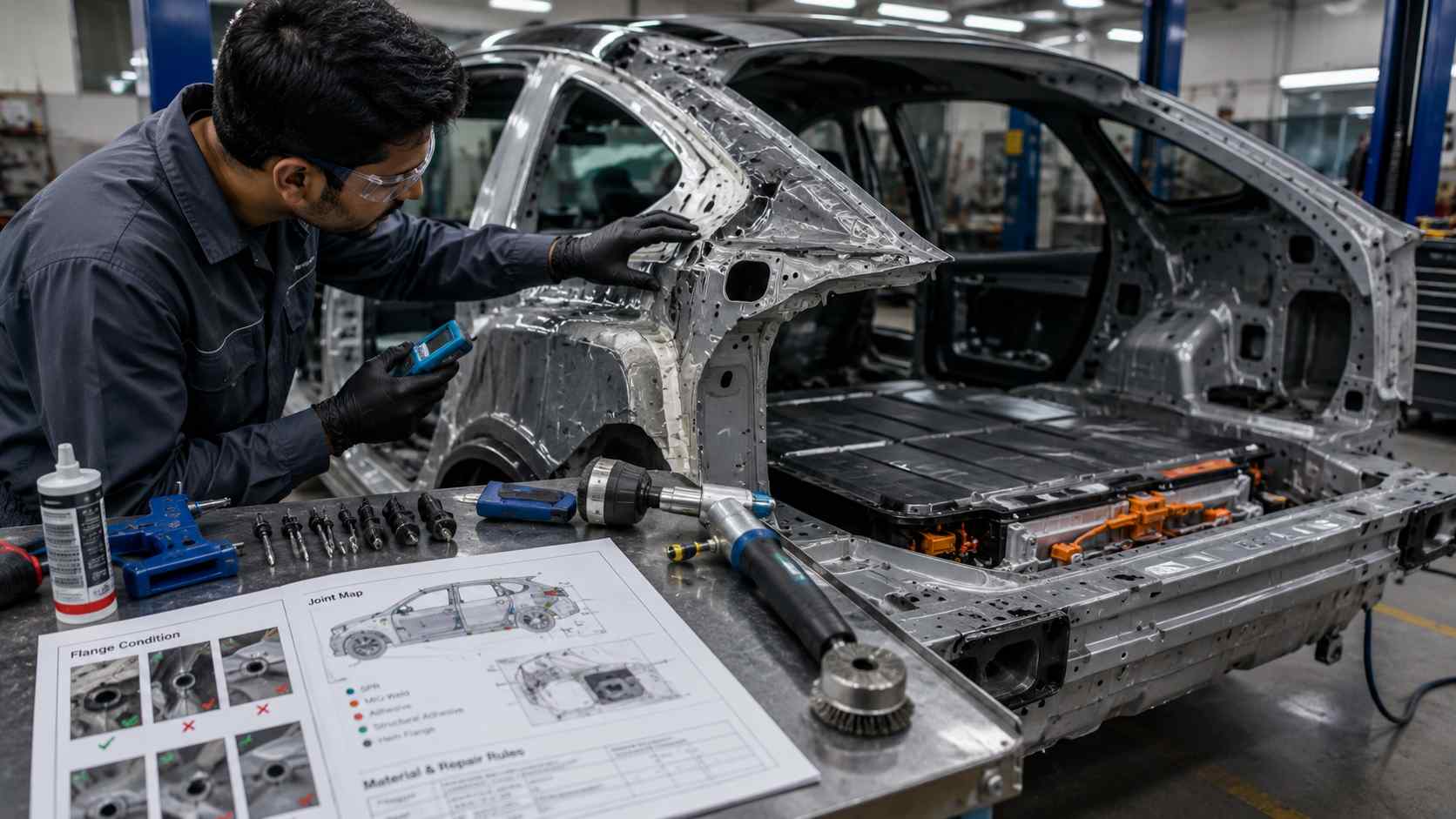
Outer appearance does not reliably identify substrate, grade, thickness, coating or joining method. Before repairing a Seal panel, the workshop confirms the exact component and retrieves the relevant method. Heat, stud welding, pulling, adhesive, sectioning or replacement cannot be selected from a generic steel-panel habit.
A shallow door dent with intact paint may qualify for paintless dent repair when access and the underlying structure allow. A sharp crease at an edge, prior filler, a damaged reinforcement or restricted access can make another method more predictable. Replacement of a welded or bonded panel is a complete operation that includes safe system preparation, joining, corrosion protection, cavity treatment, paint and reassembly.
Bumper and camera-area repair still begins with fit
The Seal’s bumper damage can affect outer plastic, retainers, grilles, lamps, sensors or camera mounts. The bumper is removed when the impact path justifies access, not automatically for every scuff. A repairable surface is retained only when the attachment points remain stable and the finished shape can hold correct gaps.
Electronic closure follows physical correction. Brackets, panel position and the camera or sensor mounting plane are restored first. Diagnostics, functional tests and calibration then follow the equipment fitted and the applicable procedure. A warning-light reset is not a substitute for correct mounting geometry.
Sculpted panels require reflection control
The Seal’s flowing side surfaces and strong shoulder treatment can make small changes visible across a large reflected area. We set reference lines before metal correction and evaluate the surface from several heights. A repair can feel smooth by hand yet show a flat spot, crown or ripple outdoors.
Repair-versus-replace decisions weigh stretch, edge condition, access, material rules and the complete downstream work. Keeping the original panel is valuable when it can be restored predictably. Replacement is preferred when a critical edge, mounting area or permitted repair boundary cannot be recovered with controlled methods.
Colour matching for the BYD Seal
Paint matching uses the vehicle’s finish, variant data and a controlled spray-out. Metallic orientation, pearl layers, sun exposure and earlier paint can change the match. The painter views the spray-out next to the car and selects blending only where it is necessary to avoid an obvious edge.
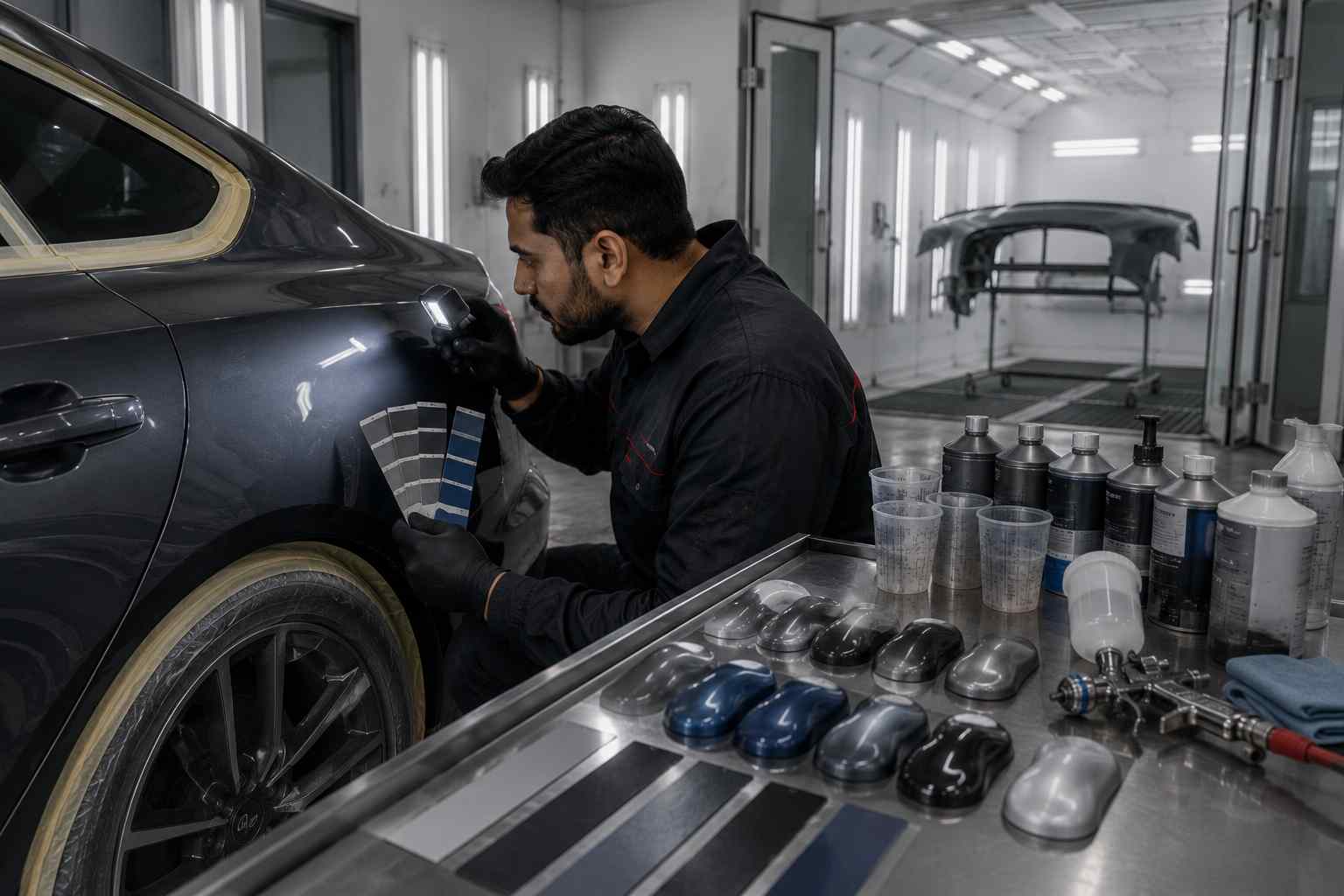
Black trim, glass edges, seals, lamps, cameras and charging components are protected from sanding residue and overspray. The cured finish is checked in daylight and workshop lighting for hue, flop, texture, dust, sanding marks and blend visibility. Our car painting service explains the general process while this page keeps the Seal’s floor, material and body-shape issues distinct.
Indicative Seal body repair costs
A minor dent or scratch may fall around AED 299 to 1,000. Bumper repair or replacement is commonly planned at AED 500 to 2,500, and a door or wing repair at AED 1,000 to 3,000. A front-corner combination involving bumper, lamp, brackets and diagnostics can be AED 2,000 to 6,000+.
These ranges come from the site’s published Dubai accident repair cost guide and are not fixed Seal prices. CTB-zone assessment, battery-related escalation, material-specific methods, calibration, part availability and hidden damage may place the job outside them. Floor or high-voltage concern is inspection-led and should not be reduced to a generic structural-price line.
What makes a Seal quotation credible
- The VIN and damaged zone are identified.
- Outer cosmetic work is separated from floor or high-voltage assessment.
- Repair methods are tied to the actual material and current information.
- Parts, paint, diagnostics and calibration are listed separately.
- Provisional work has a documented approval point.
- Authorisation and warranty claims are described accurately.
A staged BYD Seal repair workflow

- Stabilise: decide whether the vehicle can be moved, charged, lifted or stored normally.
- Identify: confirm VIN, model variant, equipment and the exact impact zone.
- Screen: inspect sill, floor, jacking points, wheels, warnings and visible underbody evidence.
- Map: record body gaps, openings, bumper or lamp mounts and the visible paint damage.
- Authorise access: dismantle only the areas needed to confirm hidden scope.
- Select methods: use applicable material, joining, corrosion and system procedures.
- Restore foundation: correct body geometry and mounting planes before paint or electronic closure.
- Refinish and assemble: verify colour, protect sensitive areas and restore attachments and seals.
- Close systems: complete diagnostics, functional tests and calibration or specialist escalation where required.
- Release: document finish, gaps, warnings, road behaviour, invoices and warranty.
For broader collision, insurance and recovery support, use our published Dubai accident repair service. The Seal page is intentionally limited to electric-sedan body, CTB, material, paint and sensor decisions.
Collection-day checks for the Seal

View the car from both sides before approaching the repaired panel. Compare stance, door and boot gaps, bumper height and lamp positions. Look along the sculpted surface at a shallow angle, then inspect colour under daylight. Open every closure that was removed or adjusted, including the charging flap when it was near the repair.
Test lamps, cameras, parking functions and warnings affected by the work. If the estimate included calibration, high-voltage assessment or a specialist inspection, collect the record. Confirm safe lift points were respected and that underbody evidence has not been hidden by fresh coating. The invoice should identify repaired and replaced parts, paint operations and approved additions.
BYD Seal body repair FAQs
Does every sill dent mean the Seal battery is damaged?
No. The location, depth, deformation, impact direction and applicable inspection criteria matter. A sill mark should be screened because of the CTB architecture, but the conclusion must come from evidence rather than alarm.
Can a BYD Seal door dent use paintless dent repair?
Possibly, when the paint is intact, access is safe, the material and reinforcement allow it, and the dent has not sharply stretched an edge. The method must be confirmed for the actual panel.
Can the car be charged after side damage?
Do not assume it can. Damage near the charging area, sill or floor, or any relevant warning, heat, odour or deformation, needs assessment before charging. Follow the vehicle-specific safety direction.
Does bumper work always require calibration?
No blanket answer applies. It depends on the equipment, disturbed mounts and current repair procedure. Physical fit, diagnostics and function checks are still required even when calibration is not.
Is BodyShop.AE a BYD-authorised repairer?
The page makes no unsupported authorised-repairer claim. The estimate should state the services offered, the methods and parts proposed, and any warranty, insurer or manufacturer condition the owner must verify.
Send the correct Seal photographs
Provide a full side view, both wheels on the damaged side, the sill and floor edge, the damaged panel in reflection, the dashboard and any charging-area contact. Do not crawl beneath an unsupported vehicle to obtain pictures. Photos are for triage; they do not replace CTB-zone inspection or authorised dismantling.
Escalation is a documented repair outcome
A body-shop inspection does not have to end with an in-house repair recommendation. If the Seal’s floor zone, high-voltage system or joining requirements exceed the verified equipment, training or information available for the job, the correct outcome is documented escalation. The owner receives the reason, the evidence captured and the condition in which the vehicle must be stored or transported.
That decision protects the vehicle from exploratory dismantling and protects the customer from paying for cosmetic work that may later have to be removed. Work can return to the body-repair plan only when the relevant technical assessment defines the permitted method and safe handling requirements.
Door glass and frameless-window relationships
Door damage is assessed with the glass, seal, mirror, hinge and latch as a system. The technician records closing effort, glass travel and wind-noise complaints before trim is removed. The repair restores door geometry first; glass and seal adjustments follow that foundation. Forcing the glass to compensate for a moved door can create leakage, noise or excessive pressure at the edge.
At handover, the window is cycled, door operation is repeated and the seal is checked along the complete opening. Any learning or reset procedure required after disconnection is documented. The finished panel is then reviewed in reflection so the long door surface remains consistent with the adjacent wing and quarter panel.
Warranty and repair records
The final file should identify which parts were repaired or replaced, the paint and blending operations, the CTB or underbody assessment performed, and any calibration or specialist work. Warranty terms are separated for workmanship, paint and supplied components. An independent workshop warranty must not be described as a BYD vehicle or battery warranty.
Repair timing for the Seal
A cosmetic bumper or accessible door repair may take a few working days. Work near the sill, floor or high-voltage system can take longer because screening, technical information, parts and specialist decisions occur before normal body operations. The written estimate should separate active repair time from approval, supplier and escalation time.
If a CTB-zone question remains open, the workshop does not continue into paint simply to protect a promised date. The customer receives the finding, the next required decision and a revised forecast. Collection is arranged only after the body, finish, affected systems and supporting records have passed their respective checks.