
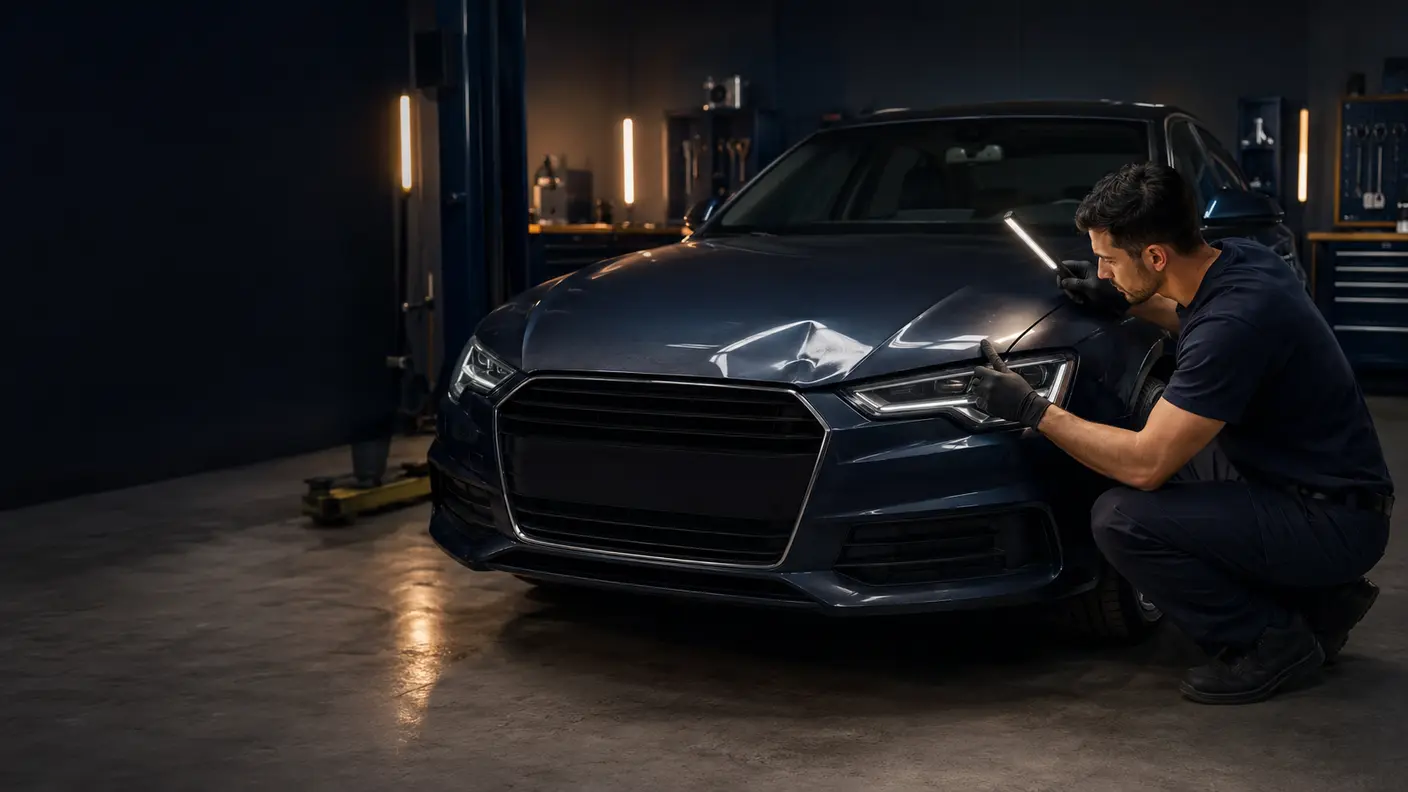
Surface, leading edge and closure geometry
Car Bonnet Repair Dubai
A bonnet is a broad painted surface and a working closure panel. We assess dents, creases, chips and collision buckling together with its edges, hinges, latch area and surrounding gaps before deciding whether repair, paintwork or replacement is the sensible route.
A panel with two jobs
Bonnet appearance and bonnet operation must agree
A bonnet can look nearly flat from one angle yet still have a softened body line, a raised crown or a changed relationship with the fenders. It can also close while sitting too high, too low or unevenly at one corner.
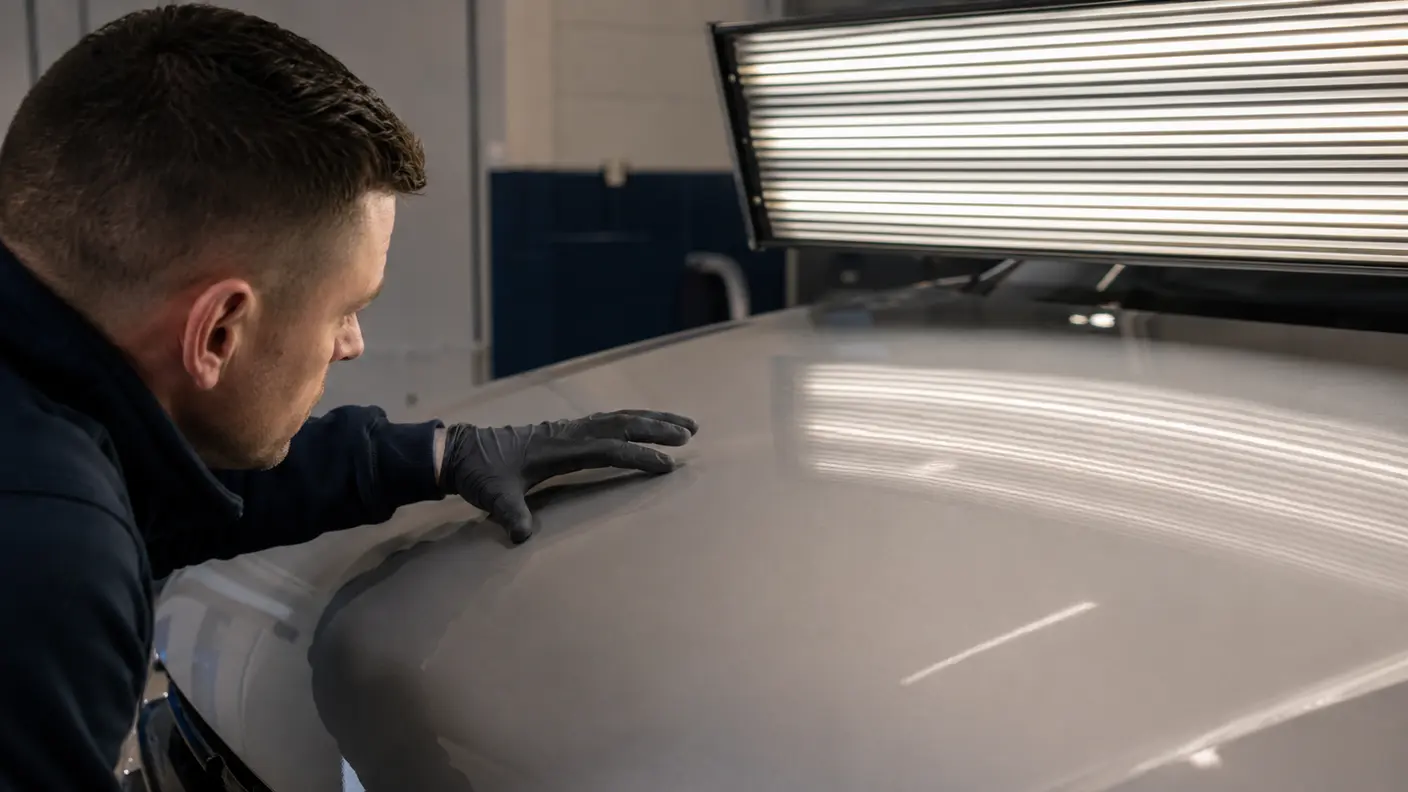
The starting point is a clean, dry surface viewed under useful light. We look across the panel rather than directly at the mark. Long reflections reveal distortion that a close photograph may hide. The leading edge, side hems and rear corners are checked because force can move through the panel and appear away from the first contact point.
We then compare the bonnet-to-fender gaps, front height and rear corner position. A difference does not automatically identify one failed part. The bonnet itself, hinge position, latch relationship, rubber stops, neighbouring panels or previous bodywork can influence what is seen. The assessment should separate observation from conclusion.
Bonnet map
Three zones tell different parts of the damage story
The bonnet is not treated as one uniform sheet. Surface shape, edge construction and closure points respond differently to force, heat and repair access.
Main surface
Broad lows, sharp dents, crowns and body-line changes are read with reflections. Location and underside access influence whether paintless dent repair is realistic.
Leading edge
The front edge may include folds, hems, reinforcement and nearby latch relationships. A small-looking buckle here can be less forgiving than a shallow open-area dent.
Closure geometry
Hinges, rear corners, stops, latch area, striker relationship and neighbouring panel gaps help show whether the issue is cosmetic, alignment-related or part of wider impact damage.
Material matters: bonnets may use steel, aluminium or other constructions depending on the vehicle. We identify the actual panel and repair information before choosing tools, heat approach, corrosion protection or replacement logic. One method is not assumed for every bonnet.
Active-bonnet and pedestrian-protection systems: some vehicles use deployable bonnet hinges, actuators or related sensing as part of pedestrian protection. If such a system has deployed, shows a warning or was involved in the impact, the job should not be treated as sheet-metal repair alone. Vehicle-specific diagnosis, reset or component replacement requirements must be identified separately from the body-and-paint scope.
Do not force a doubtful closure
If the bonnet does not latch normally, treat it as a safety concern
A webpage cannot determine whether a damaged bonnet is safe for road use. If the closure has changed after impact, avoid repeated slamming or improvised restraint and seek suitable recovery or technical advice.
It will not secure
The bonnet does not reach its normal closed position, releases again, or appears to catch only partly. Do not assume that pushing harder will solve the cause.
It lifts or moves
Visible movement, vibration, a rising leading edge or a changed gap while stationary can indicate that closure or alignment needs attention before driving.
Impact reached deeper
Severe front damage, displaced lamps or bumper parts, fluid, steam, unusual odour or new warnings call for wider assessment beyond cosmetic bonnet repair.
The latch area should not be judged by appearance alone. The relevant parts and their relationship vary by vehicle. This page does not claim electronic diagnosis, sensor calibration or safety-system validation. Any required checks outside body and paint work should remain clearly identified.
Damage types
What can happen across a bonnet
Each repair route begins with the combination of shape, paint, material, edge position, access and previous work. The same diameter does not mean the same difficulty.
Shallow open-area dents
A smooth dent away from edges and reinforcement may be a candidate for paintless dent repair when the paint remains flexible and safe tool access is available. Crown control and reflection quality still matter.
Sharp dents and creases
A focused impact stretches a smaller area more intensely. If it crosses a body line, reaches an edge or cracks the coating, conventional metal repair and refinishing may be more appropriate.
Stone chips and scratches
Chips at the front edge and scratches across the surface are assessed for depth, exposed substrate, corrosion risk and visual spread. Touch-in, local refinishing or panel paint are different outcomes.
Front-impact buckling
Ripples, raised areas, folded edges or a changed latch relationship can show that the bonnet absorbed or received transferred load. Wider front-end inspection may be required before cosmetic work.
Heat and sun-related finish concerns
Dubai exposure can make fading, clear-coat failure, old repairs and colour variation more visible on a broad horizontal panel. Surface failure is not solved by pushing a dent out.
Previous repair beneath the mark
Existing filler, repainting, stretched metal or corrosion can change tool choice and repair risk. We look for signs of earlier work before presenting the new damage as an isolated event.
For suitable dents, our dent removal service considers paint condition, access, depth and body-line involvement before choosing PDR or conventional repair. PDR is valuable when it preserves a sound original finish, but it is not a quality shortcut for cracked paint or unstable shape.
Two inspection views
Surface quality and closing fit need different checks
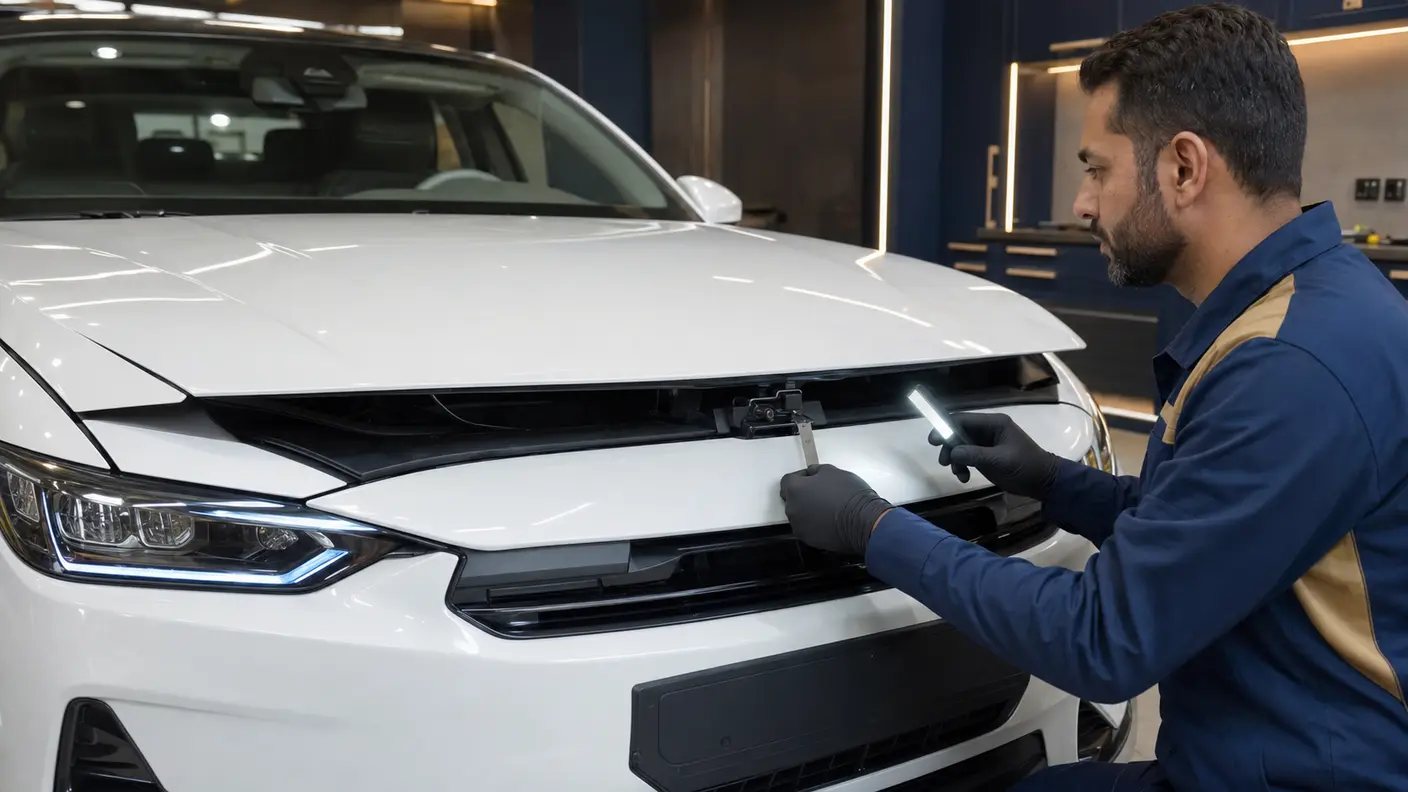
Swipe or scroll through the workshop views. The first uses reflection lines to read panel shape. The second focuses on the leading edge, latch area and surrounding alignment.
Horizontal gallery: swipe on mobile or use the scrollbar.
Repair judgement
PDR, conventional repair or replacement?
The best route is the one that can restore stable shape, suitable finish and proper closing relationship without hiding unacceptable risk or uneconomic labour.
Paintless dent repair may suit
Shallow damage with intact paint, manageable stretching and suitable access, especially away from complex hems or badly affected reinforcement.
- Original coating may be retained.
- Less paint preparation is required.
- Suitability depends on the real dent, not a label.
Conventional repair may suit
Dents, creases or local buckling that require controlled metal shaping, preparation and paintwork when the panel remains a sound repair candidate.
- Body lines and crowns can be restored.
- Paint cracking can be addressed.
- Edges and previous repairs may add complexity.
Replacement may be more sensible
Severe folds, extensive stretching, compromised attachment or closure areas, unsuitable material condition, corrosion or poor repair economics can support replacement.
- Exact part identification is required.
- Transferred trim may need inspection.
- No bonnet replacement price is assumed before specification and parts checks.
Repair judgement: A replacement decision is not made only because a dent looks dramatic. Equally, repair is not automatically better because it avoids a new panel. Material, inner construction, damage at hems, hinge points and latch areas, parts supply, labour and finish requirements all affect the comparison.
Indicative cost planning
Car bonnet repair cost in Dubai
These are starting bands for discussion after the damage type is identified. They are not a bonnet replacement price and should not be added together mechanically.
Inspection confirms whether the issue is a PDR dent, conventional dent and paint repair, panel refinishing or part of confirmed structural damage.
Suitable when the paint remains intact, tool access is practical and the dent is away from badly affected hems or reinforcement. Final suitability depends on depth, sharpness, body-line involvement and bonnet material.
Assessment considers dent diameter, depth, crown tension, body lines and underside access. Edge damage, cracked paint or excessive stretching can move the repair into a conventional metal-and-paint scope.
May include controlled metal shaping, surface preparation and bonnet refinishing. Previous filler, sharp folds, hem damage or involvement near hinges and the latch area can increase the confirmed scope.
Covers bonnet refinishing after the required preparation has been defined. Bonnet size, substrate, colour or effect, existing coating condition and any necessary blending determine the final quotation.
Applies only when inspection or measurement confirms related front-structure, mounting or chassis damage after a collision. This is a separate wider repair scope and is not included in the price of a normal cosmetic bonnet dent.
Important: the final quote depends on vehicle, bonnet material and construction, dent depth, edge involvement, paint system, previous work, access, alignment, related front damage, parts and approval needs. Bonnet replacement is quoted only after exact identification and supply checks.
Paint under Dubai light
A broad horizontal panel exposes colour and texture differences
Bonnet paint is viewed from low angles, from above and against both fenders. Metallic and pearl finishes can change appearance with viewing angle and light direction. The colour code is a starting reference, not proof that one unmixed formula will match every aged or previously painted vehicle.
Prepare the actual substrate
Preparation begins with the actual substrate and repair route. Exposed metal, old filler, chips, cracked coating and previous refinishing require different attention. If a replacement bonnet is used, its supplied coating and preparation requirements must also be assessed rather than assumed.
Decide blending from evidence
Blending into a neighbouring panel is not automatic and is not avoided automatically. The decision depends on colour evaluation, panel relationship and the standard expected from the completed repair. Our car painting service considers colour, metallic orientation, texture, gloss and edge cleanliness as a connected finish.
Final inspection: controlled workshop light and useful natural light should both be used. A repair that appears acceptable under one bright lamp may show a halo, colour shift, wave or polishing trace outside. The objective is a stable repair whose shape and finish make sense across realistic viewing conditions.
From intake to handover
A bonnet repair should follow a visible sequence
The process changes with the damage, but each stage should answer a defined question before the next one begins.
Record
Photograph the surface, leading edge, gaps and related front damage. Note closing behaviour, prior paint and the owner’s account of the incident.
Identify
Confirm material and construction where relevant. Inspect underside access, reinforcement, hinges, latch area, striker relationship and fitted attachments.
Define
Choose PDR, conventional repair, refinishing or replacement. Separate confirmed work from items that need access, parts checks or insurer approval.
Restore
Repair shape, prepare the surface, trial fit where needed, refinish, cure and reassemble without treating paint as the only operation.
Align
Compare side gaps, front height, rear corners and closing action. An adjustment should not conceal unresolved deformation elsewhere.
Inspect
Review contour and finish under useful light. Check accessible attachments and exterior operations that were disturbed within the agreed scope.
Document
Record repaired, painted and replaced items. Identify any separate mechanical, electronic or safety-related referral clearly.
Explain
Walk through the completed scope, paint aftercare, parts information, insurance documents and any observations that remain outside the repair.
Insurance and timing
Approval, parts and hidden findings can affect delivery
For insurance-related bonnet damage, the useful file usually starts with the incident documentation available to the owner, wide and close photographs, and an estimate that distinguishes confirmed work from conditional items. The insurer and policy determine coverage, excess, liability and the approved route. A body shop estimate does not decide those matters.
If impact deformation or related front damage cannot be understood externally, agreed access may reveal additional work. The new finding should be photographed, connected to the affected area and submitted for approval where required. This is clearer than quietly absorbing uncertainty into the first price.
Timing depends on the route. PDR can avoid paint stages when it is genuinely suitable. Conventional repair adds metalwork, preparation, refinishing, curing and polishing. Replacement adds exact part identification, availability, trial fitting, transfer of suitable attachments and paint preparation. Insurance review can add waiting time even when workshop time is straightforward.
If the collision extends beyond the bonnet, our accident repair service can document the wider visible body damage and build a staged scope. Specialist mechanical, electronic or safety-system checks should remain separately identified when required.
Handover
The last check returns to shape, fit and closure
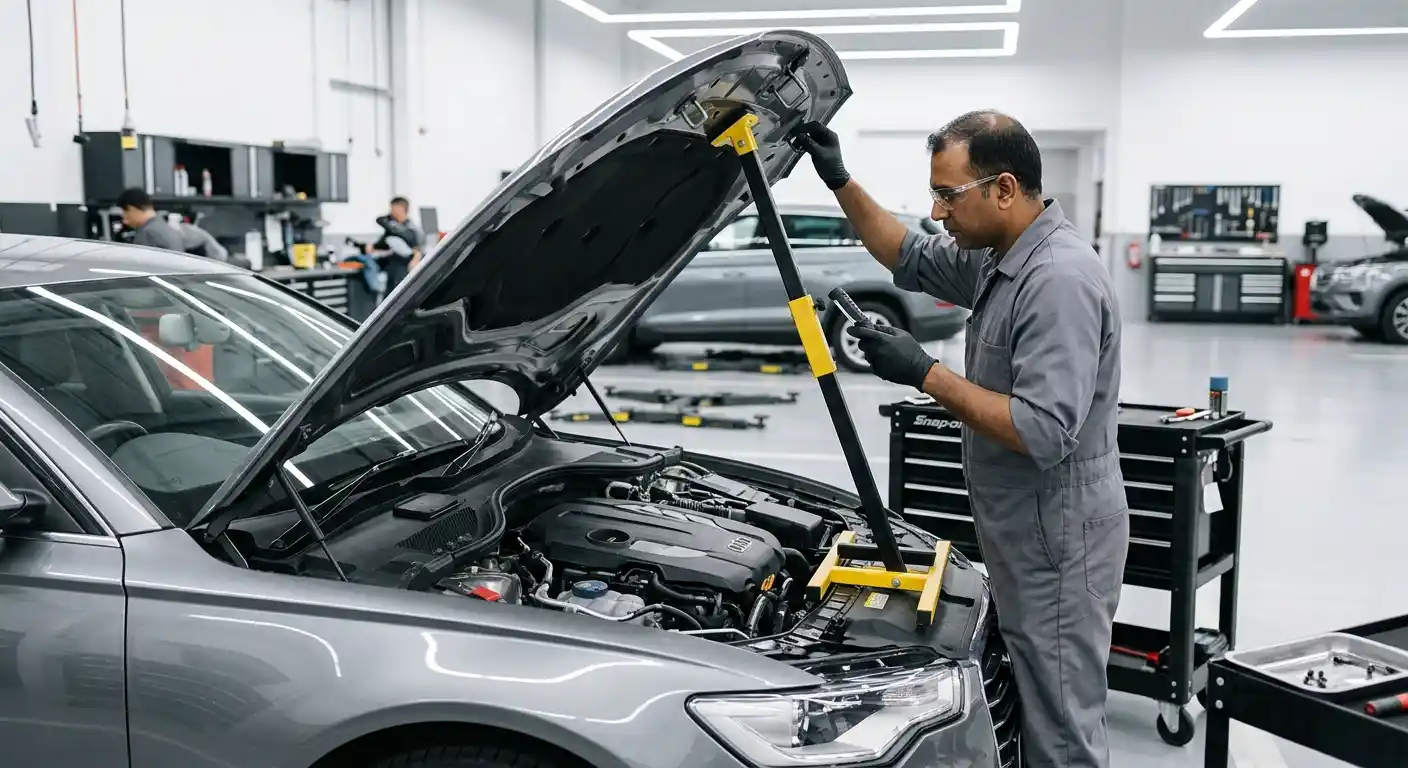
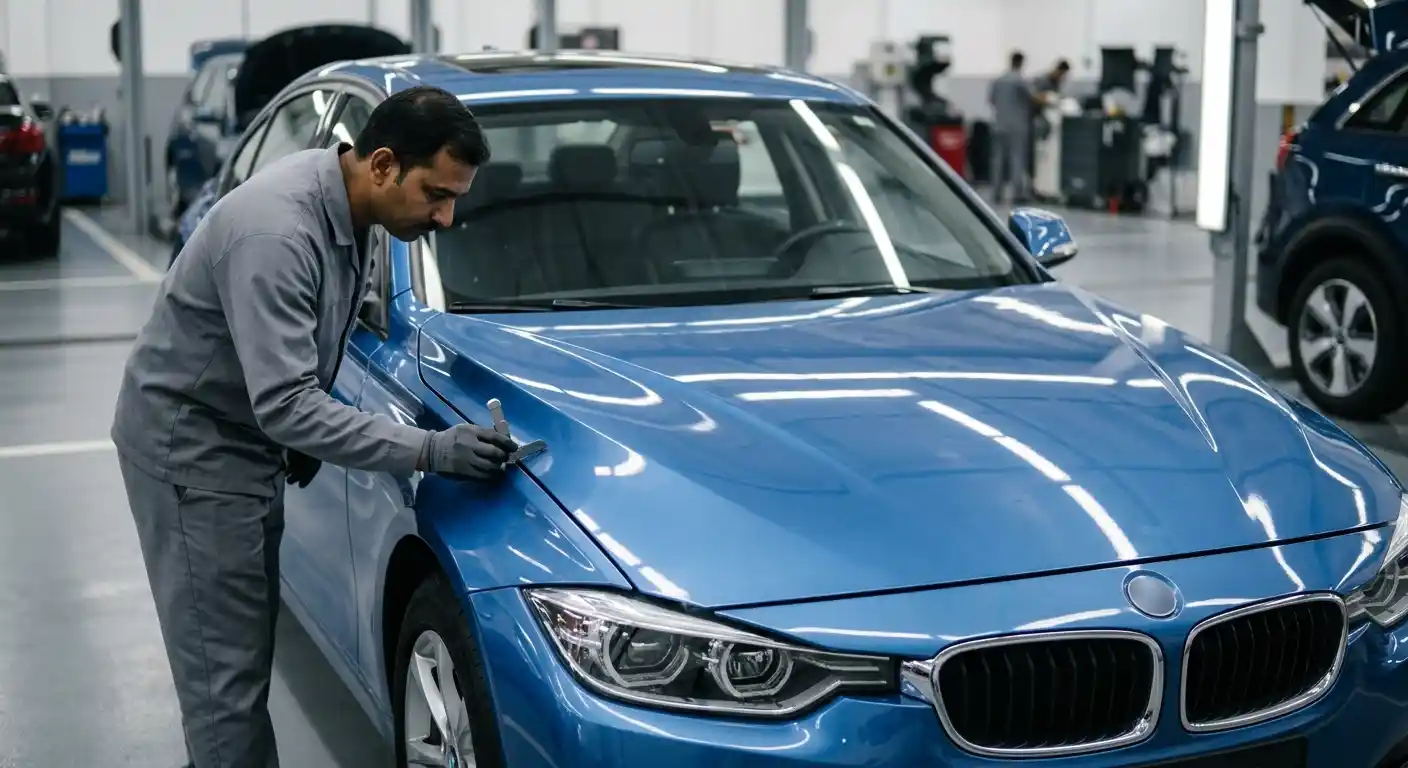
A glossy bonnet is not enough. Handover returns to the intake observations and agreed repair route. The surface is viewed across long reflections, the body lines are followed, and the leading edge is compared with the bumper, grille and lamps where relevant to the work.
Both side gaps and rear corners are reviewed. Closing and release behaviour can be checked within the body repair scope, but this must not be represented as validation of every safety, electronic or mechanical system. Anything requiring specialist testing should be stated separately.
Insulation, nozzles, hoses, seals and trim are checked where fitted and disturbed. Their design varies by vehicle, so the handover record should describe what was actually removed, transferred or replaced. The customer should know the paint areas, repaired parts, replacement parts and any remaining recommendation.
- Compare contour and body lines with intake findings.
- Review bonnet-to-fender gaps on both sides.
- Check leading-edge height and rear corner position.
- Review closing and release action without repeated slamming.
- Inspect colour, texture, gloss and repaired edges.
- Confirm accessible attachments disturbed by the work.
- Remove repair residue and check under useful light.
- Explain aftercare and separately referred concerns.
Common questions
Car bonnet repair FAQs
Can a dented car bonnet be repaired without painting?
Sometimes. Paintless dent repair may suit a shallow or moderate dent when the paint is intact, the metal is not excessively stretched and safe tool access is available. Sharp dents, cracked paint, edge damage, difficult reinforcement or previous repair can make conventional repair and refinishing more appropriate.
Can a bonnet body-line dent use PDR?
It can be possible, but a body line adds difficulty because the designed contour must be restored accurately. Suitability depends on sharpness, depth, paint condition, material, access and stretching. The decision follows inspection rather than the dent location alone.
How much does bonnet dent repair cost in Dubai?
Indicative bands are AED 150 to AED 350 for a suitable small PDR dent, AED 350 to AED 700 for a suitable medium PDR dent, and AED 700 to AED 1,200 or more for conventional dent and paint repair. Inspection is required because material, access, edges, paint and previous work affect the route.
How much does car bonnet painting cost in Dubai?
Panel painting starts from AED 450 as an indicative planning point. The final quotation depends on preparation, bonnet size and construction, colour, metallic or pearl effect, existing coating condition, repair beneath the paint and whether blending is appropriate.
Why is there no fixed bonnet replacement price?
Replacement depends on exact vehicle and variant, bonnet construction, part source, current availability, related attachments, preparation, paint, trial fitting and any damage to hinges, latch areas or neighbouring parts. Quoting one universal replacement figure would be misleading.
Should I drive if my bonnet will not latch properly?
A webpage cannot determine road safety. If the bonnet does not secure normally, releases again, sits visibly raised or moves, do not rely on repeated slamming or an improvised restraint. Follow suitable vehicle guidance and arrange recovery or technical advice if safety is uncertain.
Do stone chips mean the whole bonnet must be painted?
Not automatically. The number, depth, spread, substrate exposure, corrosion, colour and condition of the surrounding finish influence the choice. A small touch-in, local repair or panel refinishing produces different visual outcomes, so expectations should be discussed after inspection.
Can an aluminium bonnet be repaired?
Some aluminium bonnet damage can be repaired, but aluminium is not assumed and the method is not copied from conventional steel work. Panel construction, stretching, edge damage, access, contamination control, heat limits and manufacturer repair information influence the decision.
Why are bonnet gaps uneven after a front impact?
Possible contributors include bonnet distortion, hinge movement, latch or striker relationship, changed stops, neighbouring fender position or wider front-end damage. Uneven gaps are observations, not proof of one failed part, so the surrounding geometry should be assessed before adjustment.
Can you estimate bonnet repair from photographs?
Photographs help with triage when they include full front, corner, low surface and close damage views. They cannot reliably confirm material, underside access, paint history, stretching, hinge or latch condition, or all related front damage. The final method and quote require physical inspection.
Can bonnet damage be included in an insurance claim repair?
We can document visible damage and prepare a repair estimate. Coverage, excess, liability, required reports, approval and settlement depend on the policy and insurer. Hidden or newly exposed impact-related findings may require supplementary photographs and approval.
How long does car bonnet repair take?
Timing depends on PDR suitability, conventional metalwork, paint preparation, curing, polishing, alignment, parts availability, trial fitting, hidden findings and insurance approval. A useful schedule separates active workshop time from waiting for parts or decisions.
Start with the actual bonnet
Arrange a car bonnet repair assessment in Dubai
Send clear photographs and tell us whether the concern followed a dent, falling object, stone damage or front impact. We will prepare for inspection, identify the repair route and explain the scope before work begins.