
Claim evidence to documented handover
Insurance Accident Repair Dubai
An accident claim is not only a repair job. It is a chain of evidence, decisions and approvals. We help organise the visible damage record, repair estimate and workshop scope so you can follow what is confirmed, what is provisional and what still requires an insurer decision.
What this service does
Turn a stressful claim into a visible sequence
Insurance accident repair can feel slow when several separate decisions are treated as one. The police or accident record, claim registration, survey, repair estimate, coverage decision, parts decision and workshop schedule do not necessarily happen at the same time. Our role is to keep the body and paint repair side clear and well documented.
We begin with the vehicle and the evidence available. Wide photographs establish overall context. Close images record damage, panel gaps, broken fittings and paint condition. An intake record separates accident-related observations from unrelated marks or previous repair. The estimate then identifies known work and any areas that cannot be confirmed until controlled dismantling.
Bodyshop.ae can prepare an inspection-led estimate and support communication about the repair scope. We do not decide liability, policy coverage, excess, cash settlement, total loss, part entitlement or claim approval. Those decisions remain with the insurer and the applicable policy. This distinction protects the customer from treating a workshop estimate as a promise of payment.
The claim journey
Eight checkpoints from incident record to handover
Use the controls or swipe the cards. This rail shows where the workshop contributes evidence and where an insurer decision is still required.
Make the situation safe
Prioritise people and the road environment. Contact the appropriate emergency or police channel for the circumstances. Do not move or drive a vehicle when doing so would be unsafe or contrary to official instruction.
Secure the official record
Obtain the accident or police report required for the claim where applicable. Check the recorded vehicle details and parties. The workshop cannot correct liability or report information on the customer’s behalf.
Open the claim
Notify the relevant insurer and keep the claim reference. Ask which documents, survey route, repair choices and authorisations apply to the policy and accident circumstances.
Record vehicle condition
Photograph the whole vehicle before close damage images. Record panel gaps, lamps, glass, wheels, warnings and unrelated marks. Good evidence reduces ambiguity later.
Prepare the estimate
The visible repair scope separates parts, labour, paint, removal and refitting, and any provisional operations. The estimate is a technical and commercial document, not an insurer approval.
Receive the decision
Confirm what has been authorised, excluded, changed or left pending. Do not assume that claim registration or a survey visit means every quoted operation is approved.
Manage supplements
If agreed dismantling reveals impact-related damage, photographs and an added estimate can support a supplementary decision. Extra work should not quietly enter the job without the appropriate approval.
Close with records
Handover should compare the completed repair with the authorised scope, explain replaced and repaired items, identify separately referred work and retain useful claim documents.
Before the estimate
What to do after an accident in Dubai
If anyone is injured, the road is unsafe or urgent assistance is required, use the appropriate emergency response. The UAE Government emergency guidance identifies 999 as the police emergency number and notes that minor accidents can be reported through online channels. The exact route can depend on location and circumstances, so follow current official instructions rather than relying on an old screenshot or forwarded message.
Where an accident report is required, preserve it and check the vehicle and party details. The Central Bank of the UAE unified motor policy wording includes prompt notification to the relevant official authorities and insurer when an accident may give rise to a claim. Your own policy, insurer instructions and the official report process control what is required for the individual case.
Take photographs only when it is safe and permitted. Start wide enough to show each vehicle and its position, then capture each affected side, the registration plates, visible road context and closer detail. At the workshop, a second photo set should document the vehicle under consistent light, including pre-existing marks that are outside the reported impact.
If you need a fuller preparation list, contact the workshop with the documents you already have and we will explain what is useful for repair intake.
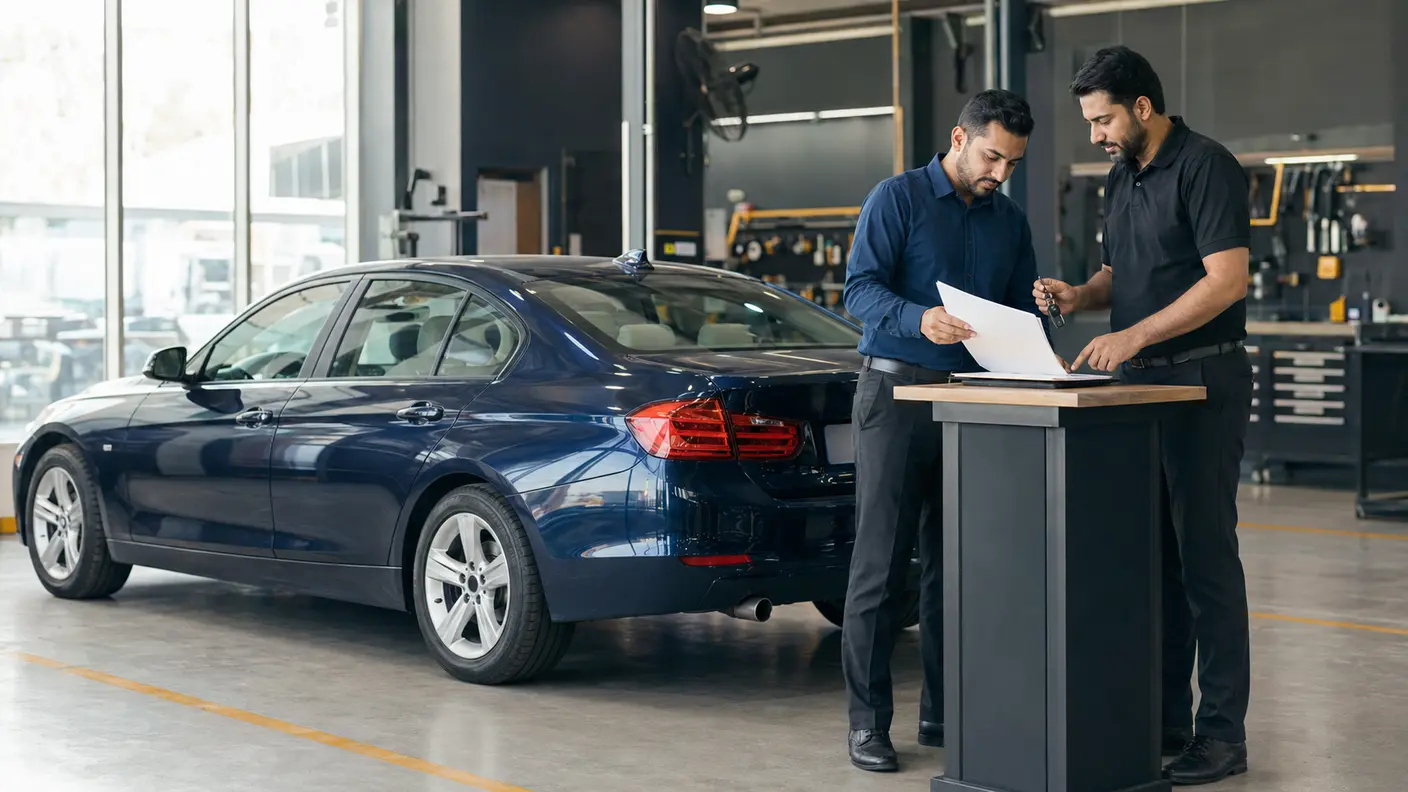
Claim file essentials
A practical documentation checklist
Not every insurer requests the same sequence, but these items commonly help prevent avoidable back-and-forth. Confirm the exact requirements with the insurer handling the claim.
Accident record
Keep the police or accident report where applicable, including the report number, date, vehicles and recorded party information. If something appears incorrect, raise it through the responsible official channel.
Claim reference
Save the insurer’s claim number and the contact route assigned to the case. Put the reference on emails, estimates and supporting images so documents are less likely to separate from the file.
Vehicle documents
Be ready with the vehicle registration and other documents the insurer requests. Check that names, registration details and policy information correspond before submission.
Damage photographs
Use wide, medium and close views. Include neighbouring panels, gaps and the direction of damage. A close-up alone may hide the context needed to understand the impact path.
Workshop estimate
The estimate should identify repair and replacement operations, paint areas, parts, labour and any provisional item. A vague lump sum makes later comparison difficult.
Approval record
Keep the written decision and scope available before work begins. If wording is unclear, ask whether a listed part, blend panel, calibration, mechanical check or supplement route is included.
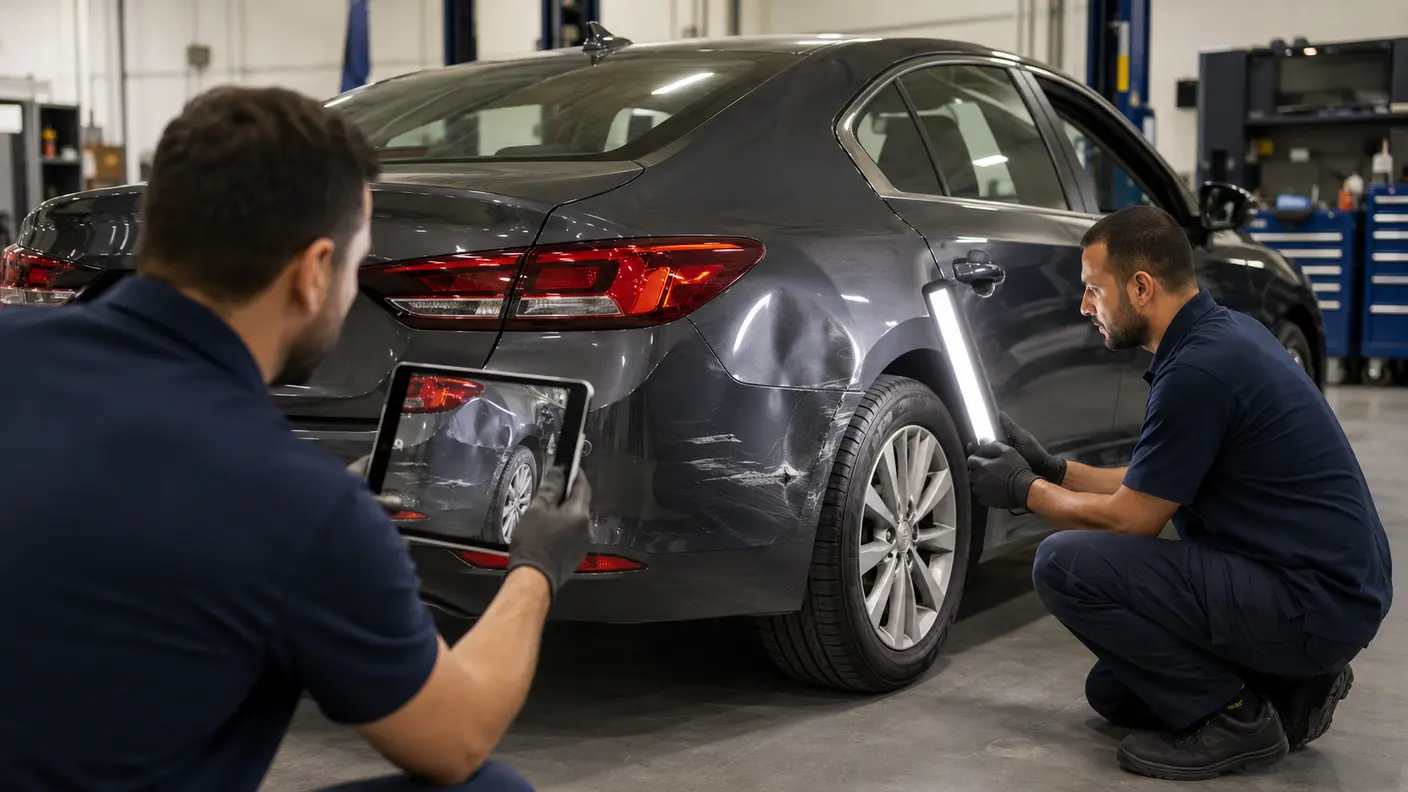
Inspection and survey
A survey is a checkpoint, not the complete repair plan
A surveyor or insurer representative may review photographs, inspect the vehicle or evaluate an estimate. That review can influence the authorised scope, but customers should wait for the actual decision rather than treating the visit itself as approval.
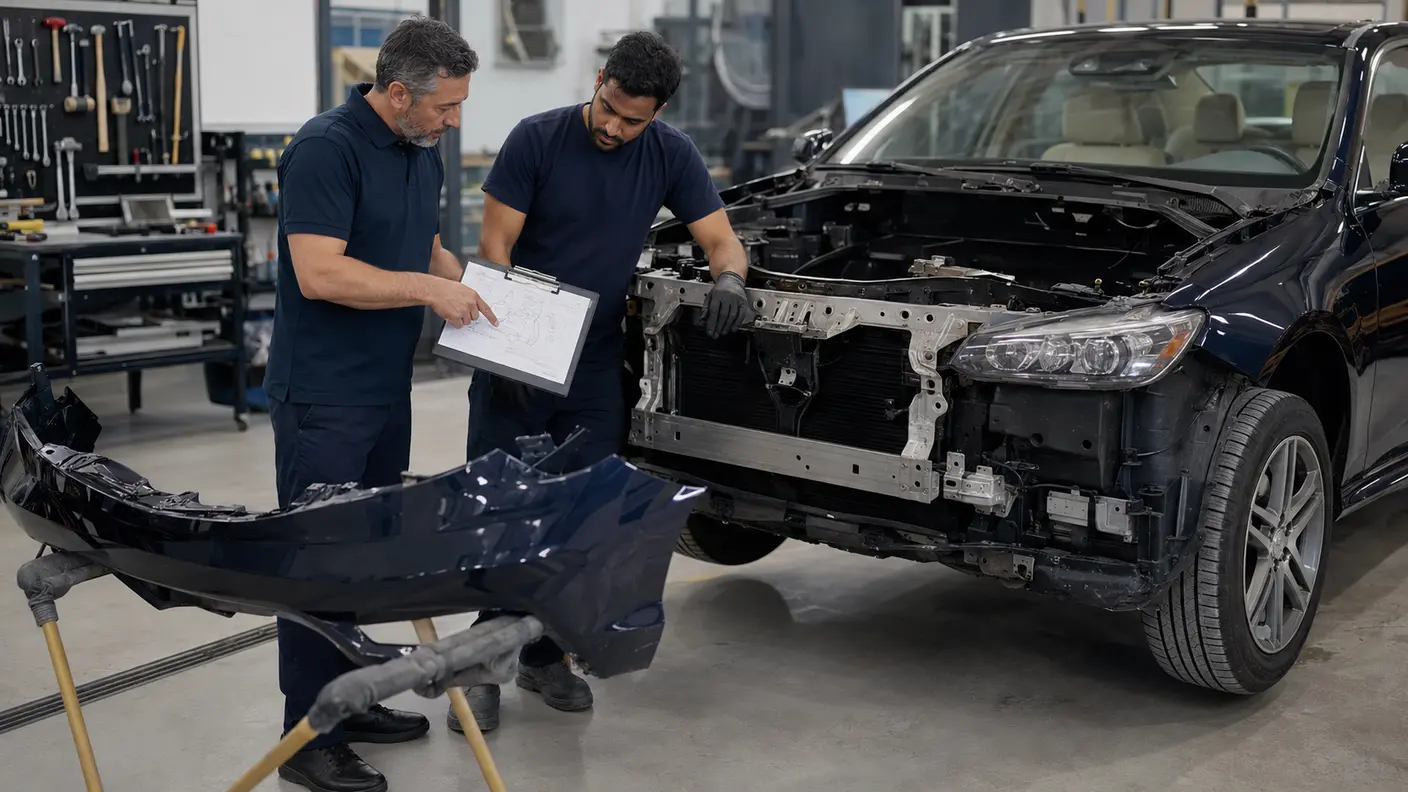
Before access or dismantling, the visible estimate may include provisional language. A bumper cover can hide broken retainers or damage to parts behind it. A door impact can affect hinges, apertures or internal equipment that is not visible from outside. A front impact can involve mounts and cooling-area components even when the painted surface appears to carry most of the mark.
Our accident repair service begins with evidence and an inspection-led scope. Where controlled dismantling is justified, we record newly revealed impact-related findings and separate them from wear, maintenance needs or unrelated previous damage.
The workshop should also identify service boundaries. Body and paint repair does not automatically prove completion of electronic calibration, mechanical diagnosis, restraint-system work or a manufacturer-specific procedure. Any separate technical requirement should be visible in the estimate or handover record rather than implied.
Estimate versus approval
Four scopes can exist in one claim
Confusion usually begins when the initial estimate, insurer decision, supplementary request and final completed work are treated as the same list.
Initial estimate
What the workshop can reasonably see and price before deeper access. It may include provisional parts or operations.
Authorised repair
What the insurer has accepted under its process. It can differ from the first estimate in method, parts or included operations.
Supplement request
Additional accident-related damage found after agreed dismantling, supported by images and revised pricing for a new decision.
Customer instruction
Work the customer chooses to pay for separately, such as unrelated marks, maintenance or an upgrade not included in the claim.
Hidden damage
Why a supplementary estimate can be legitimate
A first estimate is limited by what can be seen or accessed. Plastic covers, liners, trims, lamps, seals and interior panels can conceal impact-related damage. This does not mean every claim should grow after dismantling. It means newly found work needs its own evidence and decision.
A useful supplement should connect the finding to the reported impact, show clear photographs, explain why it was not reasonably confirmed earlier and price the added labour or parts. The vehicle should not simply continue into extra work while approval status remains unclear.
Damage that appears unrelated to the reported accident should be separated. Previous filler, corrosion, old cracks, worn mounting points or maintenance issues may change the repair approach without becoming part of insurance coverage. Only the insurer can decide whether an item falls within the claim.
Repair or replacement
The insurer decision still needs a repairable technical basis
A panel may be technically repairable but uneconomical once labour, refinishing and risk are considered. A replacement part may look simple on an estimate but require adjacent trims, clips, bonding materials, transfer work or painting. The responsible comparison is not “old part versus new part” in isolation. It is the complete method needed to restore stable fit and finish.
Repair is more plausible when shape, edges and mounting points can be restored without unsuitable heat, stretching or excessive filler. Replacement becomes more plausible with tearing, severe folds, damage through critical mounting areas, loss of material or repair labour that approaches a sensible replacement route.
Part type and entitlement can depend on policy, vehicle age, availability, insurer rules and the claim decision. The workshop should state what is being quoted and what has been authorised. It should not describe a part as original, new, used or aftermarket without clarity in the record.
When the body repair includes several panels, our body repair page explains how panel condition and access influence the method. The individual claim scope remains the controlling document. For frontal impacts involving bumper structure, lamps, cooling parts or alignment concerns, see our front-end collision repair guide.
Cost and claim position
Two numbers matter, and they are not the same
The repair exposure is the estimated cost of restoring the vehicle. The customer position is the amount, if any, that remains with the owner after the insurer applies liability, coverage, excess and other policy terms.
The workshop estimate for parts, labour, bodywork, paint and identified supporting operations.
The excess and any separately accepted customer-paid amount after the insurer gives its decision.
Excess
An excess or deductible is an amount applied under the policy and claim circumstances. Do not assume it from the visible repair cost. Ask the insurer to confirm the applicable amount in writing.
Liability
The official accident record and insurer process can affect which party or policy responds. The workshop does not decide fault, recoverability or legal liability.
Coverage
Comprehensive and third-party arrangements respond differently, and exclusions or conditions may apply. Only the insurer can confirm whether a repair item is covered.
For a broader breakdown by damage type, see the published Dubai accident repair cost guide. Its prices are also indicative and remain subject to inspection and current variables.
Paint, parts and customer choices
Where customer-paid differences can appear
Some claim decisions authorise a repair method or part route that differs from the owner’s preference. An owner may ask about a different part source, additional unrelated paintwork, cosmetic improvement beyond the accident area or replacement where repair has been authorised. That does not automatically make the difference payable by the customer. It means the alternatives need to be identified and accepted before work begins.
Paint scope also needs clarity. The damaged panel may require preparation and refinishing, while an adjacent panel may be considered for blending when colour relationship cannot reasonably be managed within the repaired panel. Whether a blend is technically proposed, authorised or customer-paid should be stated, not assumed. Our car painting service explains the preparation and finish considerations behind the paint quotation.
Parts timing can be separate from approval timing. A claim may be authorised while a precise lamp, bracket, trim or panel remains unavailable. Conversely, a part may be locally available while approval is still pending. A realistic update should name the current blocker rather than repeatedly saying the vehicle is “under process.”
If the owner accepts work outside the insurance scope, the added item should appear on a separate written instruction or clearly separated estimate. This helps prevent unrelated cosmetic work from being confused with the insurer-authorised repair at handover.
Time planning
Repair time is only one part of the calendar
A useful schedule separates administrative waiting from active workshop work. Exact timing follows inspection, approval and parts checks.
Evidence
Accident record, claim registration, document collection and initial photographs.
Assessment
Vehicle inspection, survey route, estimate preparation and any clarifying questions.
Decision
Coverage and scope review, approval, changes, part route and excess confirmation.
Repair
Dismantling, supplements if required, parts, bodywork, paint, curing and reassembly.
Handover
Scope comparison, visible checks, documentation, payment position and collection.
Repair handover
Close the claim with a scope comparison
Final shine is not the only handover test. The completed work should be compared with the latest authorised repair scope and any separate customer instruction. Repaired and replaced panels should be identifiable. Paint areas, visible fit, accessible exterior operations disturbed during the work and the condition of the repair area should be reviewed.
If a technical operation was separately referred or not included, that boundary should remain visible. A body repair handover must not silently imply that every electronic, mechanical or manufacturer-specific requirement has been completed.
The customer should understand any amount payable to the workshop, the insurer’s stated decision and any document still needed. Keep the report, claim reference, estimate, authorisation, supplement decisions and final invoice together for future reference.
Common questions
Insurance accident repair FAQs
Can Bodyshop.ae approve my insurance claim?
No. We can inspect visible body damage, prepare a repair estimate and document the workshop scope. Approval, liability, coverage, excess, part entitlement and settlement decisions remain with the insurer and applicable policy.
Do I need a police or accident report for insurance repair in Dubai?
A report is commonly required for an accident claim, but the correct process depends on the incident and current official instructions. Notify the appropriate authority and insurer promptly, and confirm the documents required for your case.
What should I send for an initial insurance repair review?
Send your contact details, vehicle information, the accident or police report where applicable, claim reference if issued, and wide plus close photographs. Mention any warning, leak, damaged lighting, tyre contact or change in driving behaviour.
Is a repair estimate the same as insurer approval?
No. The estimate describes proposed work and cost. The insurer may approve it, change the method or parts, request more information, leave items pending or decline items according to its process and the policy.
Why can the estimate change after dismantling?
Covers, liners, trims and interior panels can hide impact-related damage. If controlled access reveals a relevant finding, the workshop can photograph it and prepare a supplementary estimate for the required decision before extra work proceeds.
How much does insurance accident repair cost in Dubai?
Indicative exposure can range from AED 299 to AED 1,000 for minor cosmetic damage, AED 500 to AED 1,500 for bumper repair and paint, AED 1,000 to AED 3,000 for a door or fender, and higher for multi-panel, structural or restraint work. Inspection, current market variables and insurer decisions apply.
Does insurance always pay the full repair cost?
No payment outcome can be promised. The customer position may depend on liability, policy type, coverage, exclusions, excess, authorised method, part decision and any separately requested work. Ask the insurer to confirm the decision in writing.
What is an insurance excess?
An excess or deductible is an amount that may be applied under the policy and claim circumstances. The workshop should not guess it from the repair estimate. The handling insurer should confirm the applicable amount.
Can I choose repair instead of replacement?
You can ask for the technical and cost reasoning, but the claim decision may control the authorised method. Repair suitability depends on material, deformation, edges, mounting points, access, previous condition and the ability to restore stable fit and finish.
How long does an insurance accident repair take?
Timing can include report and document collection, inspection, estimate review, approval, parts supply, dismantling, supplements, bodywork, paint, curing, reassembly and final checks. A useful update separates workshop time from administrative or parts waiting.
Can I pay separately for work not covered by the claim?
Yes, when the work is suitable and the customer gives clear written instruction. Unrelated marks, maintenance or preferred upgrades should be separated from the insurer-authorised scope and priced transparently before work begins.
What should I check at vehicle handover?
Compare the invoice with the latest approved scope, review visible panel fit and paint finish, ask which parts were repaired or replaced, identify any separate outstanding work, and retain the report, estimate, approvals and final invoice.
Start with the claim stage you are at
Arrange an insurance accident repair assessment
Send the report or claim reference you already have, plus wide and close damage photographs. We will help define the visible repair scope, identify provisional areas and explain the next workshop checkpoint.
Bodyshop.ae prepares repair evidence and estimates. Insurer approval, coverage, liability, excess, settlement and document requirements remain subject to the relevant insurer, policy and official process.