
Infiniti Body Shop Dubai
Curved panels, crisp character lines and pearl finishes make repair quality easy to judge in Dubai sunlight. Our approach starts with inspection, separates cosmetic damage from deeper impact concerns, and builds a clear repair plan around the actual condition of your Infiniti.
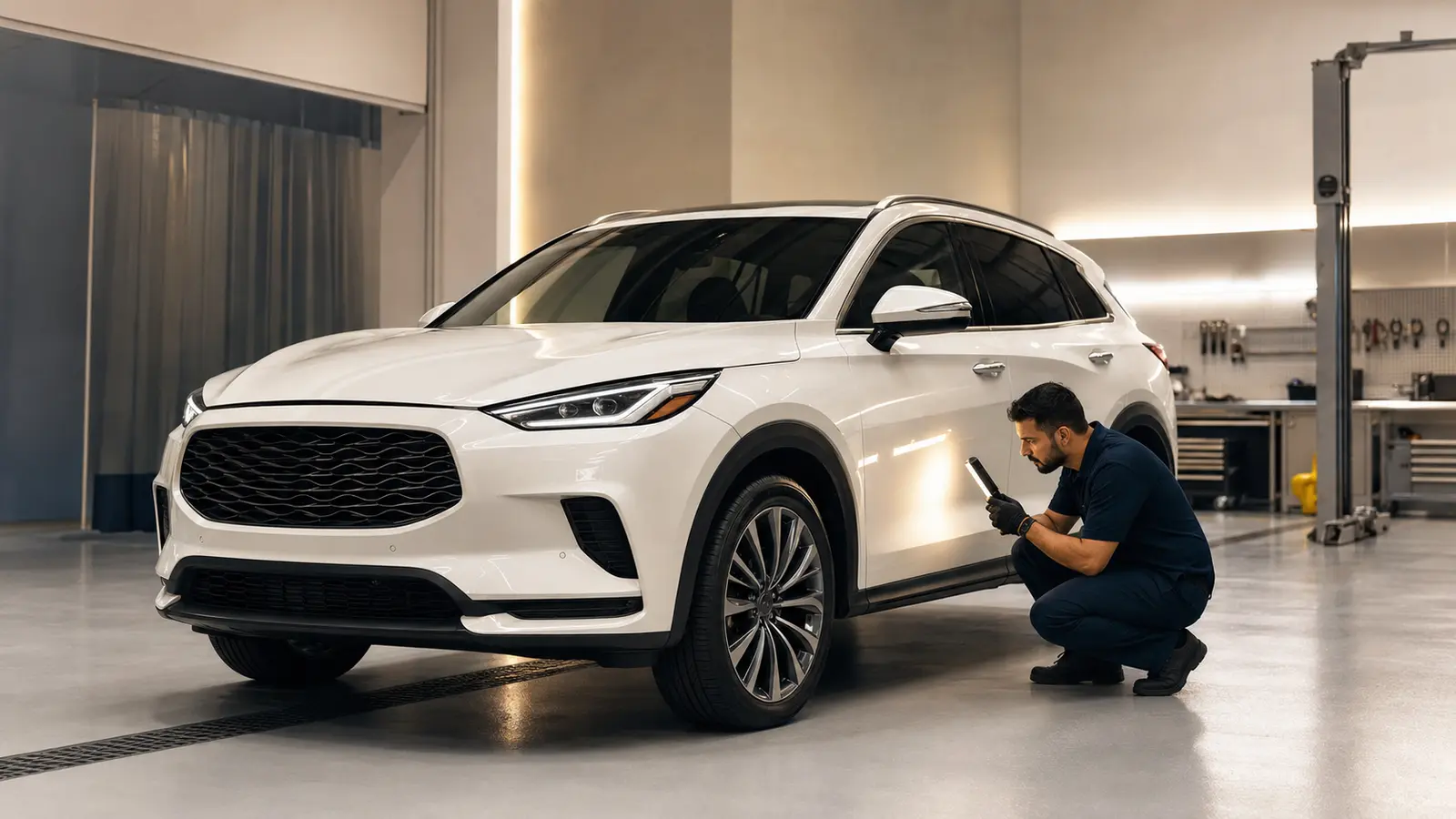
Why an Infiniti repair needs more than a quick cosmetic estimate
A scrape can look small in a phone photo while crossing several important features: a curved bumper corner, a tight wheel-arch return, a door edge, a sharp crease or a trim joint. Each feature changes the work. The first question is not simply how large the mark appears. It is where the force travelled, which surfaces changed shape, and what must be removed or inspected to understand the full repair area.
Infiniti designs often use flowing surfaces next to precise highlights. On a dark metallic or light pearl finish, a weak panel shape may only become obvious when the car moves past a light source. A body line that is a few millimetres out can create a wavering reflection. A bumper corner can look acceptable from the front but sit proud where it meets the wing. A paint match can appear close indoors yet change when viewed in direct sun.
That is why we treat assessment, panel form, fit and finish as connected stages. The useful goal is not to hide one scratch. It is to restore a coherent appearance across the damaged area and explain what the repair plan does, including any limits that can only be confirmed after access or dismantling.
Curves, creases and colour must agree
A premium finish looks convincing when the underlying shape, panel relationships and paint appearance support one another. Focusing on only one can leave the repair looking unfinished.
Flowing panel form
Broad curves carry reflections over a large area. A shallow low spot, stretched zone or sanding wave can disturb that flow even when the paint is glossy. Inspection lighting helps reveal the true shape before refinishing begins.
Sharp character lines
A crease gives the side of the car definition. If impact damage crosses it, the line must be reconstructed with attention to its height, sharpness and continuity into the next panel. A line that fades early or rises late is easy to see outdoors.
Pearl and metallic appearance
Colour is only part of the match. Metallic flake and pearl layers react to light and viewing angle. Application technique, ground shade, blend strategy and clear-coat finish all influence the final appearance.
Grille, lamp and trim alignment can reveal the real repair area
The front of a premium vehicle contains several closely related visual references. The grille opening, bumper contour, lamp edge, bonnet line, wing tip and lower trim all contribute to a balanced appearance. After a corner impact, replacing or painting only the most visibly marked piece can leave one joint tight and another wide. Before the work is defined, it is useful to compare heights, gaps and attachment points across the whole fascia.
A chrome-look moulding or painted insert may survive the initial contact but lose a retaining clip. A bumper cover can also hold tension after it has been pushed out of shape. Forcing it into position without understanding the mount may create stress, poor fit or a repeat separation. The inspection should distinguish damage to a replaceable trim piece from deformation in the larger cover or support area.
Lamp edges require similar care. A lens can look unbroken while a concealed tab or bracket has moved. If the lamp sits lower, shakes, collects moisture or changes the surrounding gaps, that condition belongs in the repair assessment. We do not describe an electronic or lighting function as resolved solely because the exterior appears aligned.
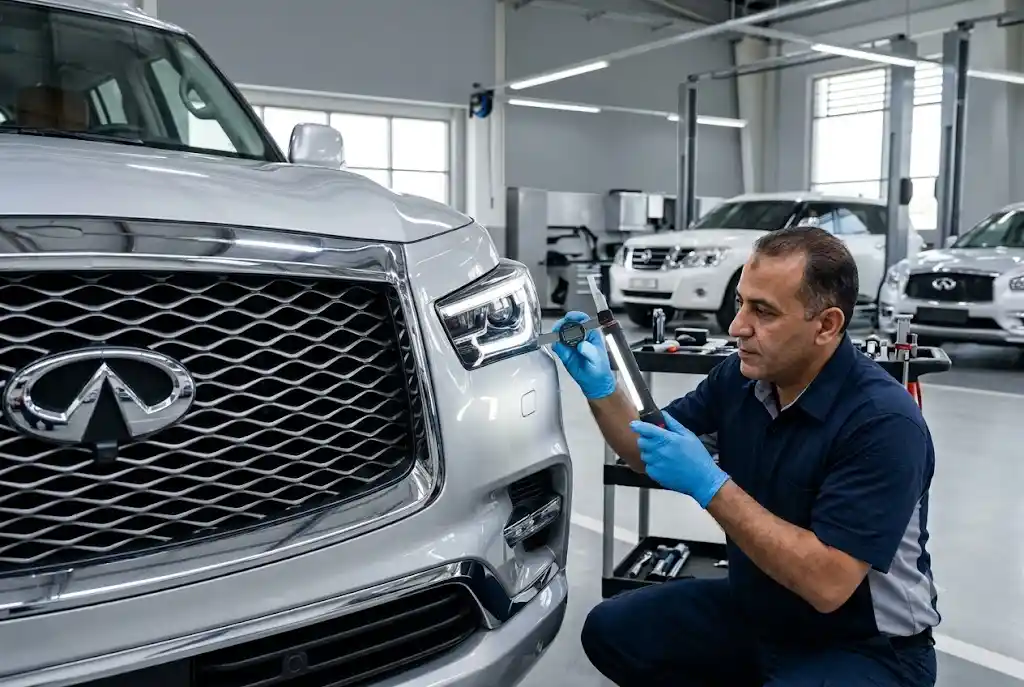
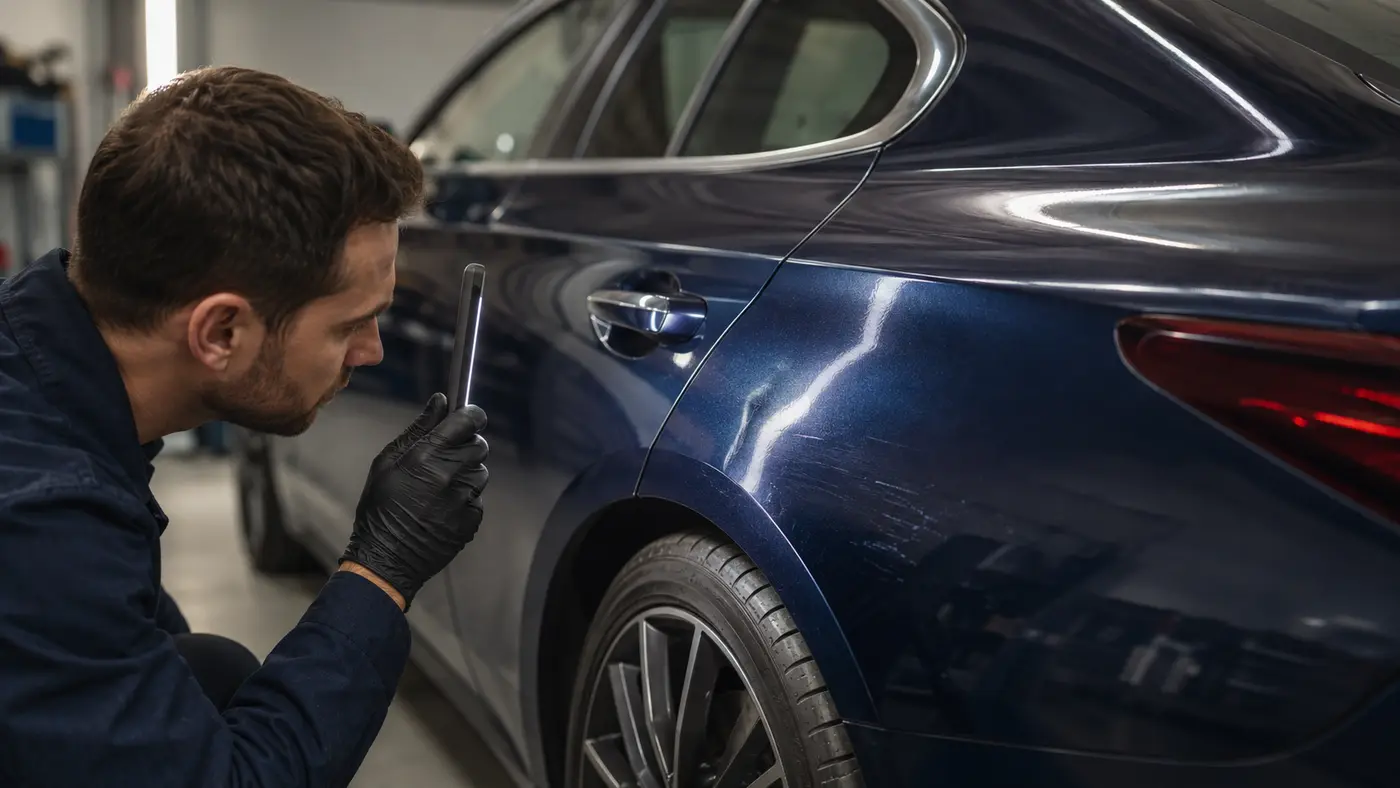
What looks like one dent may be several repair decisions
Dubai parking damage commonly combines paint transfer, a shallow depression and a sharp impact point. The mark may also touch an edge or body line. These details affect whether dent removal is suitable, whether paintwork is required, and how wide the working area needs to be.
Paintless dent repair can be useful when the coating remains intact, the metal has not stretched beyond a sensible correction, and there is workable access behind the panel. It is not automatically the right route for every shallow dent. Damage on a reinforced edge, a severe crease or a panel with fractured paint may need a conventional repair and refinishing plan.
Paint transfer can also disguise the condition. Some transferred material may sit above the clear coat, while deeper lines may have cut through colour or primer. We avoid promising a polish-only outcome before the surface has been examined. The safest estimate distinguishes what is visible now from what may be confirmed during preparation.
Common Infiniti body damage and what changes the scope
| Damage area | What we inspect | Why the decision can change |
|---|---|---|
| Bumper corner | Paint fracture, plastic distortion, mounting tabs, adjoining wing fit and trim alignment | A cosmetic scuff may be local, while a displaced corner can indicate damaged retainers or hidden deformation |
| Front grille and trim zone | Visible fit, broken clips, surrounding bumper shape and gaps near lamps | Decorative parts can appear intact while their supports have moved or cracked |
| Door skin and edge | Dent depth, crease location, paint condition, opening feel, edge damage and gap consistency | A repairable skin mark is different from damage affecting the shell, hinges or latch area |
| Rear quarter panel | Wheel-arch form, fuel-door area where applicable, lamp edge, bumper joint and access behind the panel | The quarter is part of the body structure, so access and replacement choices differ from a bolt-on panel |
| Bonnet or front wing | Leading edges, panel height, lamp and bumper relationships, paint chips and inner mounting points | Visible panel damage may be accompanied by disturbed brackets or gaps |
| Boot and rear bumper | Closing action, floor and aperture signs, lamp fit, bumper reinforcement zone and seal contact | A low-speed rear impact can leave little outer damage while affecting parts behind the cover |
Hidden impact damage matters more than the first photograph
Bumper covers are designed to flex. After contact, the outer plastic can partially return toward its original shape, leaving a scuff or small distortion. Behind it, retainers, guides, brackets, absorbers and adjoining mounts may not have recovered in the same way. If the bumper now sits unevenly, moves when pressed, touches another panel or shows a growing gap, a closer inspection is sensible.
Doors and boot lids also provide clues. A new closing noise, extra force, wind noise, water entry or a change in gap can mean the impact affected more than the visible skin. These signs do not prove major damage, but they should be recorded before the scope is fixed.
Where parking aids, lamps, cameras or other electronic items are near the damaged zone, we note their position and any warning reported by the driver. Cosmetic refinishing must not casually cover, fill or disturb sensor surfaces and openings. Any electronic diagnosis or separate calibration requirement should be based on the vehicle condition, fitted equipment and applicable repair information. We do not infer a calibration need from appearance alone.
The better choice depends on condition, access and final quality
Replacement is not automatically better, and repair is not automatically cheaper. A sound decision considers material condition, deformation, access, adjacent parts, refinishing needs and the standard of result that can reasonably be achieved.
Damage severity
Shallow deformation away from edges may offer a practical repair path. Severe folds, tears, stretching or damage through critical mounting zones can push the decision toward replacement.
Panel location
A bolt-on wing or door is approached differently from a fixed quarter panel. Removal, joining, corrosion protection and access requirements can change the overall plan.
Part fit and availability
The condition and fit of the available part matter. The estimate should identify whether the plan depends on a new, used or alternative part and whether related clips or trims are included.
Finish continuity
Even when a panel is replaced, preparation and colour strategy remain important. Adjacent panels may influence how the colour transition is managed.
A transparent estimate should separate confirmed work from possible additions. If dismantling is needed to see mounts or inner damage, that uncertainty should be stated before work progresses. This gives you and, where relevant, the insurer a clearer basis for deciding on the next stage.
Why pearl and metallic matching is a process, not a colour code
A paint code is the starting reference. It does not account for every real-world variation. Age, previous refinishing, ultraviolet exposure, panel orientation and production variation can influence how the existing finish appears. Pearl colours add another challenge because translucent layers can change brightness and hue depending on film build and viewing angle.
The repair area therefore needs practical colour evaluation. Test applications can help compare a formula under more than one light source. The painter also considers metallic orientation, transition space and the position of body lines or panel edges. On some repairs, blending into an adjacent panel can create a smoother visual transition than ending fresh colour at a prominent boundary.
After application, gloss alone is not enough. The result should be viewed from several angles. Direct Dubai sun, shade and controlled workshop lighting reveal different characteristics. A finish can look uniform head-on yet show a light or dark flop from the side. Careful car painting work includes the preparation and inspection needed to manage these differences.
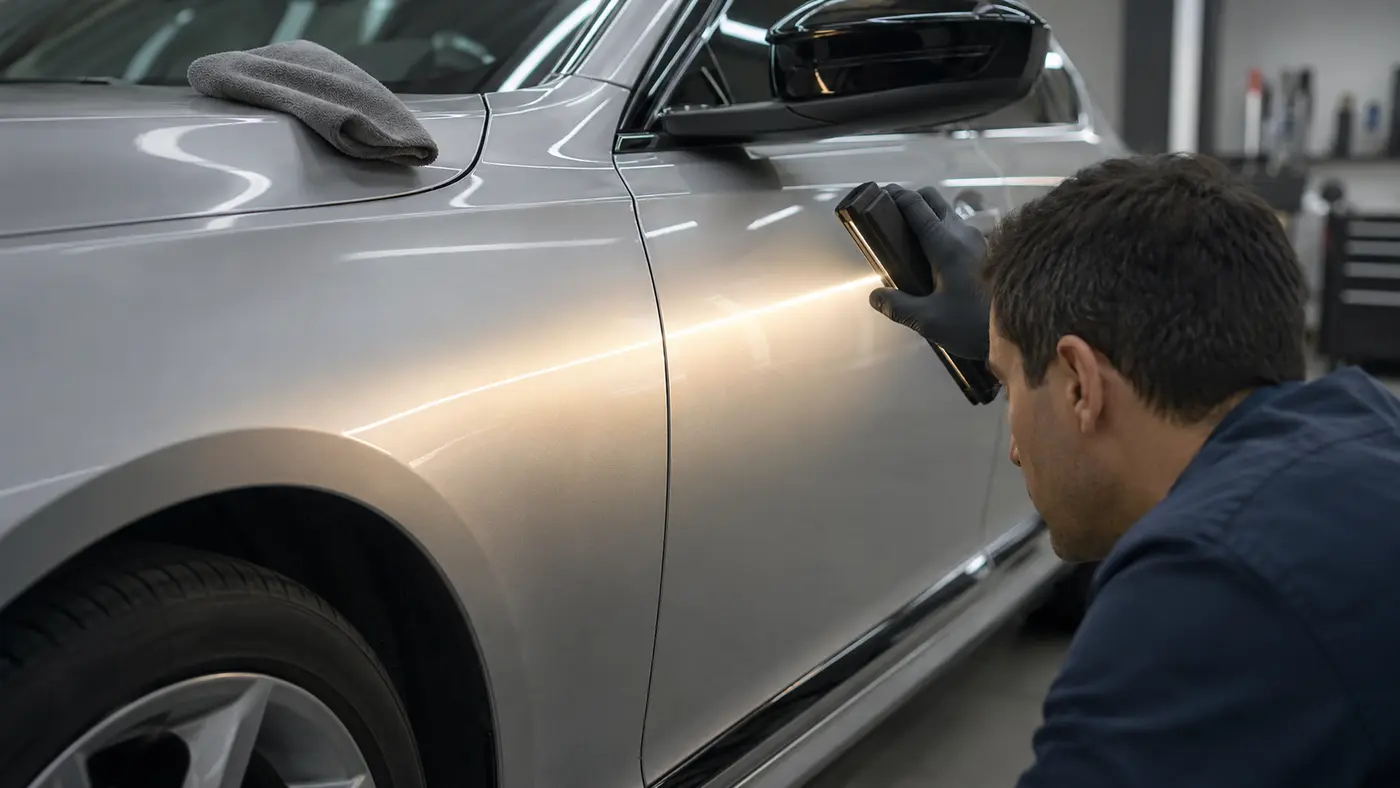
From first inspection to handover
1. Record the condition
We discuss how the damage occurred, photograph the affected area and note fit, finish, operation and any warning reported after the incident.
2. Define the scope
The repair plan identifies visible work, parts and refinishing. Any item that depends on dismantling or insurer response is kept clear.
3. Repair and refinish
Panel correction, preparation, fit checks and paint stages follow the agreed scope. Findings that materially change it are communicated before extra work.
4. Inspect and hand over
The repaired area is checked for appearance, basic operation and cleanliness. Handover is also the time to explain any aftercare that applies.
Keep the claim conversation tied to evidence
For an insured accident, the policy and insurer determine what is covered. The useful role of a body shop estimate is to document the vehicle condition and describe the proposed work clearly. Photographs, part requirements, repair operations and refinishing areas help the insurer assess the claim.
An initial insurer scope may change if concealed damage becomes visible after agreed dismantling. Where that happens, supplementary evidence can be prepared for the insurer to consider. Response timing, excess, depreciation, part type, liability and replacement-car benefits remain subject to the policy and insurer decision.
Do not assume that every visible mark from the same side belongs to the same event. Existing damage should be separated where possible. This protects the accuracy of the repair record and reduces confusion later. For larger collision work, our accident repair page explains the broader inspection-led process.
A practical handover check for your Infiniti
Take a few minutes before leaving. View the repaired area as a connected part of the car, then check the functions that were involved in the work.
- Look along the repaired panel from a low angle for waves or a broken character line.
- Compare panel gaps on both sides where the design allows a meaningful reference.
- View pearl or metallic colour in workshop light, shade and daylight when possible.
- Check that bumper edges and trim pieces sit evenly without new looseness.
- Open and close any repaired door, bonnet or boot to confirm normal feel and latching.
- Check lamps and basic parking-aid behaviour if those areas were part of the repair scope.
- Inspect rubber seals and nearby interior trim if access required their removal.
- Confirm the agreed items are listed clearly on the final paperwork.
- Ask what washing or surface-care guidance applies to fresh refinishing.
- Report a warning message, water entry or unusual noise promptly instead of waiting.

Condition and finish must be priced together
An Infiniti estimate becomes more useful when it explains both the physical repair and the finish needed across curves, character lines and adjacent surfaces. The same size dent can follow a different route when paint is broken or rear access is restricted.
Lens one: restore shape
Small PDR dent: AED 150 to AED 350. A medium dent is about AED 350 to AED 700. These bands assume intact paint and a shape that can be recovered without conventional preparation.
A larger conventional dent with paint is about AED 700 to AED 1,200 or more. Edge damage, a hard crease or stretched metal can change the method after inspection.
meets
finish
Lens two: restore appearance
Panel painting starts from AED 450. A light bumper polish or transfer can start around AED 150. Plastic repair plus paint is about AED 500 to AED 1,200, while complete bumper repainting is about AED 600 to AED 1,500.
Bumper replacement is about AED 1,200 to AED 6,000 or more. Confirmed structural or chassis work is broadly about AED 2,000 to AED 5,000 or more.
Pearl or metallic behaviour, a sculpted reflection and the relationship between grille, lamp and bumper edges can widen the operations beyond the closest mark. The estimate should separate dent work, paint preparation, blending, trim handling and parts. It should also identify any amount that remains provisional until access or part confirmation.
Indicative only: an inspection is required. Infiniti make and model, material, parts, finish, hidden damage and current market conditions affect the final quote. These bands do not confirm repairability or promise that a neighbouring panel will not need colour blending.
Infiniti body repair FAQs
Can you estimate Infiniti body damage from photos?
Photos can support an initial discussion and help us plan an inspection. They do not always show dent depth, damaged mounts, previous repairs or hidden impact effects. A final scope usually needs the vehicle to be examined.
Can a dent be repaired without repainting?
Possibly. Paintless dent repair may suit some dents when the paint is intact, access is workable and the metal has not been severely stretched. Creases, edge damage and fractured paint can require a conventional repair.
Why does a bumper gap appear after a small impact?
The cover may have flexed while a side retainer, bracket, tab or nearby mounting point moved or broke. Inspection of the joint helps distinguish a fitment issue from deeper deformation.
Can a cracked Infiniti bumper be repaired?
Some plastic damage can be repairable, depending on crack position, material condition, missing sections, mounting integrity and expected finish. Replacement can be the more sensible option when critical tabs or heavily stressed areas are compromised.
How do you match pearl or metallic paint?
The paint code provides a starting point. Existing colour, variants, application technique, metallic or pearl orientation, test applications and blend strategy can all affect the result. The finish should be checked under more than one viewing condition.
Will you blend paint into the next panel?
That depends on colour, repair location, adjacent-panel condition and the practical transition available. The purpose of blending is visual continuity, not simply making the painted area larger.
Should a damaged door be repaired or replaced?
The choice depends on deformation, intrusion area, edge and shell condition, access, mounting or latch involvement, part options and the quality achievable. We prefer a condition-based decision after inspection.
What if hidden damage is found after dismantling?
We document findings that materially change the agreed scope and communicate them before additional work. For an insurance claim, supplementary items may need insurer consideration.
Do bumper repairs affect parking sensors or cameras?
Damage and refinishing near electronic items require care. We record warnings and inspect the surrounding area. Any diagnostic or calibration requirement depends on the fitted system, damage and applicable repair information, not on a visual guess.
How long does Infiniti body repair take?
Time depends on damage, parts, dismantling findings, insurer response, preparation and refinishing. A small cosmetic repair can be shorter than work involving several panels or hidden damage. We give a practical estimate after the scope is understood.
Is BodyShop.ae affiliated with Infiniti?
No. BodyShop.ae is an independent Dubai body shop and is not affiliated with or endorsed by Infiniti or its parent companies. Brand names are used only to describe the vehicles we service.
Arrange an Infiniti bodywork inspection in Dubai
Send clear damage photographs, your model details and a short description of what changed after the incident. We will help you identify the sensible next inspection step at our Al Quoz 4 workshop.