
Land Rover Body Shop Dubai
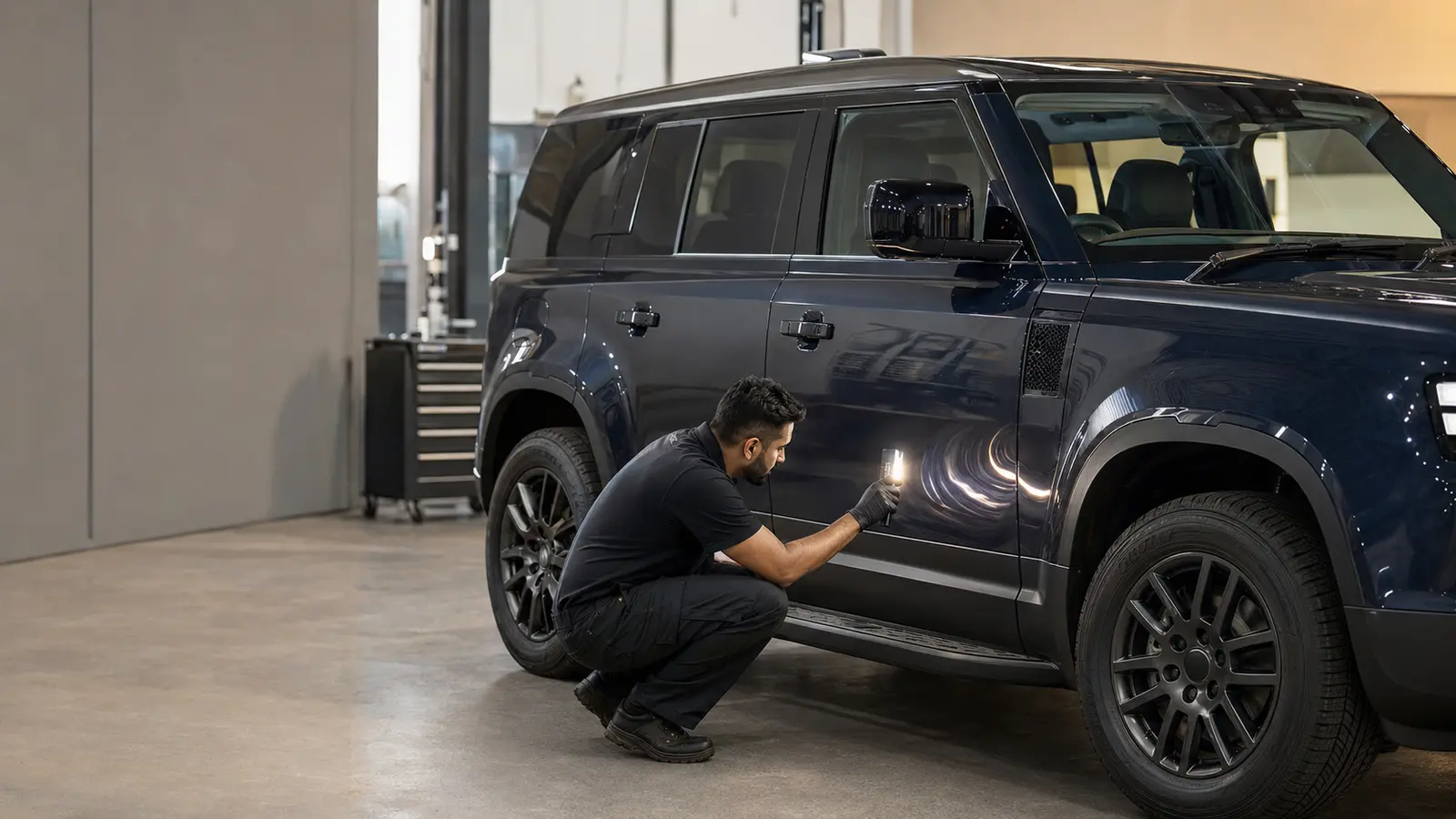
A tall SUV can hide the route of a parking impact across a bumper corner, wheel arch, lower door, sill or tailgate. We inspect the complete damage path, explain what is known and separate any conditional checks before a repair plan is agreed.
For useful initial guidance, send one close image, one wider corner view, one photograph along the panel reflection and any warning message shown after the incident. Photographs help us prepare, but the final scope follows a physical inspection.
Tall-body geometry needs more than a close look at the scratch
Land Rover vehicles include different body sizes, shapes, construction methods and equipment packages. A compact SUV, a long-wheelbase model and a vehicle with extensive lower cladding do not present the same repair problem. We therefore avoid a model-wide assumption. The specific panel, damage position, adjacent attachments and available repair information guide the method. For impacts involving a rear spare-wheel carrier, side steps or roof accessories, our Land Rover Defender body repair guide explains how force can travel from the attachment into hinges, brackets and body openings.
Height affects how body damage is noticed. A shallow wave in a lower door may look minor while standing beside the vehicle, then become obvious when viewed from several metres away. A bumper corner can appear to have recovered after a light impact while its side guide remains displaced. A tailgate gap can look even from one height and change when followed upward toward the roof opening. The useful inspection moves around the vehicle and changes eye level.
That broad view is important for accident work and smaller car-park incidents. Our body-repair service covers panels, bumpers and accident damage generally. On this page, the focus is the way tall SUV proportions, lower-body exposure, large openings and trim layers influence the assessment.
The aim is not to dismantle every vehicle. It is to use the damage evidence to decide where access is justified. Fresh contact marks, changed gaps, loose trim, a displaced corner, water entry, dust trails or an opening that no longer closes normally can each point toward a wider check. If those signs are absent, a local repair may remain proportionate.
Read the body from upper openings to the contact-prone lower edge
The zones connect. Damage at a wheel arch may continue into the bumper guide or lower door. A rear-corner impact may affect the bumper, quarter-panel edge, lamp area, tailgate relationship and lower trim without making every item visibly broken.
Doors, hinges and long vertical reflections
Doors are inspected for dent boundaries, creases, paint cracking, edge contact and any change in the relationship with the adjacent fender, quarter panel, sill and roof opening. Opening and closing feel is noted without forcing a door that appears displaced.
- Follow character lines through neighbouring panels.
- Compare gaps while allowing for normal production variation.
- Check handles, mouldings and the lower door edge.
Wheel arches, cladding and bumper corners
These areas are exposed to kerbs, parking columns, trolley contact and low obstacles. Flexible trim may carry a scrape while a clip or retainer behind it has also moved. The paint, panel edge and attachment points are assessed as separate items.
- Look for a changed arch-to-tyre relationship.
- Check whether cladding sits flat along its full length.
- Trace a bumper gap upward and around the corner.
Tailgate, rear opening and lamp relationships
A rear-corner mark can cross several visual references. We view the tailgate perimeter, lamp alignment, quarter-panel edge, bumper top line and lower trim together. If the opening operation has changed, that becomes part of the assessment rather than a cosmetic afterthought.
- Inspect the complete perimeter, not one local gap.
- Record existing chips and edge marks before work.
- Identify nearby wiring and powered components where fitted.
Sills, lower covers and underbody clues
Off-road use, steep ramps and kerb contact can affect areas that are difficult to see from standing height. A scrape on a cover does not automatically prove damage behind it, but fresh distortion, missing fasteners or an unusual gap can justify closer access.
- Differentiate surface abrasion from a split or torn mount.
- Check adjoining shields and fasteners within the impact path.
- Escalate mechanical or structural concerns for suitable assessment.
Cladding can protect a surface and also hide the attachment story
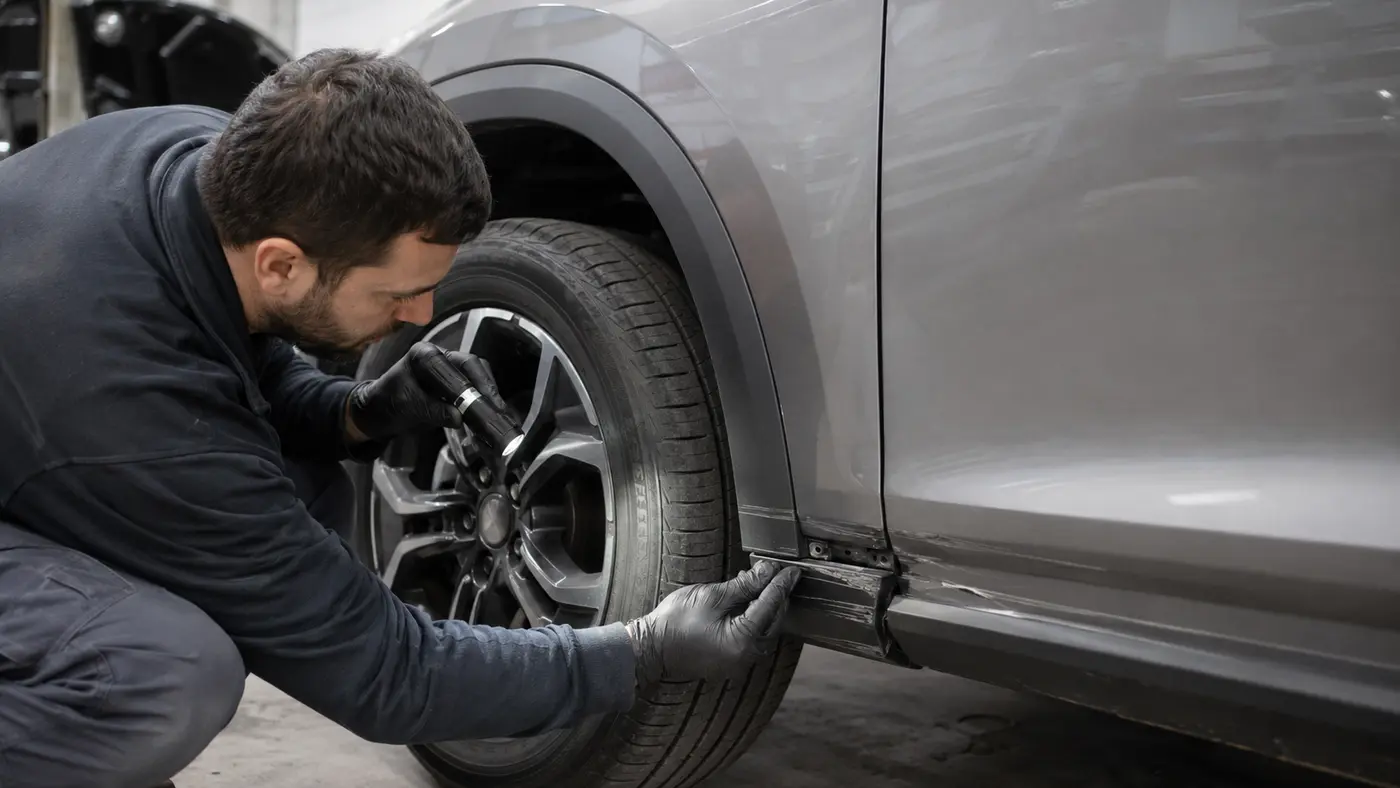
Wheel-arch mouldings, sill covers and lower bumper pieces can take the first contact from a kerb, ramp edge, rock or parking obstacle. A light surface scuff may need only a limited cosmetic plan. A cover that is bowed, loose or sitting away from the body introduces a second question: is the trim itself distorted, is a clip damaged, or has the mounting edge moved?
We avoid judging the panel beneath from the plastic surface alone. Removal is considered when the evidence supports it, especially where the cover no longer seats correctly, fasteners are missing, a panel edge is exposed or the contact route continues behind adjoining pieces. Existing dirt patterns can sometimes help show recent movement, but they are treated as clues rather than proof.
A hard strike near a wheel can also create driving, tyre, suspension or alignment concerns outside a cosmetic body repair. A changed steering feel, tyre contact, warning message, unusual wheel position or fluid loss should be reported immediately. The vehicle should not be driven simply to obtain an estimate when safety is uncertain.
- Photograph the complete side before cleaning away contact marks.
- Show the obstacle height if it is safe and useful to do so.
- Do not push loose cladding back if a broken edge may catch underneath.
- Report any new sound, vibration, warning or steering change.
What looks local can follow a bracket, edge or opening
Surface recovery can conceal a displaced guide
A flexible bumper cover may spring partly back after contact. We look for a corner that sits proud, a gap that widens, paint transfer at an attachment line or movement when lightly checked. Where access is warranted, retainers, guides and nearby mounts can be inspected rather than guessed.
A low strike can cross materials and visual lines
Contact can start on arch trim, continue across a painted edge and finish along the lower door or sill. Each part can have a different repair decision. The visible scrape is mapped as one route, then divided into trim, paint, metal and attachment conditions.
Tailgate fit is read around the full perimeter
A local rear-corner impact can alter the relationship between the bumper, quarter panel and tailgate without creating the same gap change everywhere. We follow the opening around both sides and across the top, then consider hinges, latch behaviour, seals and powered functions only where relevant.
Large openings must close, align and seal as a system
A dent can be local to an outer surface, but a door or tailgate is also an opening with edges, hinges, a latch and sealing surfaces. The assessment records whether the panel operates normally, whether a gap has changed and whether the impact reaches an edge or attachment point. We do not force an opening merely to complete a checklist.
For a suitable shallow dent with intact paint and safe access, paintless dent removal may be considered. Sharp body-line creases, cracked coating, stretched metal, damaged hems or restricted access can make another method more sensible. The dent-removal page explains the broad options, but the actual panel construction and damage decide the route.
Tailgate work deserves the same restraint. Adjustment is not a cure for every uneven gap, and replacing one trim piece does not correct a moved mounting edge. The cause should be understood before a component is shifted. Where cameras, lamps, powered hardware or sensors are near the repair, their mounting and handling requirements are identified for the particular vehicle.
Aluminium may be present, but no universal body assumption is safe
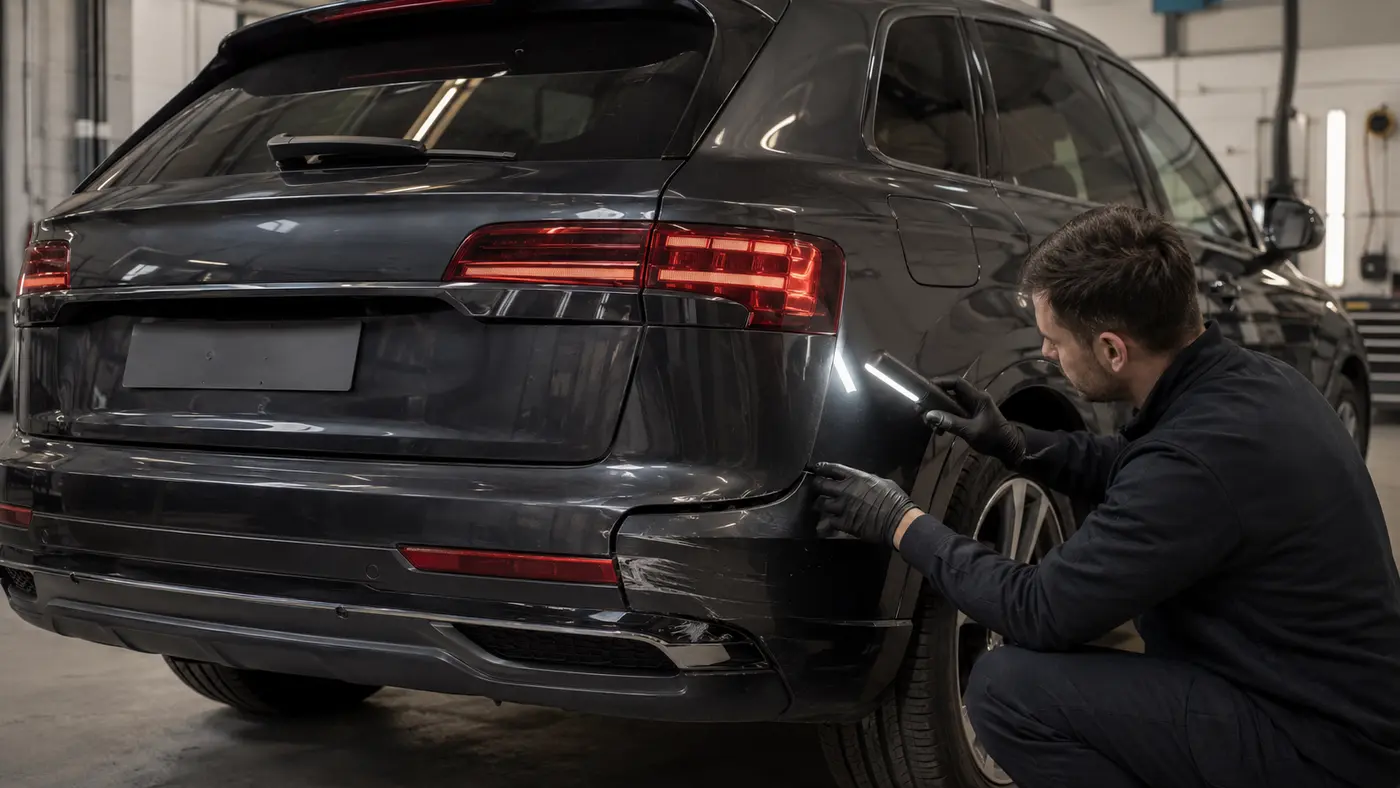
Some Land Rover vehicles and components use aluminium, while construction varies by model, year, position and specification. A badge does not identify the material of every outer panel, reinforcement or attachment. The repair plan should be based on the actual component and applicable information.
Aluminium can respond differently from conventional steel during reshaping. Stretch, tears, access, edge condition, heat sensitivity and previous repairs influence whether controlled repair is sensible. Contamination control can also matter when working with different metals. These are reasons for identification and planning, not reasons to claim that every dent needs replacement.
Composite, plastic and coated trim parts require their own judgement. A bumper cover may be repairable in one condition and unsuitable in another. A moulding may look reusable but have damaged retainers. A part may appear cosmetic while also providing a mounting location for nearby equipment. The condition and function must both be considered.
First identify
Confirm the affected component, repair zone and available access. Do not select a method from the vehicle name alone.
Then test the repair logic
Consider deformation, stretching, cracks, tears, edges, mounting points, previous bodywork and any limits in applicable repair information.
Finally explain the decision
Show why repair, replacement or further access is proposed. A clear reason is more useful than a blanket material claim.
Sealing checks belong in the body repair conversation
Doors and tailgates sit against seals, drainage routes and finished opening edges. An impact near an opening can disturb fit without creating an obvious hole. Water marks, wind noise, damp trim, dust trails or a change in closing effort can provide useful evidence.
We do not promise universal water-tightness testing or make a capability claim from the page. The responsible approach is to record symptoms, inspect the affected opening and determine what check is appropriate for the actual repair scope.
Useful checks around an affected opening
- Check seals for cuts, flattening, movement or trapped residue.
- Inspect the flange and painted edges for distortion or exposed coating.
- Confirm trim, weatherstrip and drains are seated correctly.
- Safely test normal door or tailgate travel and latch operation.
- Record powered-opening or warning concerns and any specialist check required.
The better decision protects shape, fit and proportionate intervention
Repair is not automatically the cheaper shortcut, and replacement is not automatically the higher-quality answer. The decision should consider the full condition of the component, the ability to restore its function and appearance, the intervention required and any model-specific limitations.
Repair may be considered when
- Deformation is within a controlled and accessible area.
- Edges, hems and mounting points remain suitable.
- Cracks, tears or stretching do not compromise the intended result.
- Previous work does not undermine the new repair zone.
- The finish can be restored without disproportionate intervention.
- Applicable repair information permits the proposed method.
Replacement may be more sensible when
- Damage reaches critical edges, mounts or complex reinforced areas.
- A plastic or composite part is torn through an unsuitable zone.
- Metal is severely stretched, split or repeatedly folded.
- Previous filler, corrosion or earlier damage materially changes the basis.
- Repair labour and disturbance become disproportionate.
- Applicable information directs replacement for the condition found.
A bumper skin or arch cover can hide a split guide, bent bracket, damaged fastener, contact mark, disturbed wiring support or moved panel edge. These are possibilities, not assumptions. If access reveals a new fact, it should be photographed and explained before the additional scope proceeds.
Colour match, texture and reflection must work across large surfaces
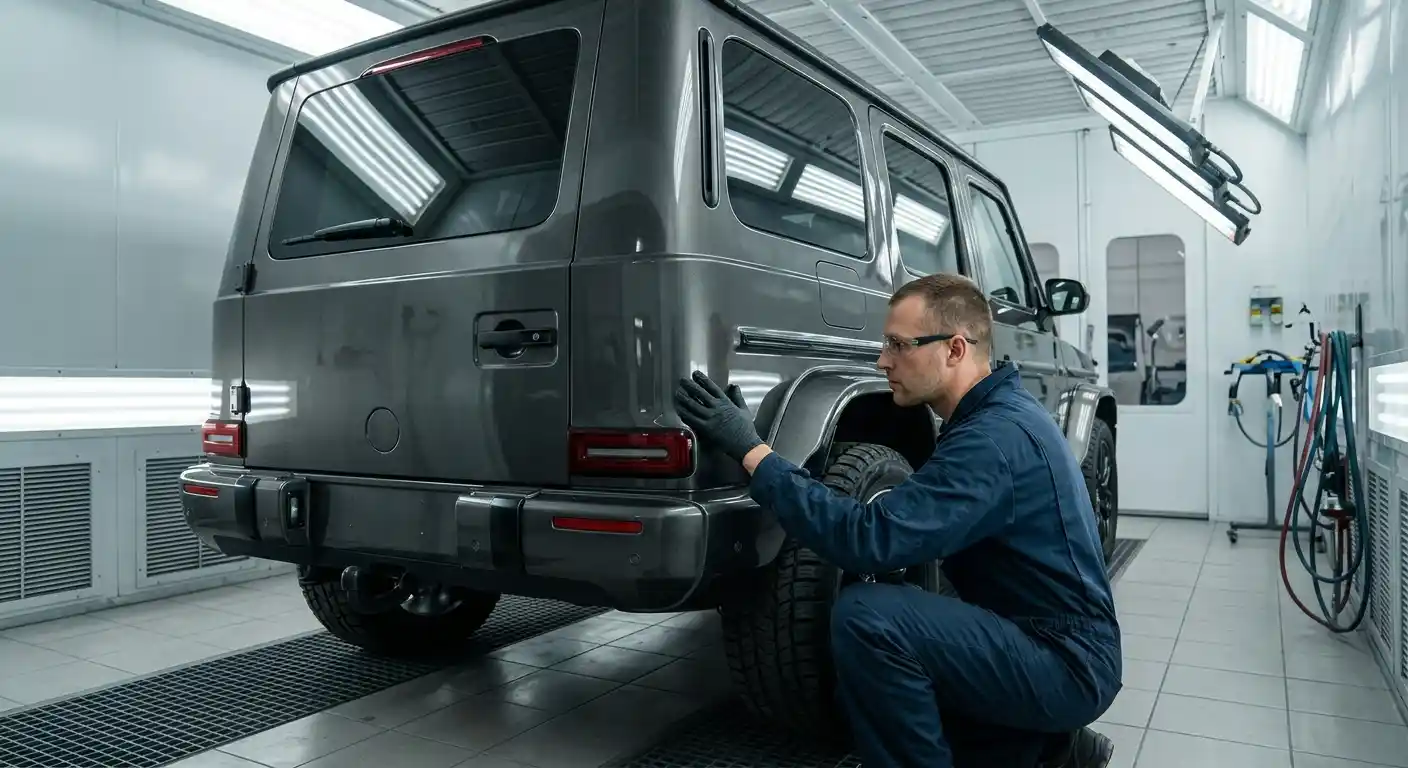
A paint code is a useful starting reference, but it cannot establish an invisible match by itself. Sun exposure, age, previous refinishing, metallic or pearl orientation, application technique and panel angle can alter how colour is perceived. Tall doors and broad quarter panels create large reflection fields, so shape and finish must be judged together.
Preparation comes first. A glossy coating cannot correct an inaccurate surface underneath. Repaired contours, edges and transitions are reviewed before refinishing. When blending is technically appropriate, its purpose is to manage the visual transition into a neighbouring area, not to disguise poor colour preparation.
Our car-painting service explains refinishing more broadly. For a Land Rover repair, practical final checks include colour behaviour at different angles, gloss, texture, overspray control, clean trim edges and consistency along the full side or corner.
Directional inspection light
Helps reveal shallow waves, sanding marks, edge mapping, texture changes and metallic control that flat light can miss.
Diffuse workshop light
Supports a broad review of gloss, coverage, surface continuity and cleanliness across a large panel.
Natural daylight when practical
Adds a useful real-world comparison before handover, while recognising that weather and viewing conditions vary.
Normal viewing distance
Confirms whether the complete side, arch or rear corner reads coherently rather than only passing a close inspection.
From first evidence to final walk-around
Consistency comes from decision points, not from giving every vehicle the same operations. The scope can be simple or extensive, but each stage should explain what is being checked and why.
We collect photographs, incident details, warning messages, driving concerns and insurance status. Safety concerns are identified before a workshop journey is suggested.
The complete stance, damaged surface, gaps, trim and nearby components are inspected. Known work and conditional access are separated.
The proposed repair, likely parts, hold points and documentation needs are explained. Owner or insurer authorisation is obtained as applicable.
Relevant covers or trim are removed only where justified. Concealed findings are recorded and the plan is updated before additional work proceeds.
Reshaping, fitting, preparation and paint operations follow the confirmed condition. Nearby cameras, sensors and wiring are handled according to the specific scope.
Panel fit, trim seating, affected openings, surface, colour, gloss, texture and cleanliness are checked. Any external or follow-up requirement is documented.
Keep the repair scope understandable at both ends

Useful information for an insurance repair
- Vehicle details and a concise description of the incident.
- Police or accident documentation where applicable.
- Insurer and policy details if the work is a claim.
- Wide and close photographs taken before temporary cleaning.
- Warning messages, unusual noises, fluid loss or driving changes.
- Relevant previous repairs to the same area, if known.
Coverage, excess, parts policy and final authorisation depend on the individual policy and insurer. We can document the condition and prepare a repair scope, but we do not promise coverage on an insurer’s behalf.
A useful collection checklist
- View the repaired area from several angles and a normal distance.
- Follow door, arch, bumper and tailgate gaps around the affected zone.
- Check colour behaviour, gloss, texture and surface continuity.
- Confirm that disturbed cladding, trim and seals sit correctly.
- Operate involved doors or the tailgate where applicable.
- Ask what was repaired, replaced and checked after reassembly.
The handover should also identify aftercare advice, any documented limitation and any separate procedure still required. A clear explanation matters as much as a clean vehicle.
Follow the repair route from surface to structure
A Land Rover estimate should distinguish painted panels from textured cladding, bumper covers, retainers and opening alignment. Tall surfaces and lower protective pieces can make one impact cross several repair decisions.
Surface and small dent
From AED 150 for light bumper polish. Small paintless dent repair is about AED 150 to AED 350, while a medium dent is about AED 350 to AED 700 when paint and access suit the method.
Shape and panel finish
AED 700 to AED 1,200 or more is a planning band for a larger conventional dent with paint. Panel painting starts from AED 450. Large doors and quarter surfaces may need a wider colour plan.
Bumper and lower pieces
Plastic repair plus paint is about AED 500 to AED 1,200. A complete bumper repaint is about AED 600 to AED 1,500. Bumper replacement is about AED 1,200 to AED 6,000 or more.
Opening or structural concern
Confirmed structural or chassis work is broadly about AED 2,000 to AED 5,000 or more. Door, tailgate and sealing checks can add operations even when structural work is not required.
Where a full exterior refinish is genuinely being considered, an SUV repaint starts from AED 3,500. That figure should not be substituted for a local repair estimate. The quotation should name the affected materials, state which cladding or trim is removed, and separate confirmed parts from provisional allowances.
Indicative only: inspection is required. Land Rover make and model, material, parts, finish, hidden damage and current market conditions affect the final quote. A price band does not prove that concealed attachments, seals or alignment are undamaged.
Land Rover body repair FAQ
These answers explain the assessment logic. A physical inspection remains necessary for the confirmed method, parts scope, timing and price.
Can you estimate Land Rover body repair from photographs?
Photographs can support initial triage when they include close, wide and reflection-angle views. They cannot reliably show every dent boundary, hidden retainer, opening relationship or impact route. A workshop inspection is needed before the final method, parts and price are confirmed.
Why can a small bumper-corner impact need a wider inspection?
A flexible bumper cover can partly recover while a side guide, clip, bracket or nearby mounting edge remains displaced. Changed gaps, movement, contact position or loose trim can justify inspection behind the cover. This access is evidence-led, not automatic for every surface scuff.
Can a dent on a Land Rover door be repaired without repainting?
Paintless dent removal may be considered when the coating is intact, the dent shape is suitable and safe access is possible. Sharp creases, stretched material, damaged edges, reinforced zones, cracked paint or previous repairs can make another method more appropriate.
Do all Land Rover vehicles have aluminium body panels?
No universal assumption should be made. Construction varies by model, year, component and specification. Some vehicles and parts use aluminium, while other materials may be present elsewhere. The affected component should be identified before the repair method is selected.
Can scraped wheel-arch cladding be repaired?
The decision depends on the trim material, finish, depth of damage, distortion and condition of its clips or mounting points. A light cosmetic mark may permit a limited solution, while a split, warped or poorly seated piece may make replacement more sensible.
What should be checked after a tailgate-area impact?
The visible damage is reviewed together with the bumper line, quarter-panel edge, lamps, tailgate perimeter, latch behaviour, seals and any nearby powered components. The exact scope depends on the impact evidence. An uneven gap should be traced around the full opening before adjustment is proposed.
What if water or dust appears after the accident?
Report it before repair and, if possible, photograph the location. Seals, flanges, drainage routes, trim seating and opening fit may require inspection. The suitable check depends on the affected area and symptoms, so the page does not promise one universal test.
Can metallic or pearl Land Rover paint be matched in Dubai?
A colour code provides a starting reference. Application control, spray-out evaluation and visual checks help refine the result. Sun exposure, age, previous refinishing, panel shape and metallic or pearl orientation can affect appearance, so colour, gloss and texture are reviewed together.
What happens when a camera or parking sensor is near the repair?
The device and its mounting area are identified before work. Removal, refitting, inspection and any diagnostic or calibration requirement are then confirmed for the specific vehicle and repair scope. We do not assume one requirement applies to every bumper or panel repair.
How long does Land Rover body repair take?
Timing depends on inspection, access, parts availability, insurer authorisation, repair complexity, curing stages and quality checks. A local dent may be quicker than work across a bumper, arch and door. A more useful time estimate follows the confirmed scope.
Can you assist with an insurance claim repair?
We can inspect visible damage, document the condition and prepare a repair scope for the process. Coverage, excess, parts policy and final authorisation remain subject to the individual policy and insurer decision. Bring the relevant accident and insurance documents when booking.
What should I check when collecting my Land Rover?
View the repair from different heights, angles and a normal distance. Check panel shape, paint appearance, gaps, bumper and cladding seating, involved openings, seal fit and cleanliness. Ask what was repaired or replaced and whether any aftercare or follow-up applies.
Arrange a Land Rover body assessment in Dubai
Send clear photographs and a short incident description, or bring the vehicle to Al Quoz 4 for an inspection-led discussion. We will separate the visible repair from conditional access and explain the next decision before the scope proceeds.