
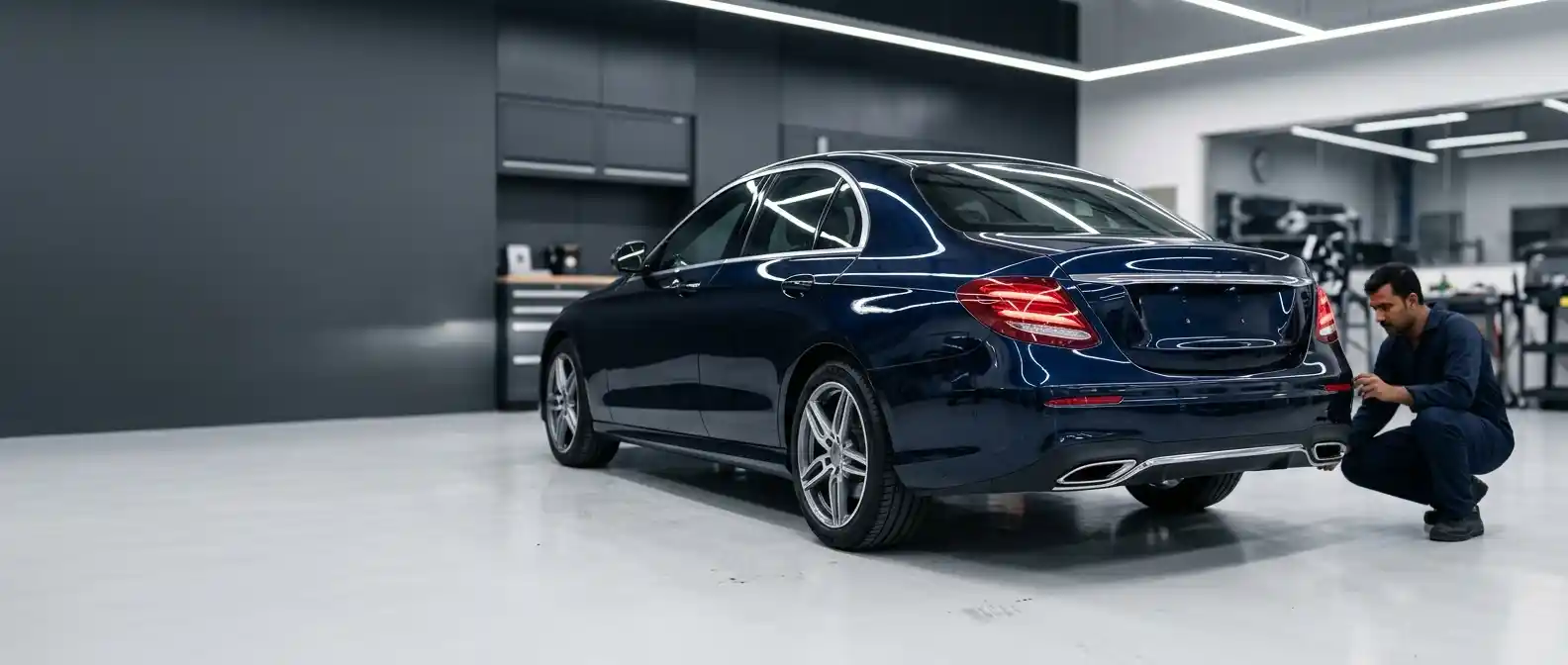
Independent E-Class panel and paint control in Dubai
Mercedes-Benz E-Class Body Repair Dubai
The E-Class needs more than a straight panel and a fault-free scan. Its lamp graphics, brightwork, quiet closures and flowing saloon surfaces form one visual system. Our repair ledger pairs every visible relationship with the measurement or function that proves it.
E-Class workshop decision map
Use a closure and light ledger to make the repair accountable
Each row links a visible relationship to hidden causes and closure evidence. The order changes with the impact, but no row is approved from appearance alone.
An executive saloon reveals errors through quiet details
Owners often notice an E-Class repair because a door closes differently, a lamp graphic steps across the boot, or a long reflection bends near a character line. Those details are captured at reception. They provide a better baseline than a general statement that the car was fine before the accident.
We ask which function changed and under what condition. A warning photographed in full, a video of normal closure effort or a wide image across the rear can preserve useful evidence. Unsafe driving tests are never requested when steering, suspension, cooling, restraint or tyre risk is possible.
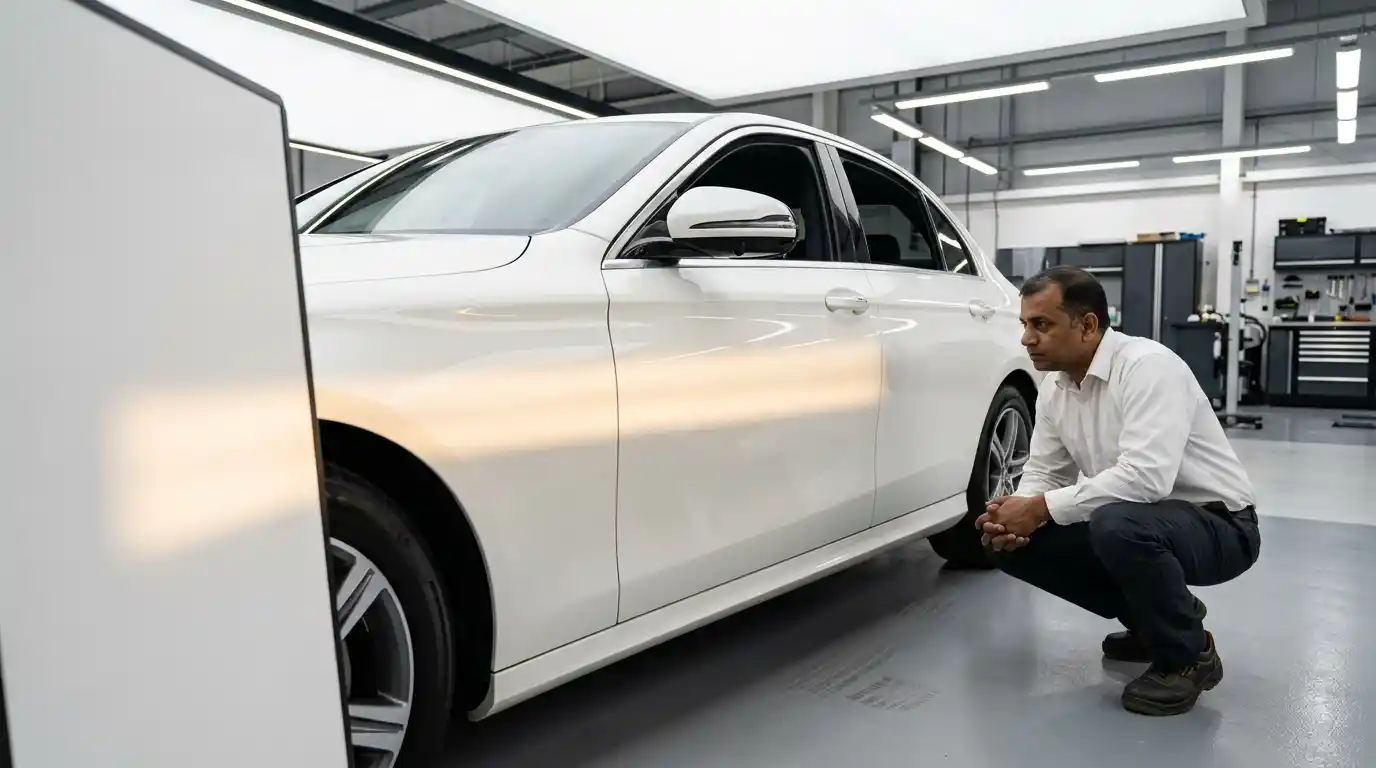
E-Class front wing reflection-board inspection
The current E-Class may use an illuminated radiator shell and different exterior lines. That makes the grille, lamp, bonnet, front wing, apron and bright trim dependent on one another. A replacement face must be right for the car’s package before paint or wiring transfer begins.
We assess mounting pockets and panel references before using adjustment to make a component appear centred. Linear reflection light across the front wing reveals crown, edge and surface errors that ordinary workshop light can hide.
Star-look rear lamps create a clear alignment test
Mercedes-Benz describes split LED rear lamps that connect visually through the centre of the current E-Class. A rear impact can disturb the outboard lamp, boot-lid element, aperture or bumper guides independently. The ledger records every step in that graphic.
Boot effort, latch engagement, gaps and seal contact are measured before adjustment. Moving a striker too early may hide aperture distortion. After repair, the lamp line, panel flushness and closure behaviour must agree without forced fit or an improvised water seal.
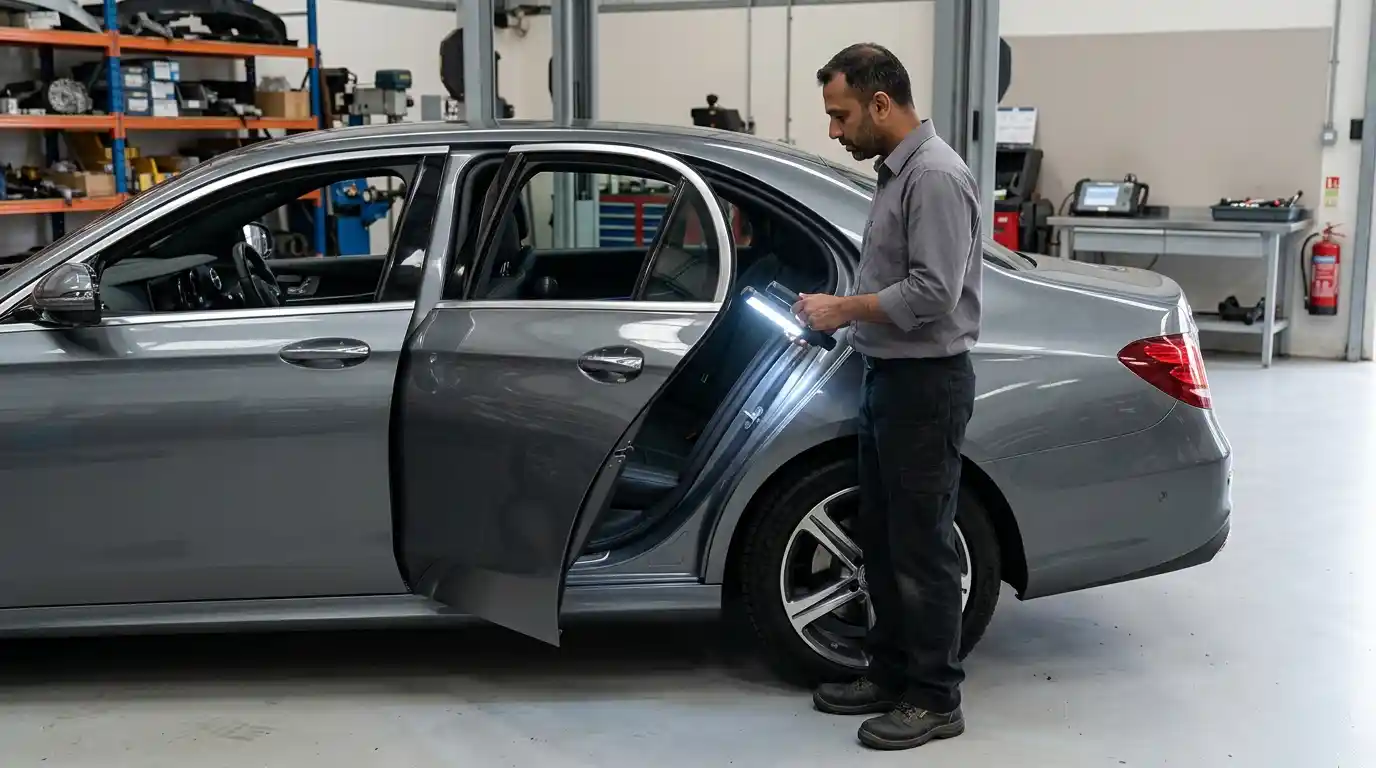
E-Class door and B-pillar alignment check
An E-Class can be equipped with acoustic glass and additional body insulation. When a side repair involves door trim, glass, seals or mirror hardware, reassembly affects more than appearance. Rattles, air leaks and changed closing sound belong in the quality plan.
We catalogue clips, membranes, absorbers and sealing paths before removal. Door-to-B-pillar gaps, flushness, glass movement and pinch protection are checked using the applicable procedure. A newly painted door is not complete if the owner inherits wind noise or a trim vibration.
Parking functions rely on the repaired surroundings
Mercedes-Benz lists parking packages with active, remote and memory functions depending on configuration. The exact E-Class equipment is identified at intake because the body shop cannot assume every vehicle carries the same cameras, sensors or software.
Physical checks cover bracket angle, aperture shape, wiring and camera view. Diagnostics follow, but they do not replace geometry. Any calibration or initialisation occurs only after the body, tyres and wheel alignment satisfy the conditions required for that operation.
Corner-impact evidence
Wheel and body evidence are joined after a corner impact
A scrape that reaches the wheel arch prompts a tyre, rim and suspension review. The panel contact is considered together with steering position, tyre clearance and any relevant measurement result, so alignment evidence remains connected to the impact.
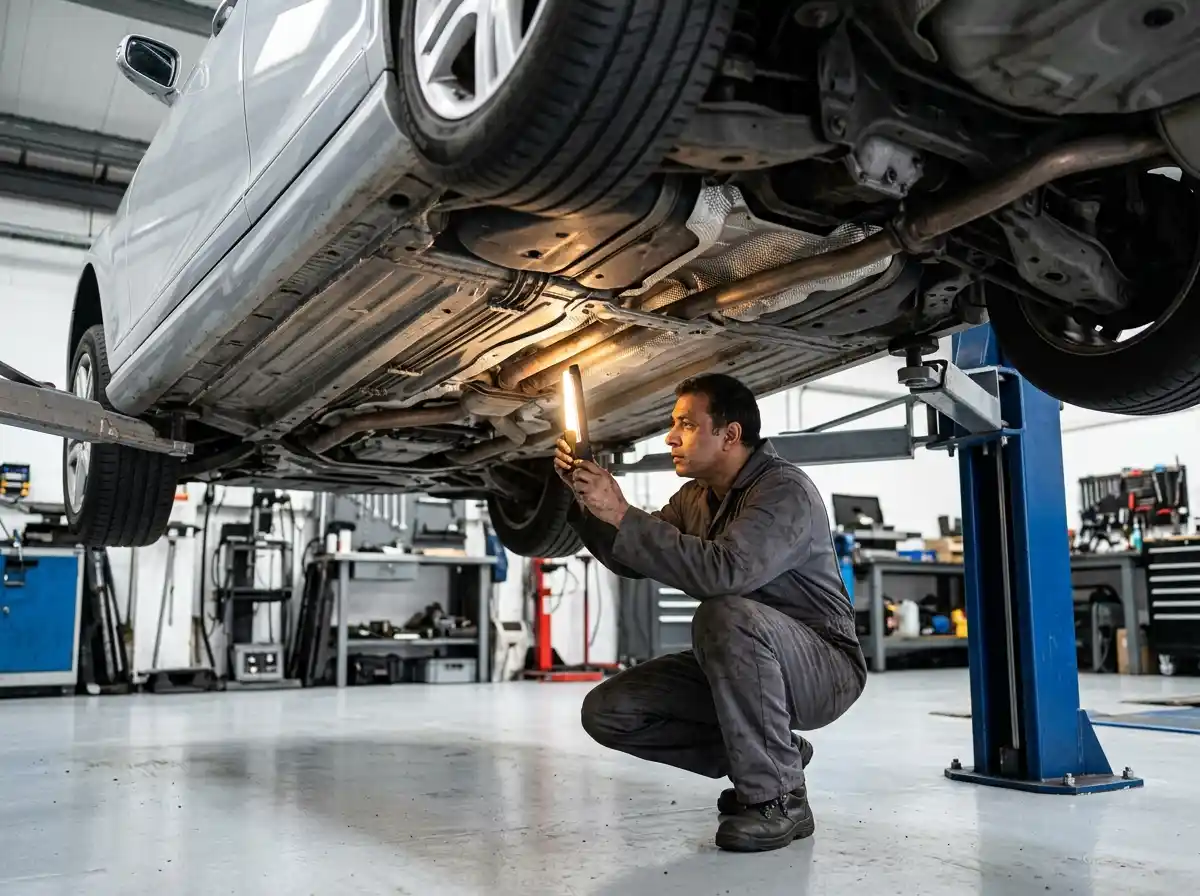
E-Class underside inspection on lift
Lower contact, a wheel-corner strike or a loose shield can leave service clues beneath the visible body. With the E-Class supported at approved lift points, the technician checks undertrays, mounting points, fasteners, fluid traces and clearances before the exterior repair is closed.
The underside image and findings are linked to the reported impact rather than treated as a general inspection. Cosmetic refinishing waits when a shield, suspension reference or containment concern still needs a defined repair path.
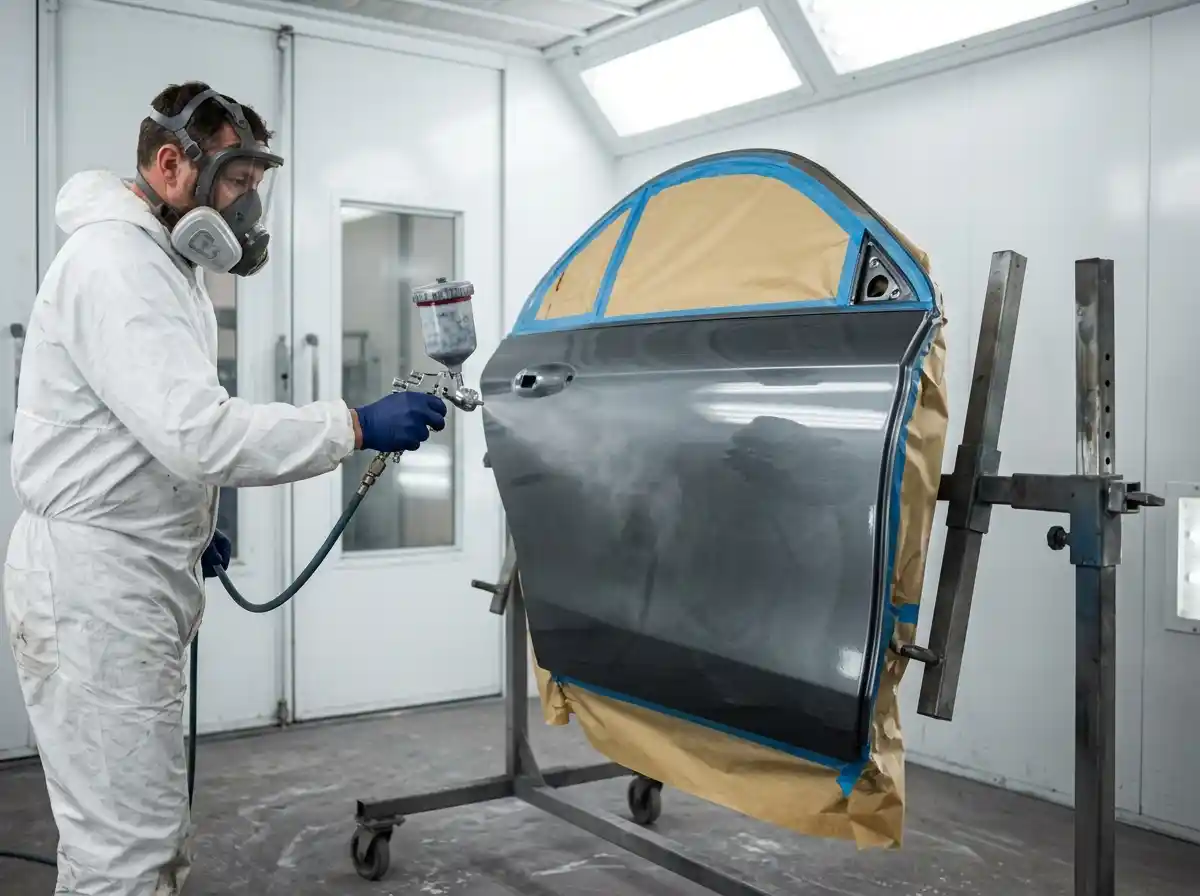
E-Class door repaint in the spray booth
The E-Class side and bonnet present broad reflections beside chrome or dark trim boundaries. Paint code, instrument reading and spray-out comparison help choose a formula, while adjacent-panel viewing decides the blend plan. Previous refinishing can change that decision.
Controlled preparation, masking, airflow and application support the colour result, but final review still separates colour from clear-coat quality. Face tone, flop, metallic orientation, gloss, orange peel and edge coverage are checked under more than one light direction.
Bright trim must not be used to disguise a gap
Chrome-look strips and black packages can frame a panel so strongly that a small misalignment becomes obvious. Trim is therefore installed onto established body references, not used as a flexible cover for unevenness. Distorted clips and stretched retainers are renewed when required.
The technician checks the whole run rather than one joint. A locally perfect join can create a step at the next door or lamp. Photographs taken before removal help restore the intended relationship and identify pre-existing movement.
Repair route after full finishing
Repair choice depends on stability after finishing
Repair may be supported when the material can regain durable shape, access suits the permitted method, and the panel edges and mounting points remain sound.
Replacement is considered when deformation remains unstable, a critical pocket is cracked, corrosion protection cannot be restored reliably, or repair limits are exceeded.
Transfer labour, clips, adhesives, paint preparation, programming and verification are included where applicable. The cheapest bare component is not automatically the least costly completed route.
The quotation uses evidence rather than a single lump sum
Visible damage, dismantling risk, body work, parts, refinishing and verification appear as understandable groups. A photograph can support preliminary scope, but hidden carriers and sealing paths may require authorised access. Supplements include new evidence and an explanation.
Timing follows approvals, part confirmation, production gates and curing. No universal E-Class turnaround is promised. Owners receive milestone updates when a dependency changes instead of a date that silently moves.
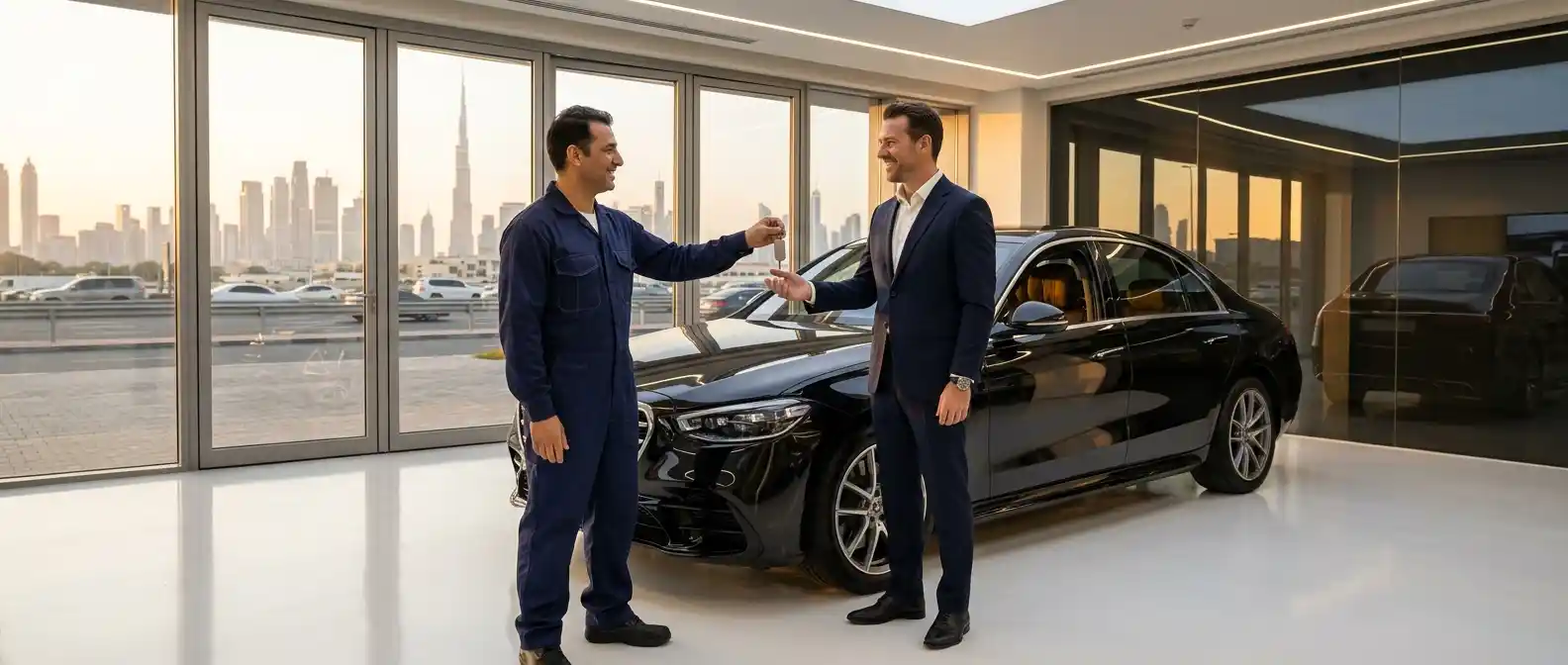
E-Class body repair complete — vehicle handover
The completed car is checked against the original complaint and the five device rows. Lamps, grille, boot, doors, seals, parking hardware, wheel corner and paint continuity are reviewed in the sequence relevant to the accident. Cleaning follows, not leads, the inspection.
Supporting records may include component identity, hidden images, seal checks, spray-out approval, alignment, scans and calibration evidence. The handover names deferred or pre-existing conditions. That protects both the owner and the integrity of the repair claim.
Related pages remain responsible for broader topics
The planned Mercedes-Benz body repair hub covers brand-wide questions. Detailed panel reconstruction belongs on the body repair service page. Refinish preparation and matching are handled through our automotive painting service.
This page earns its place only by addressing E-Class closure, lighting, quietness and equipment relationships. It should not duplicate the parent page’s complete service explanation.
The official E-Class source defines the supported claims
The Mercedes-Benz UAE E-Class overview describes the split star-look lamps, available illuminated grille and configuration-dependent parking and assistance packages. Those details explain the ledger’s priorities.
Sales information does not authorise a repair method. The car’s VIN, physical construction, build state and current repair documentation control parts, joining, calibration and system-specific procedures.
Aftercare protects the repaired relationships
Product-specific guidance covers early washing, pressure distance, adhesive cure and any coating or film limitation. The owner is asked to observe the repaired closure and trim during normal use. Unusual noise, movement, warning or water entry should be reported promptly.
At collection, examine the vehicle under shade and daylight. Operate only the features discussed during handover and review the paperwork beside the invoice. A calm, evidence-led collection is more useful than a hurried key exchange.
Bonnet and grille relationships are checked before trim
A front contact may shift the bonnet edge or latch reference while leaving chrome pieces visually dominant. We measure the painted opening first, then fit grille and decorative elements to that established geometry. Trim cannot become the ruler for body repair.
Latch engagement and secondary retention receive functional checks after adjustment. If the bonnet does not close normally, repeated force is avoided. The cause is found through hinge, latch, aperture and support evidence rather than trial-and-error slamming.
A camera view needs a clean and correct window
Parking or assistance cameras can be affected by a cracked lens cover, moved housing, paint edge or replacement grille. The workshop verifies cleanliness, physical seating and the surrounding reference before analysing the displayed image or diagnostic status.
A clear picture on the screen is not sufficient if the field has shifted. Where an approved calibration process applies, it follows body and wheel corrections. The result is saved with the repair file instead of being reduced to a verbal statement.
Boot water management belongs in rear repair
Rear impacts can disturb seals, lamp gaskets, vents, seams and drain paths. We inspect dry evidence before washing removes clues. Water testing, when justified, uses a controlled method and records the entry route rather than flooding the whole rear body.
- Boot and aperture seals
- Lamp gaskets and body vents
- Seams, cavities and drain paths
- Connectors and trim backing
- Dry evidence before cleaning
- Controlled water-test entry route
The boot trim is refitted only after the relevant cavities and connectors are dry and secure. Additional sealant is not applied over an unidentified leak. A clean luggage compartment at collection must also be a correctly managed one.
Business use changes communication, not repair limits
An E-Class owner may rely on the car for daily appointments, chauffeur work or family travel. The workshop therefore explains which milestones control release and which delays are still uncertain. Convenience never authorises incomplete curing or skipped verification.
Updates identify the completed gate, next dependency and any choice requiring approval. This is more useful than repeating an estimated completion date. A substitute travel plan can then be made around evidence rather than hope.
Night inspection complements daylight review
The star rear graphic, illuminated front elements and lamp colour are easier to compare after dark, while paint and panel shape require strong neutral light. Quality control uses each condition for the feature it can reveal. One lighting environment cannot approve everything.
The final walk-around therefore combines functional illumination, close mounting review and broad daylight reflection. This mixed evidence suits the E-Class better than a single polished photograph inside the workshop.
Seat and restraint evidence stays outside cosmetic assumptions
A side or rear collision can raise questions that body appearance cannot answer. Airbag messages, belt behaviour and occupant-system faults are recorded without clearing them at intake. Deployed or suspect restraint components require the appropriate technical route.
Trim removal around repaired openings is controlled so connectors and interior surfaces are protected. The body shop does not declare the restraint system safe from a scan alone. Completed operations and unresolved specialist requirements are stated separately at release. The collection file identifies which warning belonged to the reported impact, which check was completed and which condition still needs authorised diagnosis.
Build the first ledger from clear evidence
Send a wide front, side or rear view, close photographs of the contact, the nearest lamp and closure gaps, plus the full instrument message. Tell us if sound, effort, parking behaviour or steering changed.