
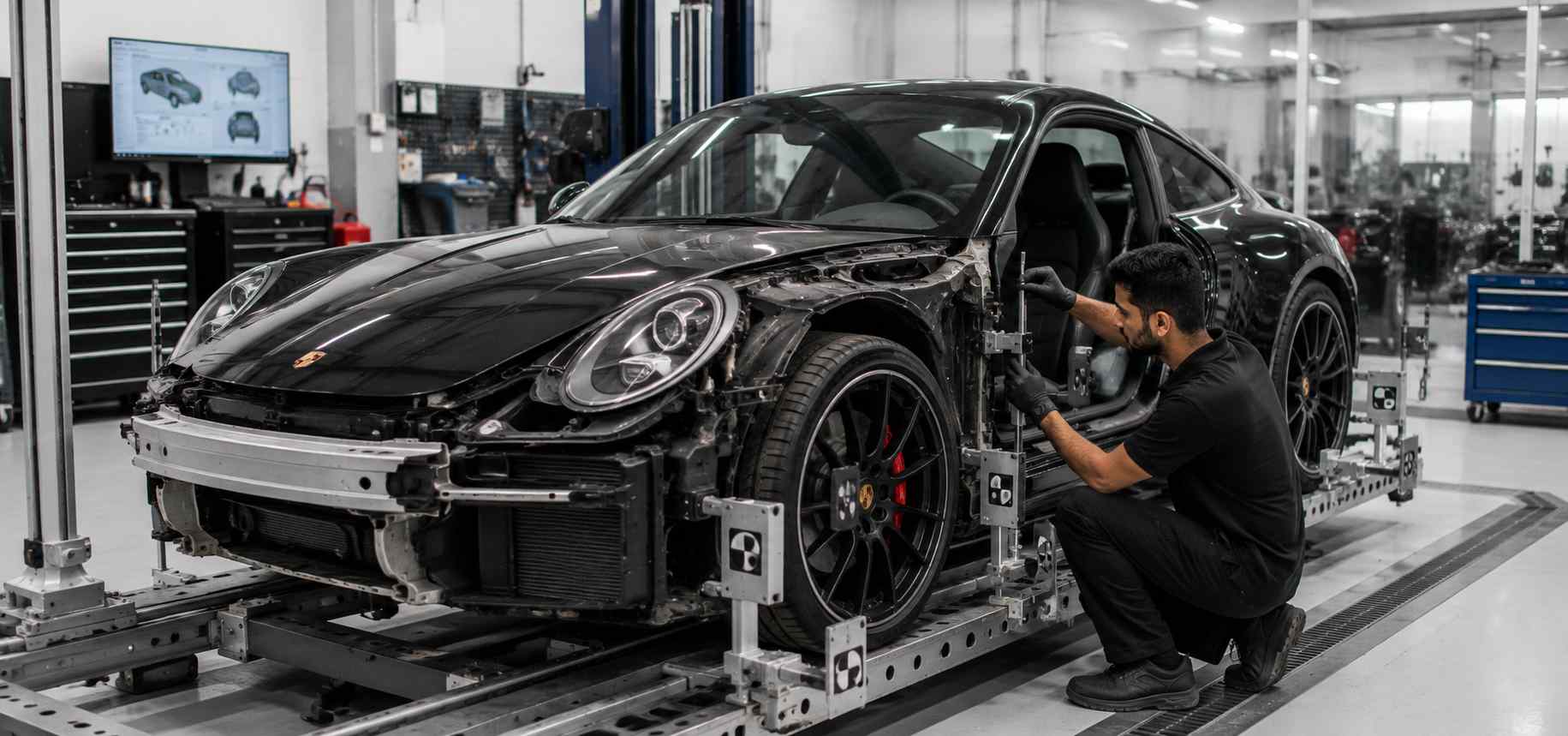
911 impact routing from body surface to mechanical boundary
Porsche 911 Body Repair Dubai
Porsche 911 body repair in Dubai needs a different inspection map at each end of the car. A front strike can reach low air paths and wheel references, while a rear contact approaches the engine zone, exhaust-adjacent hardware, lamps and deployable aerodynamic parts. The repair scope follows the contacted end and stops wherever specialist mechanical evidence is still required.
Safe intake before repair planning
The contact end decides the first safe action
Photographs can help plan access, but they cannot certify that a low sports car is safe to drive after a collision.
A 911 with a loose front underbody piece raises a different risk from one with a hot smell or fluid trace after rear contact. Intake records where force entered, the driver’s immediate observations and whether the car was moved. We do not ask the owner to reproduce a warning or operate damaged hardware for diagnosis.
Changed steering, tyre contact, fluid loss, smoke, unusual heat, restraint warnings or unsecured bodywork call for controlled inspection and possibly recovery.
911 two-end boundary map
Do not apply a front-end repair sequence to the rear
The five checkpoints divide low-front, wheel-corner and rear-engine-adjacent questions. This keeps paint work from crossing an unresolved mechanical, thermal or aerodynamic boundary.
Ground-level evidence
Low front damage is photographed near ground level
Complete impact context
The first image shows the complete front with both wheels, followed by a safe low view of the contacted apron or shield. The object or kerb is included when it can be photographed without reaching beneath the vehicle.
Hidden route and hardware
This reveals impact height and direction that a close picture of paint transfer cannot supply. On the lift, technicians trace damaged fasteners, underbody panels, air guides and neighbouring mounts.
Verified closure
A front skin may look correctly aligned while a duct or lower profile remains displaced. Closure evidence is recorded before covers hide the route.
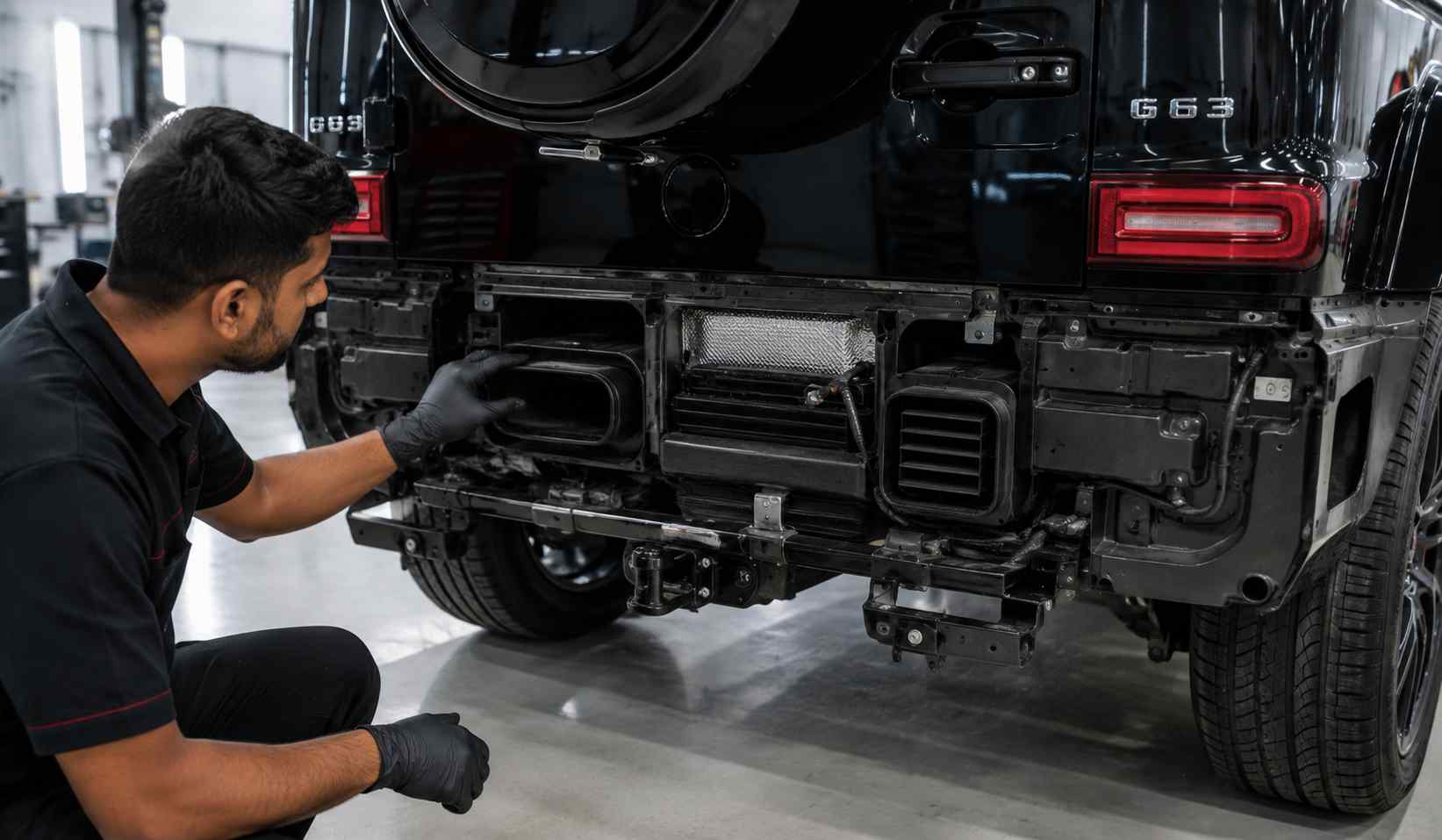
Front airflow and hidden hardware
Cooling openings remain a separate workstream
An opening in the 911 front is not assumed to be decorative. The installed derivative and physical components establish whether ducts, shutters, radiators or seals lie behind the damaged area. Removed pieces are labelled so orientation and sealing are restored rather than improvised during final assembly.
A finished bumper photograph cannot prove the hidden route. If leakage, temperature warnings or damaged cooling hardware are present, road use and mechanical release follow the relevant specialist process. The body scope states that boundary instead of implying that fresh paint resolved it.
Wheel-corner evidence must precede panel refinishing
A strike near the wheel prompts tyre, rim, liner, clearance and steering checks. The 911 body line can make a wing or quarter dent visually dominant, but mechanical evidence determines whether cosmetic production can begin. Alignment information is used when impact direction and findings support the need.
Numbers are interpreted with tyre condition, ride height and the repair stage. A scan cannot reveal every distorted mount, and a green alignment screen cannot approve arch shape. The final file connects the original contact to the specific mechanical and body decisions.
Rear thermal and mechanical boundary
Rear contact approaches a different thermal environment
Rear context and installed-variant inspection. The 911’s rear-mounted engine is an official model characteristic, so a rear collision is not treated as the mirror image of a front one. Bumper carriers, exhaust-adjacent trim, cooling paths, lamps and deck or spoiler hardware are examined according to the installed variant. Heat-damaged or contaminated pieces are not hidden behind refinished panels.
Mechanical boundary and release before movement. Specialist mechanical findings remain outside the body shop’s unsupported assumptions. If a leak, abnormal odour, warning or altered engine operation appears, the boundary is escalated before movement. Exterior reassembly waits for the required release.
Deployable aero needs geometry before movement
Where movable aerodynamic hardware is fitted, intake establishes its resting condition without repeated cycling. A shifted deck surface, bracket or bumper relationship can interfere even when a motor still responds. Damage is documented before any approved functional procedure is attempted.
The body opening, mounts, wiring and clearances are corrected first. Paint build and replacement-part fit also matter because small dimensional changes can create rubbing. Final operation is recorded on the actual configuration rather than inferred from a generic 911 feature list.
Evidence-led repair routing
Trace the 911 clue toward the contacted end
A 911 front impact and rear impact must not share one collision sequence.
Low front⌄
Apron, cooling, lamps, wheel corners and lower attachments
Rear⌄
Engine-area boundary, deck, active aero, lamps and quarters
Side or roof⌄
Door aperture, glass, roof variant and restraint evidence
A related Porsche model can require a different repair path. For the wider brand-level body, panel and paint route, use the published Porsche body repair service.
After this 911 evidence is collected, the accident repair service manages the wider collision scope and authorised work.
Rear-quarter surface control
Wide rear quarters demand disciplined reflection control
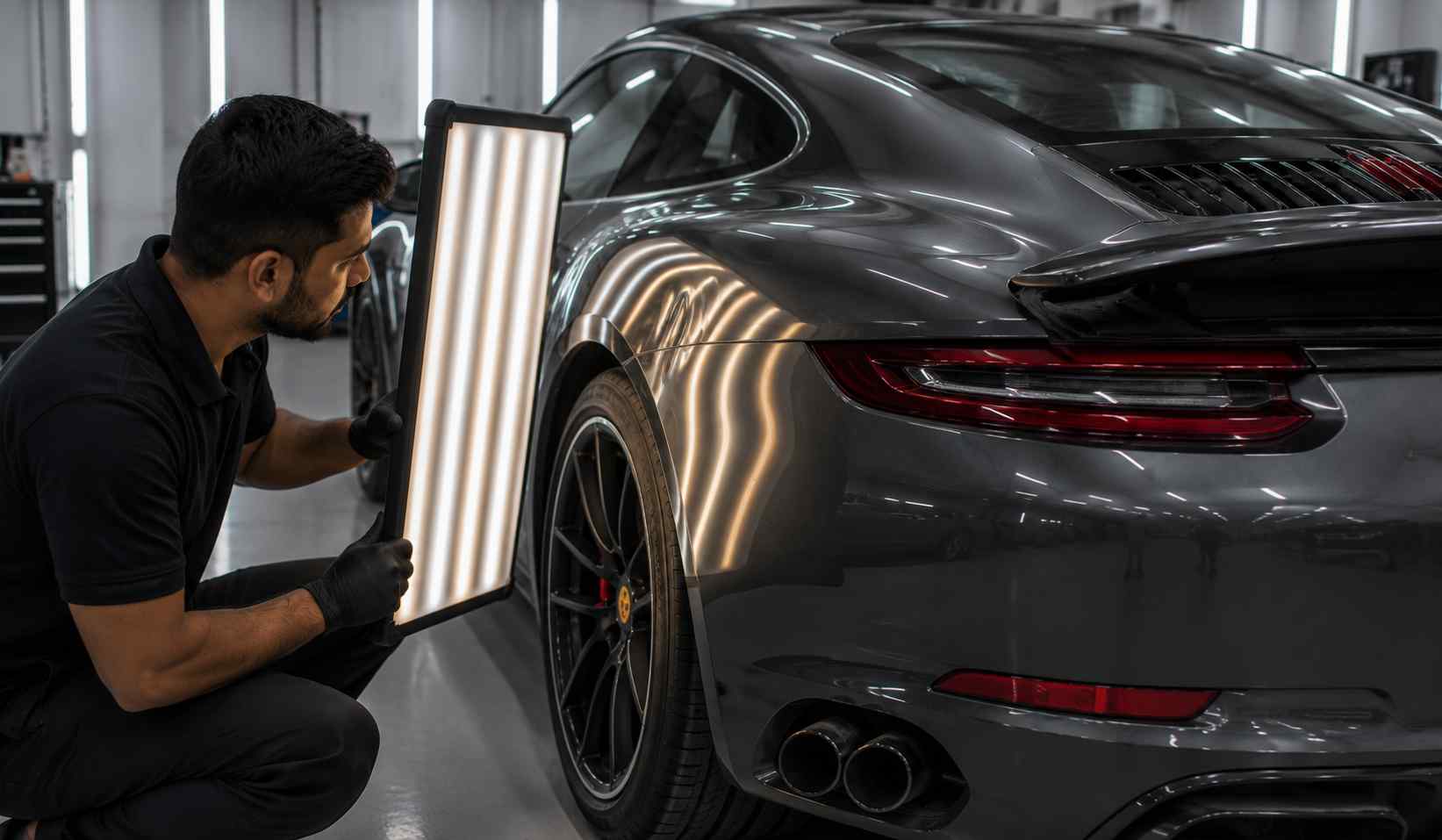
A 911 rear quarter carries complex curvature around the wheel and into the lamp and deck areas. Line lighting reveals crowns and tension outside the obvious dent. The repair decision considers material, edge loading, access, previous work and the current permitted method rather than promising a technique from the footprint alone.
Trial fit of adjacent lamps, bumper edges and openings precedes paint when their relationships have changed. The completed contour is viewed from several heights and along the car, because a local repair can look correct straight on while the shoulder reflection remains broken.
Roof variants change the upper-body question
The 911 family includes coupé, cabriolet and Targa body types. Upper-side or roof-edge damage must therefore begin with exact body identification and fitted hardware. Glass borders, seals, roof movement and drain paths can create very different repair limits.
Powered roof components are not repeatedly operated through resistance. Exterior panel work is separated from any specialist roof-system requirement, and current instructions govern access. Water testing is targeted after likely paths are understood rather than replaced by excess sealant.
Colour and reflection approval
Paint formula is only one part of the match
Porsche colours can include solid, metallic, pearl and special finishes. The code, instrument readings and spray-out cards narrow the choice, while the existing vehicle reveals ageing, previous repair and texture. A blend is approved from the body relationship, not automatically added to every estimate.
Quality control reviews face and side tone, effect orientation, clear-coat texture, edge coverage and dust control. On a 911, curved panels make viewing angle especially important. The final surface must carry one coherent reflection into neighbouring areas.
Parts identity follows generation and derivative
Bumpers, lamps, ducts, spoilers, trims and mounts can change across 911 generations and variants. The VIN, removed part, connector count and physical apertures settle the order. An online image or broad description is insufficient for a component that controls airflow, fit or sensor placement.
New parts are inspected and dry-fitted where appropriate. Transfer items and one-use hardware are catalogued before they leave the vehicle. If supply changes the plan, the owner receives a revised dependency tied to a confirmed component rather than an optimistic date.
Installed result, not isolated panel cost
Repair versus replacement includes the installed outcome
A local repair may preserve factory fit when deformation is stable and the permitted method protects the substrate. Replacement becomes stronger when a critical mount is torn, a panel is kinked beyond the allowed operation or an aerodynamic item cannot retain geometry. The reason is written beside the decision.
Installed cost includes transfers, preparation, clips, electronics, alignment or calibration where applicable and the risk discovered after access. No unapproved 911 price is published. The estimate separates visible work from inspection-dependent boundaries so supplements remain explainable.
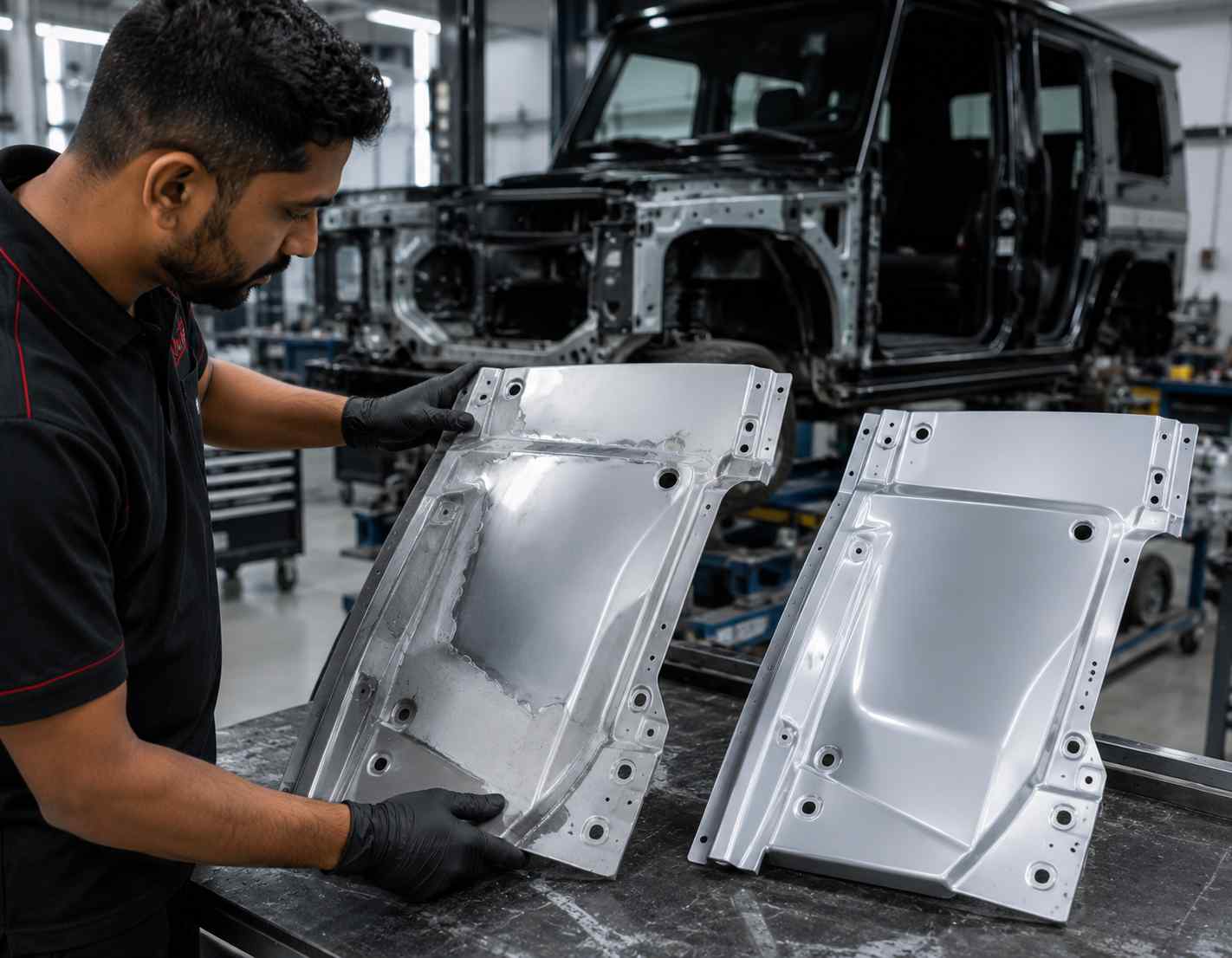
Configuration evidence and repair limits
Official Porsche information supports the rear boundary
Porsche describes the 911 Carrera with its flat-six engine positioned at the rear, while the range includes several body types and derivatives. That supports end-specific inspection and exact configuration identification.
The model page is not used as collision-repair authority. Current procedures, VIN data and physical evidence determine allowable operations. We do not claim a material, joining method or calibration requirement from sales copy, and this independent workshop page does not imply Porsche authorisation.
Return to the original evidence
Quality control retraces the contacted end
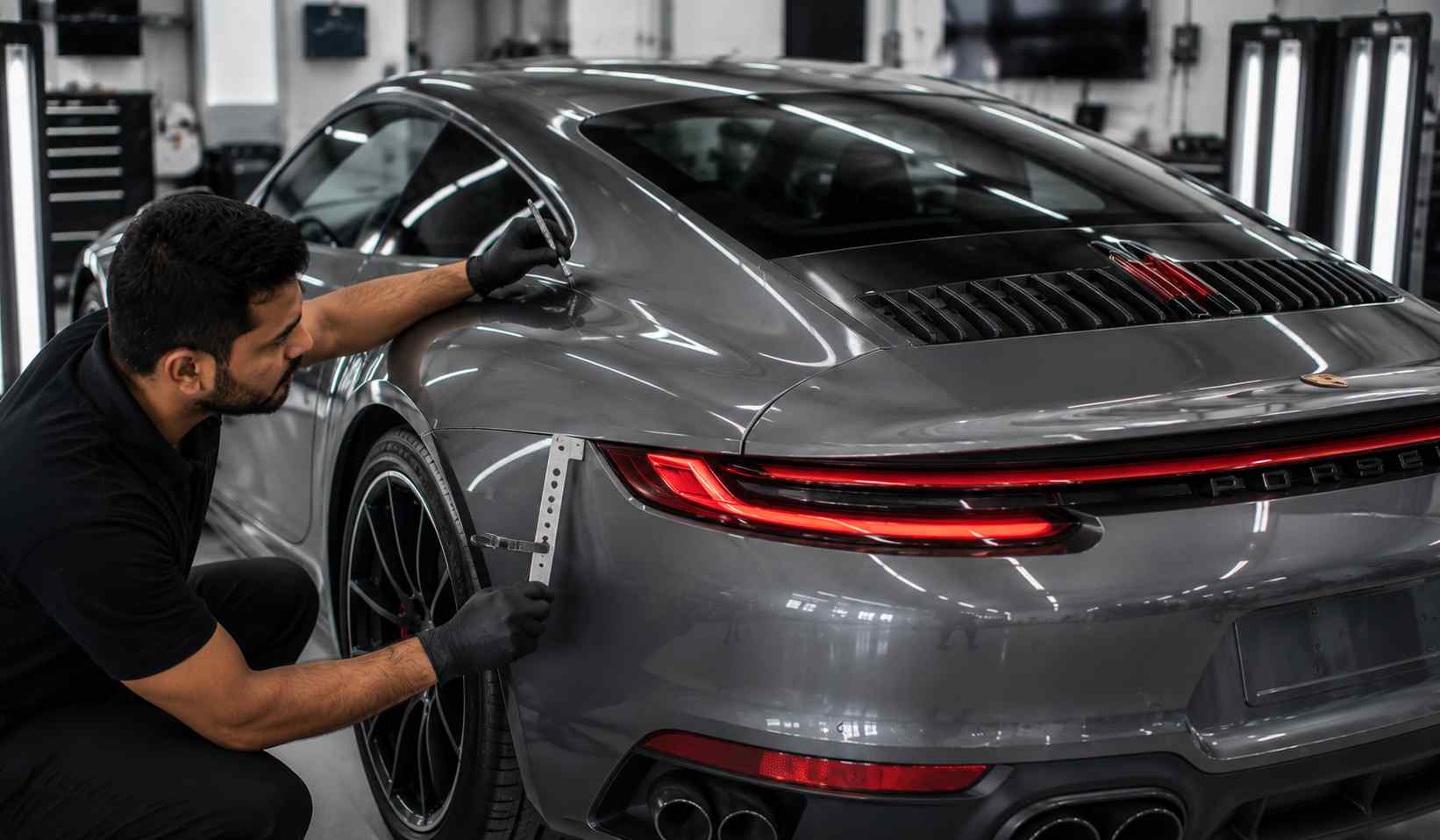
The final reviewer begins at the original mark and follows the same route through lower hardware, wheel reference, panel form, opening fit and relevant function. Rear work adds lamp, deck, aero and thermal-adjacent checks that a front repair may not need. The sequence remains evidence-led rather than symmetrical.
Available documents can include dismantling images, parts identity, body measurements, spray-out approval, alignment or diagnostic records and specialist releases. Pre-existing issues are separated from the completed repair. That gives the owner a usable handover rather than a collection of unrelated printouts.
Controlled checks after body production
Four boundaries that need separate evidence
A sports-car road test needs a defined question
Road use after repair is not an automatic ritual. It is authorised only when safety prerequisites are satisfied and a specific observation cannot be completed statically. The route, driver and conditions are selected for that check, never for performance demonstration.
Many acceptance points are better proved in the bay, including gaps, lamp seating, aero clearance, wheel torque and warning status. A controlled process protects the 911 and produces clearer evidence than an informal drive followed by a verbal assurance.
Fixed glass work is coordinated with body geometry
Damage near the windscreen, rear glass or quarter glazing requires the surrounding opening to be understood before bonding work begins. The glass is not used to pull a distorted aperture into shape. Trim and seal evidence is recorded before removal.
Preparation, bonding and cure conditions follow the applicable system. Water management and camera-related work, where relevant, remain separate checks. The vehicle is not released for normal use until the adhesive and body requirements have both been satisfied.
Track accessories are documented without assumptions
A 911 may arrive with non-standard splitters, wings, wheels, protective film or suspension components. Intake records markings, mounting method and existing condition. The workshop does not assume an accessory belongs to the original build or shares factory repair limits.
Removal, refit and outside specialist input are written into the estimate. An accessory cannot be reattached to an unverified mount simply to reproduce the arrival appearance. Any change to aerodynamic or road-use suitability remains clearly stated.
Protective film can conceal and preserve different evidence
Paint protection film may tear, stretch or hold loose coating after contact. Its edge and age are recorded before removal. The underlying paint can reveal a different damage footprint from the visible mark, while adjacent protected areas may have aged differently from exposed paint.
Replacement film is planned only after the coating has completed the required cure and inspection. Film fit does not approve colour or panel shape. The quotation distinguishes paint work, film removal and film installation so each result has a clear acceptance point.
End-specific handover guidance
Aftercare follows the repaired end of the car
Front work may require attention to lower clearances and newly fitted shields, while rear work may add heat-adjacent trim, deck or spoiler observations. The handover guidance names the relevant components instead of giving a generic sports-car warning.
The owner should report a loose lower piece, changed movement, renewed warning, fluid trace or finish defect without driving to reproduce it. Photographs and the condition in which it appeared help the workshop choose a safe inspection path.

Start with the complete impact context
Identify the contacted end before discussing the finish
Send the complete front or rear, a safe low view, the nearest wheel, all warnings and any change in spoiler, deck or roof behaviour. We will map the body boundary and the specialist evidence still needed.