
Independent body and paint repair in Al Quoz 4
Rolls-Royce Body Shop Dubai
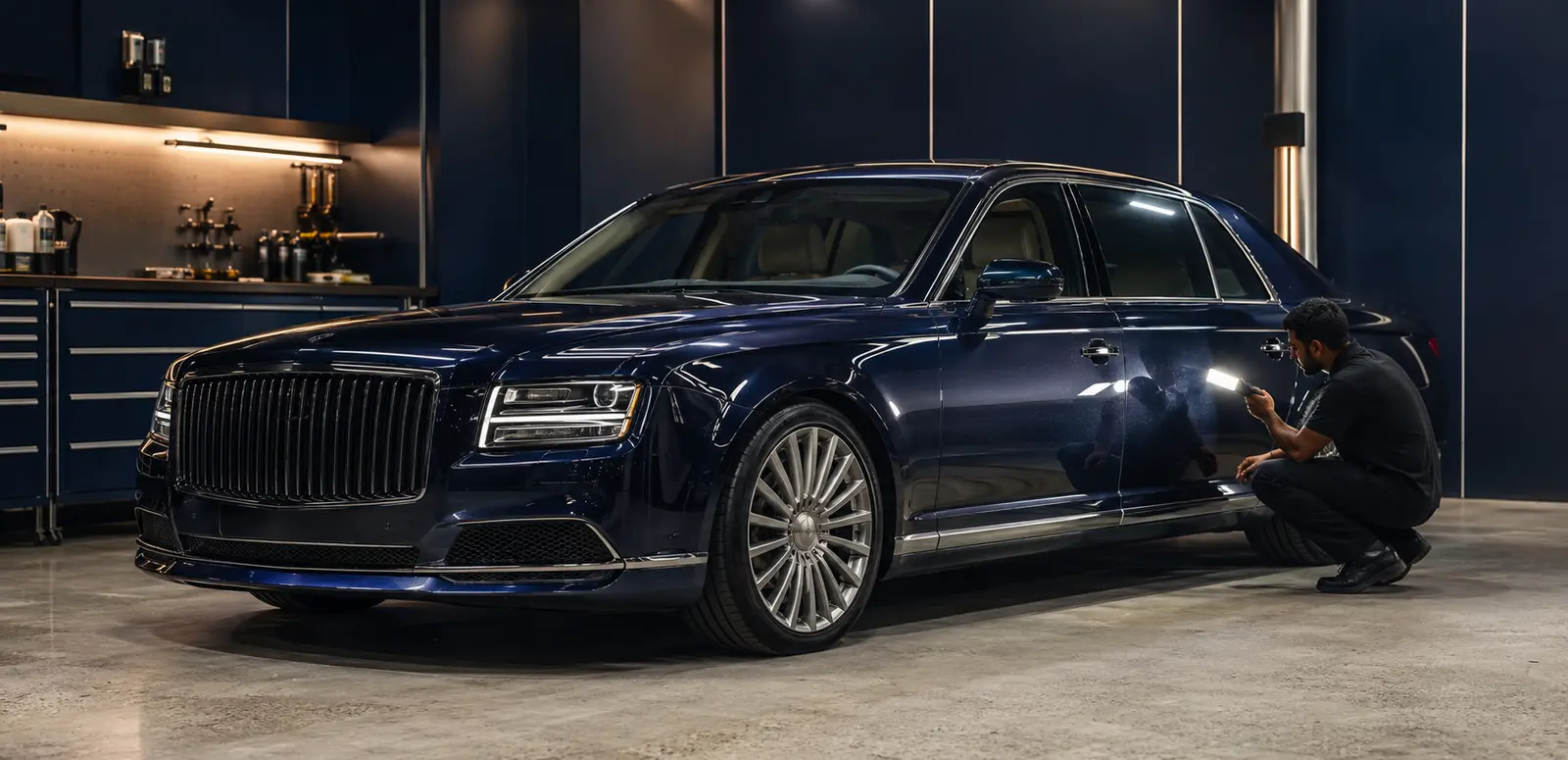
On a large luxury body, a repair is judged across the whole surface. Long reflections, calm closure lines, bright trim and paint depth all have to read together. We begin with the damaged area, then inspect the neighbouring panels and fittings that can affect the final result.
The standard is visual continuity
A small mark can disturb a much larger visual field
A Rolls-Royce body carries broad panels, restrained lines and extensive painted surfaces. A dent that occupies only a few centimetres can interrupt a reflection running across an entire door or quarter. A bumper corner can appear local, while the force has also moved a retainer, opened a panel gap or placed stress near a lamp or trim edge.
That is why the useful first question is not simply, “Can the visible mark be covered?” The better questions are: Has the panel shape changed? Are neighbouring closures still even? Is the coating damaged through its layers? Are bright trim, seals or mounts involved? Does the area flex or sit differently when viewed from more than one angle?
Our assessment is built around those questions. The aim is to define the damage accurately before choosing a method. For broader accident damage, the inspection may lead into a structured car body repair plan covering panels, fittings and finish rather than treating the first visible symptom alone.
Reflection principle: a finish can look acceptable under one ceiling lamp yet show a wave, sanding edge or colour shift in a longer line of light. We check the surface from several positions because the viewing angle changes what the eye can detect.
Body zones that deserve context
Where a careful inspection goes beyond the obvious mark
The repair plan changes with location. Large closures behave differently from bumper covers, and a bright trim edge can make a small alignment change easier to see. We do not assume construction, attachment or finish details are the same across every model or year. The vehicle and damaged component are inspected as presented.
Long doors and quarter panels
Broad side surfaces carry reflections over a long distance. We look for shallow distortion beyond the central dent, examine the relationship between door and quarter, and check whether the upper frame, lower contour or adjacent edge has moved. A door must also be considered as a closure, not just a painted skin.
Upright front and bumper corners
Corner contact may mark painted plastic, disturb trim, alter a mount or change the meeting point between bumper, wing and lamp. Scuffs alone can sometimes be refinished, but cracking, deformation or an unstable mounting point can change the sensible direction.
Bright trim, seals and fine edges
Polished or bright elements create strong visual reference lines. We inspect them for bends, pressure marks and disturbed clips, while nearby seals are checked for seating and possible water or wind concerns. Removal and refitting should be planned before paint preparation begins.
Closure and alignment assessment
A door repair must still behave like a door
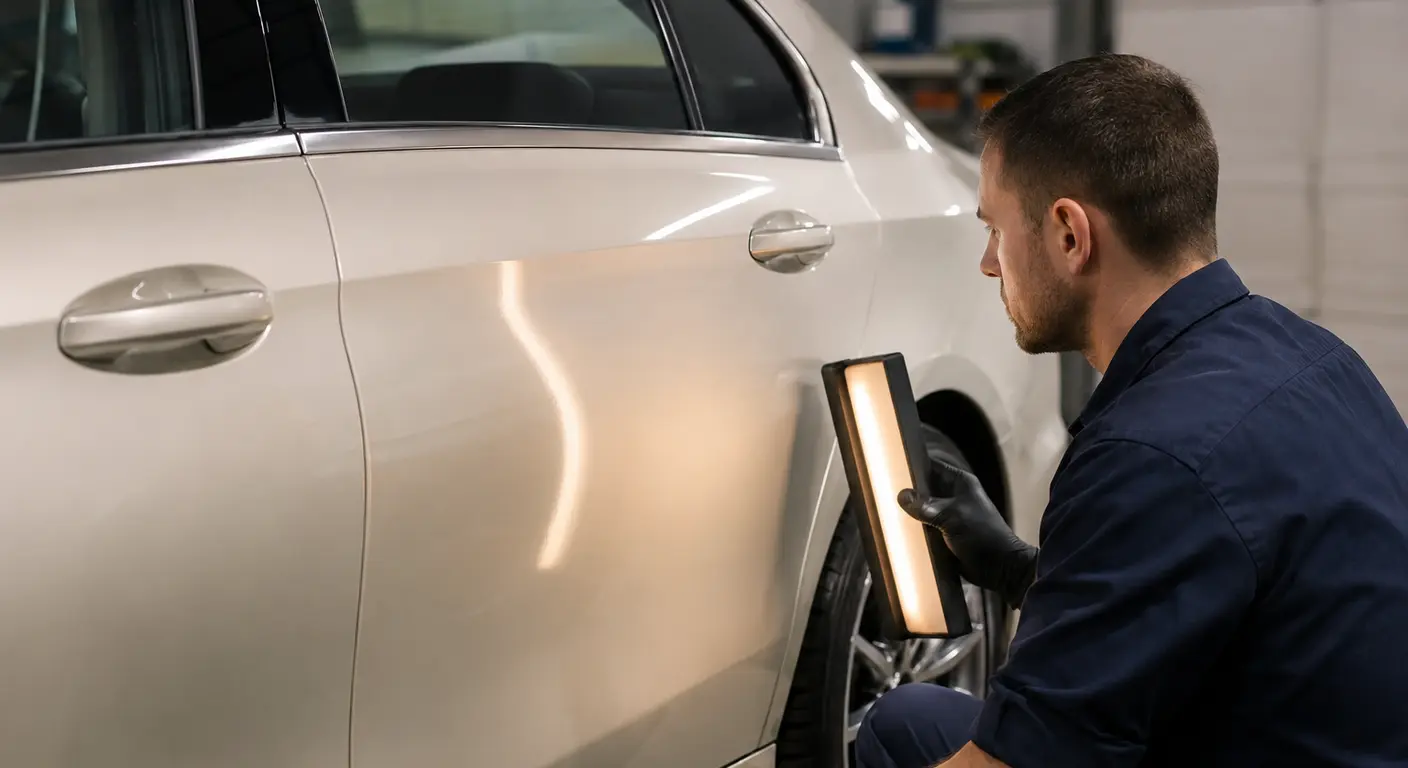
A large door can show damage in several ways. The outer surface may be dented, the edge may be chipped, a bright strip may no longer sit evenly, or the closure may feel different. The visible panel and the way it opens, latches and aligns are therefore considered together.
During the initial check we compare surrounding gaps, inspect accessible edges and watch the reflection across the panel. We also note any unusual resistance, noise or seal position. This does not mean every cosmetic dent has affected the closure. It means a repair decision should not ignore the possibility when the location or impact direction makes it relevant.
- Gap consistency at the front, rear, upper and lower door edges
- Flushness between the door and adjacent body surfaces
- Condition of handles, trim, seals and visible attachment points
- Paint damage at folds, edges and high-tension contours
- Any change in opening, latching or closing feel
Choosing the least disruptive sound repair
Repair or replace is a component decision, not a slogan
Owners often ask whether a panel or bumper should be repaired or replaced. There is no responsible universal answer. Access, material, damage depth, edge condition, previous work, attachment integrity, part availability and the expected finish all matter. The decision should follow inspection and be explained in terms of the actual component.
Repair may be considered when
- The panel or cover retains a recoverable overall shape
- Edges, mounts and neighbouring junctions remain serviceable
- Damage can be reached and corrected without creating disproportionate disturbance
- The proposed preparation supports a controlled paint result
- Previous repair material does not undermine the new process
For selected shallow dents with suitable paint and access, dent removal options can be assessed before conventional refinishing is chosen.
Replacement may enter the discussion when
- Cracks, tears, stretched areas or sharp folds limit stable correction
- Critical edges or attachment points cannot be restored sensibly
- Hidden damage changes how the component sits or is retained
- Earlier repairs have left excessive filler, corrosion or unstable coating layers
- The repair route creates more risk, time or disturbance than a suitable replacement route
Replacement still requires planning. The part must be identified correctly, fitted with attention to neighbouring gaps, prepared as required and refinished in relation to the surrounding vehicle.
Seen in the light, not just promised
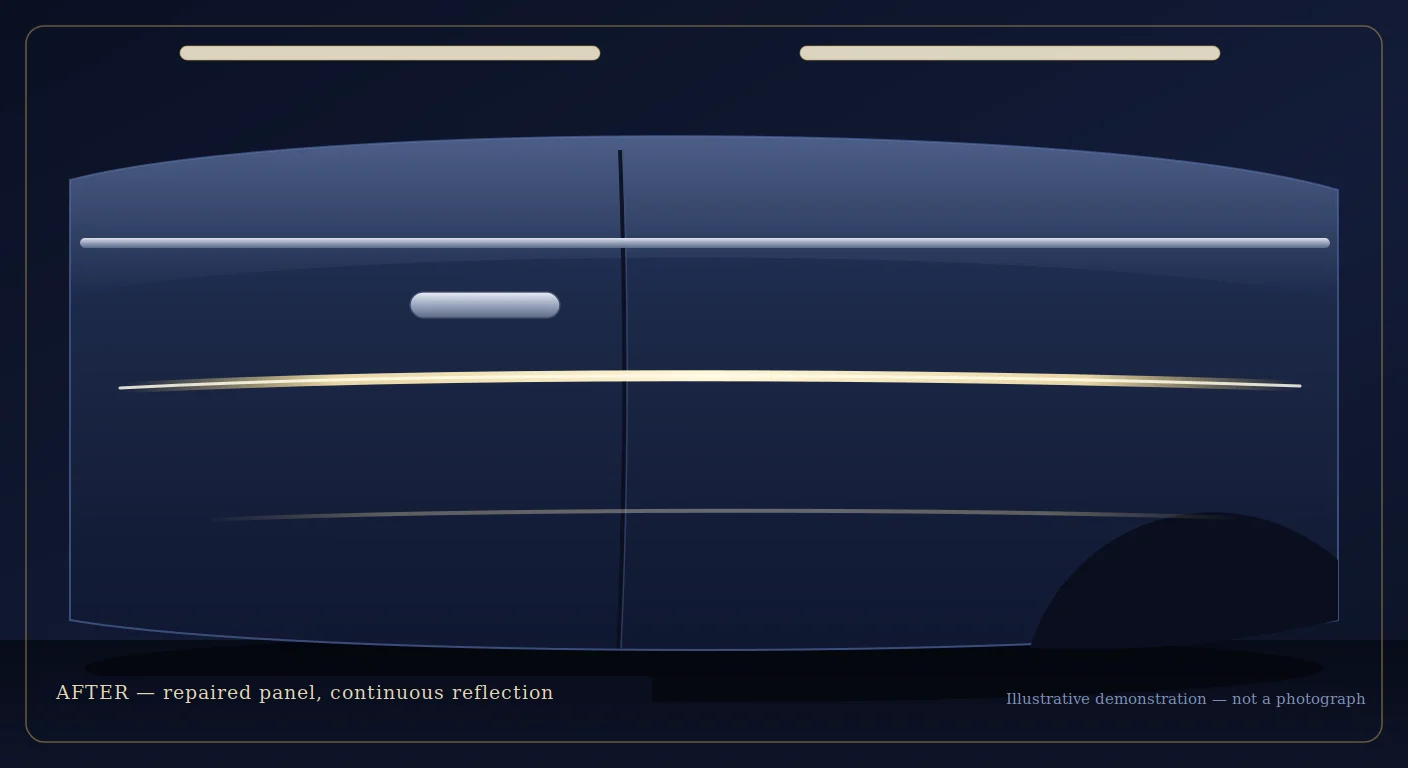
Before and after, judged in the same reflection
Drag the handle to compare. The standard is that the repaired area reads correctly in a long line of light, not only in a close-up.
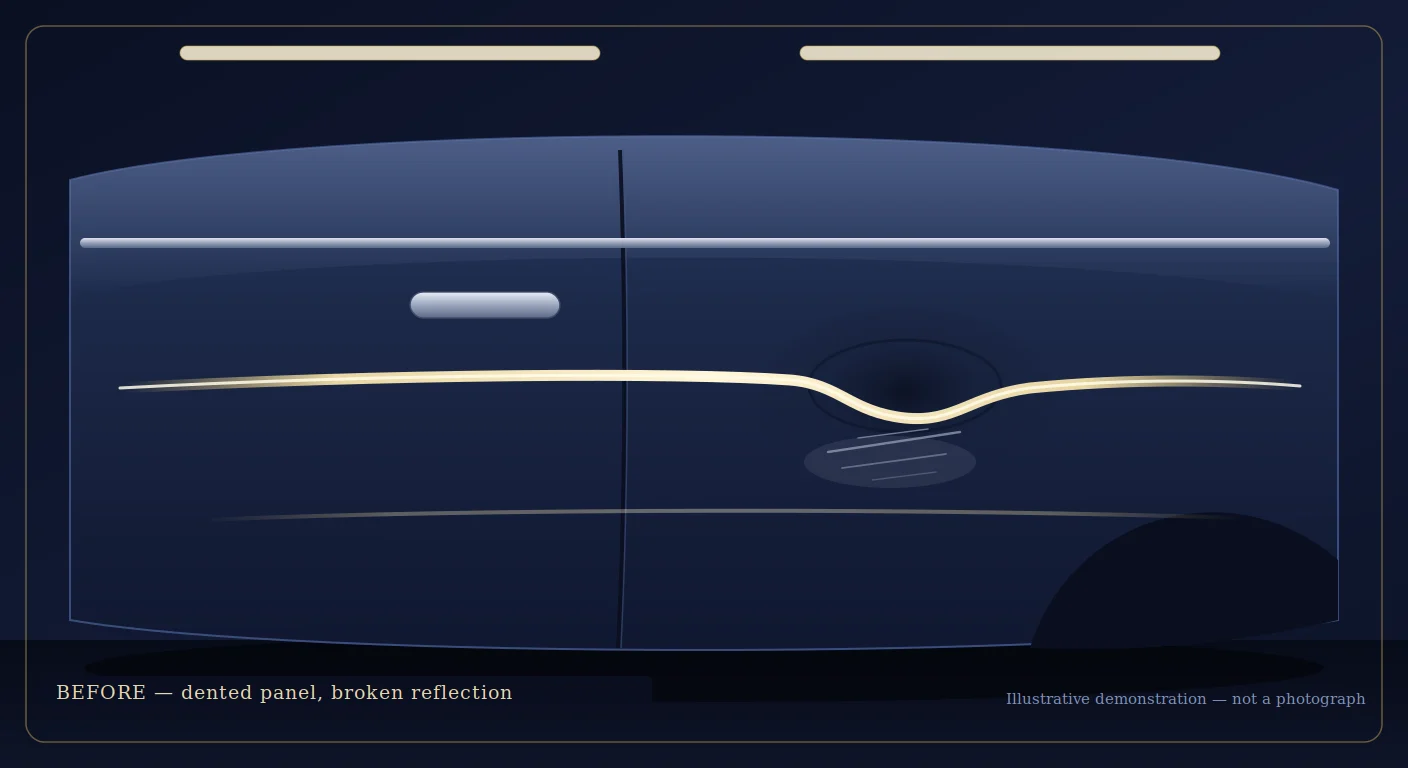
Before
After
Illustrative demonstration of our inspection standard — these are labelled illustrations, not photographs. When you photograph a real repair (same position, before and after), replace the two image URLs and delete this note.
Send photos before arranging an inspection
Wide and close views can help us understand the location, but an in-person assessment may still be needed before a repair direction or timing estimate is confirmed.
Hidden effects around a visible impact
Retainers and impact paths can change the scope
A painted surface is only the visible layer of an assembly. Behind a bumper corner may be guides, brackets, fasteners and other nearby components. Behind a door skin are internal structures and mechanisms. The exact arrangement varies, so we avoid assuming what lies behind a panel until access and vehicle information support the assessment.
Impact energy can also travel away from the most obvious mark. A corner push may open a gap at the opposite end of a bumper. Pressure on a door can be visible near the handle but influence an edge or trim line farther away. A rear contact can mark the bumper cover while the boot opening or nearby fittings provide additional clues.
Inspection depth should match the signs. A light surface scuff does not justify unnecessary dismantling. Conversely, a loose corner, changed gap, warning message, fluid trace or abnormal closure should not be dismissed because the outer mark appears small. We explain when further access is useful and what question that access is intended to answer.
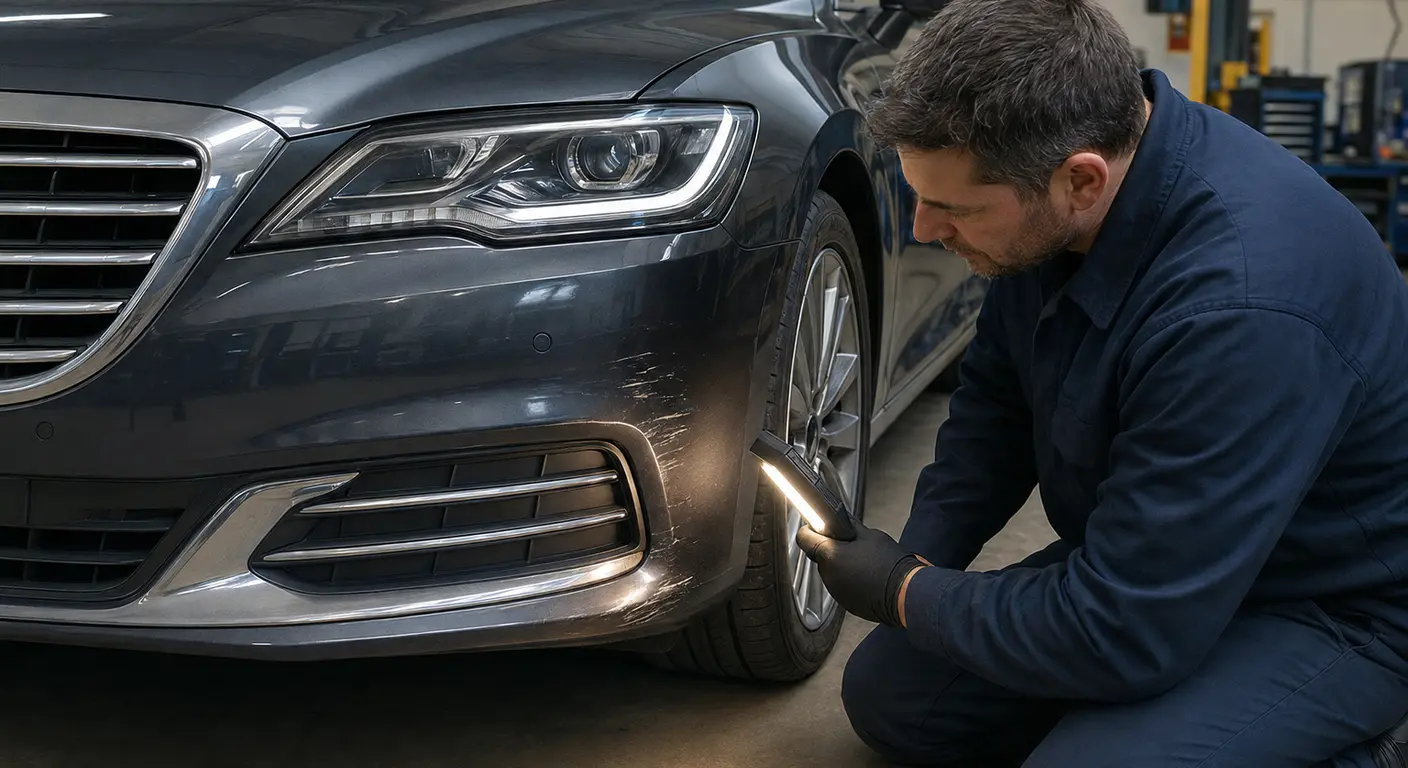
Clues worth mentioning at assessment
What changed after the impact can guide the inspection
The driver’s observations often help define where to look, especially when a mark has been cleaned or the vehicle has been used since the incident. A symptom is not a diagnosis. It is a clue that can help separate a surface-only concern from an area that deserves a wider check.
A gap looks wider or tighter
Compare the affected junction with the opposite side only as a general reference, since normal tolerances and prior work can differ. A changed gap near a bumper, lamp, door or boot may point to a moved retainer, deformed edge or altered component position. It should be inspected before anyone attempts to hide the symptom with local paintwork.
The mark feels loose or flexible
A corner that moves under light hand pressure, a trim strip that no longer sits flat or a panel that makes a new noise may indicate an attachment concern. Avoid repeatedly pressing or pulling the area. Photograph its resting position and mention when the looseness first became noticeable so the inspection can focus on the relevant junctions.
A reflection breaks beyond the dent
Shallow distortion can extend farther than the central point that first catches the eye. A long light line viewed from the side may reveal a broad low area, a crown around the dent or a previous repair edge. This changes how much shaping and preparation may be needed even when the paint surface is still intact.
A closure sounds or feels different
New resistance, an unusual click, increased effort or a change in wind or water behaviour should be reported. The cause may not be obvious from the outer skin. The closure, seals, local alignment and related fittings can then be considered together. If a door or boot appears unsafe or will not latch securely, avoid continued use until it is assessed.
A normal wash is generally enough for photographs, but aggressive polishing, touch-up paint or forcing a displaced trim piece back into place can hide boundaries or change the condition before assessment. If safe, leave the area as found and record several angles in daylight.
Collision and equipment checks
Rolls-Royce collision repair follows geometry before electronics
After an impact, panel fit and body references are checked before a warning or powered feature is treated as an isolated electronic fault. Bumper, lamp, grille, camera or sensor-adjacent damage can involve brackets, apertures and surrounding geometry that must be restored first.
Where fitted equipment sits beside the repair area, the workshop records the relevant warning status and physical condition, then follows the applicable post-repair procedure only after the body and wheel conditions required by that procedure are correct. A visual check is not represented as electronic calibration.
Changed gaps, disturbed brackets, warning messages and the impact direction guide whether further access or specialist checks are justified.
Paint depth and colour continuity
Deep gloss is built through disciplined preparation
A high-gloss finish exposes preparation quality. Waves, sanding marks, contamination, uneven texture and abrupt colour transitions can all become more noticeable across broad panels. The final appearance depends on the condition beneath the colour as much as the colour itself.
Surface shape first
Paint cannot correct an inaccurate panel shape. The repaired surface must be assessed in line lighting and from changing angles before colour and clear layers are treated as the finishing answer.
Colour is assessed on the vehicle
A paint code is a starting reference, not the only visual test. Age, previous refinishing, application and viewing light can affect how adjacent areas appear. A sample process may be useful before final application.
Texture and polish matter
Gloss level and surface texture should be judged with the surrounding finish in mind. Excessive polishing is not a substitute for controlled preparation and application.
If refinishing is required, the scope of car painting is chosen around the damaged area, its neighbouring panels and the finish observed on the vehicle. Two-tone or specially layered appearances require particular caution because boundaries, layer sequence and adjacent colour relationships can influence both the process and the estimate. We do not assume every Rolls-Royce has the same paint system.
From assessment to handover
A clear repair journey for owners and chauffeurs
A discreet handover is mostly about clear information, careful vehicle handling and an agreed contact path. Whether the vehicle is brought by its owner, chauffeur or authorised representative, practical decisions should reach the right person without creating confusion.
Initial condition record
We identify the requested repair area and note relevant surrounding condition. Existing marks or previous repair clues can affect the quotation and should be separated from the new incident where possible.
Inspection and repair direction
The visible damage, panel relationship, fittings and finish are assessed. If further access, part identification or insurer input is needed, that is raised before the plan is treated as final.
Estimate and permission
The proposed scope should distinguish repair, replacement, refinishing and parts-related items. Work proceeds according to the agreed direction and any applicable claim process.
Repair and preparation
Panel or bumper work is completed before the surface is prepared for finish. Removed trim and fittings are managed according to the agreed scope and component condition.
Finish and reassembly checks
Reflections, local alignment, visible gaps, trim seating and the repaired coating are reviewed. The exact checks depend on the repair area and what was removed or adjusted.
Handover explanation
The receiving person should understand what was repaired, any replaced item, relevant paint care guidance and any observation that remains outside the authorised scope.
Parts and timing
Accurate timing follows identification and scope
Repair duration is affected by more than labour hours. A component may need identification by vehicle details. Trim, brackets or seals can be involved even when the painted damage appears local. Parts availability, previous work, insurer steps and discoveries after agreed access can all affect the sequence.
For that reason, an early time range should be treated as provisional until the repair direction is stable. If a replacement component is being considered, the estimate should make clear whether sourcing is confirmed or still being checked. If the repair route is selected, preparation time still depends on damage depth and coating condition.
We would rather explain the variables than present an unrealistic completion promise. A useful update states what has been confirmed, what remains dependent on parts or approval, and whether any new finding changes the authorised scope.
Insurance repairs
Keep claim decisions separate from workshop assumptions
Insurance procedures differ by policy, incident and insurer. Before repair begins, confirm what documents are required, whether an inspection is needed, how liability or excess applies, and whether the insurer must agree to the estimate or any additional damage.
Visible photos may support a claim, but they do not always show hidden attachment damage or the full relationship between panels. If additional damage becomes apparent during authorised work, the relevant evidence and revised scope may need to return through the insurer’s process before proceeding.
An independent workshop should not be presented as the insurer, vehicle manufacturer or policy decision-maker. Our role is to assess the vehicle, describe the repair need and provide workshop information for the process applicable to the case.
The standard we hold ourselves to
Commitments made to every owner, on every repair
Colour is judged in Dubai daylight. A match that looks right in the booth can drift in full sun. Before handover, the repaired area is checked outdoors against the surrounding panels, because that is where the owner will see it.
BodyShop.AE · Al Quoz 4, Dubai
You approve the scope before work begins. Repair, replacement, refinishing and parts are listed separately in the estimate. If a new finding changes the scope, it comes back to you first — there are no surprise items at collection.
BodyShop.AE · Al Quoz 4, Dubai
Updates reach the decision-maker. Whether the car arrives with its owner or a chauffeur, progress photos and stage updates go to the person who decides, on WhatsApp, without needing a workshop visit.
BodyShop.AE · Al Quoz 4, Dubai
The final inspection is the reflection. Every repaired panel is walked in line lighting from several angles before we call it finished. If the light line breaks, the panel is not done.
BodyShop.AE · Al Quoz 4, Dubai
Insurance paperwork is prepared properly. Estimates, photographs and any revised scope are documented the way assessors expect to receive them, so the claim process does not stall at the workshop’s end.
BodyShop.AE · Al Quoz 4, Dubai
Removed parts are catalogued at drop-off. Trim, fittings and fasteners that come off are recorded. Reassembly is checked against the list, not against memory.
BodyShop.AE · Al Quoz 4, Dubai
Colour is judged in Dubai daylight. A match that looks right in the booth can drift in full sun. Before handover, the repaired area is checked outdoors against the surrounding panels, because that is where the owner will see it.
BodyShop.AE · Al Quoz 4, Dubai
You approve the scope before work begins. Repair, replacement, refinishing and parts are listed separately in the estimate. If a new finding changes the scope, it comes back to you first — there are no surprise items at collection.
BodyShop.AE · Al Quoz 4, Dubai
Updates reach the decision-maker. Whether the car arrives with its owner or a chauffeur, progress photos and stage updates go to the person who decides, on WhatsApp, without needing a workshop visit.
BodyShop.AE · Al Quoz 4, Dubai
The final inspection is the reflection. Every repaired panel is walked in line lighting from several angles before we call it finished. If the light line breaks, the panel is not done.
BodyShop.AE · Al Quoz 4, Dubai
Insurance paperwork is prepared properly. Estimates, photographs and any revised scope are documented the way assessors expect to receive them, so the claim process does not stall at the workshop’s end.
BodyShop.AE · Al Quoz 4, Dubai
Removed parts are catalogued at drop-off. Trim, fittings and fasteners that come off are recorded. Reassembly is checked against the list, not against memory.
BodyShop.AE · Al Quoz 4, Dubai
Frequently asked questions
Rolls-Royce body repair questions
Can you assess a small dent on a Rolls-Royce door?
Yes. The assessment considers dent depth, paint condition, access, edge proximity, the long panel reflection and whether the door still aligns and operates normally. The suitable method depends on those findings.
Can a Rolls-Royce bumper corner be repaired instead of replaced?
Sometimes. Surface scuffs or recoverable deformation may support repair, while cracks, torn material, damaged mounts or poor previous work can change the direction. The bumper and nearby junctions should be inspected first.
How do you check paint colour on a large luxury panel?
The paint reference is considered alongside the finish already on the vehicle. Viewing light, adjacent panels, prior refinishing and sample comparison may influence how the colour and effect are evaluated before application.
Will you repaint the whole side for one damaged panel?
Not automatically. The refinishing scope depends on the damage, colour relationship, panel boundaries and observed finish. The recommended area should be explained after inspection rather than assumed from the vehicle name alone.
Do bright trim and seals need to be checked after side damage?
They should be checked when they are near the impact or when their seating has changed. Bent trim, disturbed clips or displaced seals can affect appearance, reassembly and the repair sequence.
Can photos provide a final Rolls-Royce body repair quote?
Photos can help identify the area and arrange the next step, but they may not show panel distortion, hidden mounts, previous repair layers or closure changes. A final scope may require an in-person inspection.
How long does Rolls-Royce body repair take in Dubai?
Timing depends on damage depth, repair or replacement choice, parts availability, paint process, insurer steps and findings after authorised access. A useful estimate is confirmed once these variables are clearer.
Can an insurance claim be used for the repair?
That depends on the policy, incident and insurer requirements. Confirm documents, inspection, excess and scope approval with the insurer. The workshop can provide repair information relevant to the vehicle assessment.
What should a chauffeur bring when dropping off the vehicle?
They should have the correct contact for repair decisions, relevant incident or claim information, any available photos, and clear authority for the agreed handover process. Personal items should be removed from the repair area.
Do you use a featured image on this service page?
No. The page uses controlled inline editorial images so the theme does not place an additional featured image above the designed hero.
Is BodyShop.AE affiliated with Rolls-Royce?
No. BodyShop.AE is an independent body and paint repair business and is not affiliated with, endorsed by or an authorised repairer for Rolls-Royce Motor Cars.
Arrange a careful bodywork assessment in Dubai
Tell us where the damage is, how it happened and whether any closure, trim or warning has changed. We can then guide the most useful next step.