
STAINLESS EXTERIOR, CASTING AND IMPACT-ROUTE ASSESSMENT
Tesla Cybertruck Body Repair Dubai
Tesla Cybertruck body repair in Dubai cannot be scoped by applying an ordinary painted-pickup formula. The exterior stainless-steel finish, angular panel relationships, large cast underbody components, powered closures, cameras and high-voltage floor area create distinct repair boundaries. The first assessment classifies the damage as surface finish, replaceable exterior component, bumper/trim, closure, structural/casting, mechanical or high-voltage-related before any sanding, pulling or paint work is approved.
Do not sand the stainless finish before classifying the mark
A light surface mark, transferred material, scratch, dent and crease are not the same repair. Cleaning and inspection come first. The panel is viewed along its grain and from several angles under controlled light. If the mark is only contamination or transfer, an aggressive abrasive can create a larger appearance problem than the original defect. If the metal is deformed, surface refinishing alone cannot restore geometry.
Tesla’s official Cybertruck stainless-steel refinishing procedure notes that sanding can change the appearance of the repair area and may require adjacent portions to be refinished for consistency. That makes sample area, direction, finish continuity and customer expectation part of the estimate. A local bright patch on a large panel is not an acceptable hidden cost.
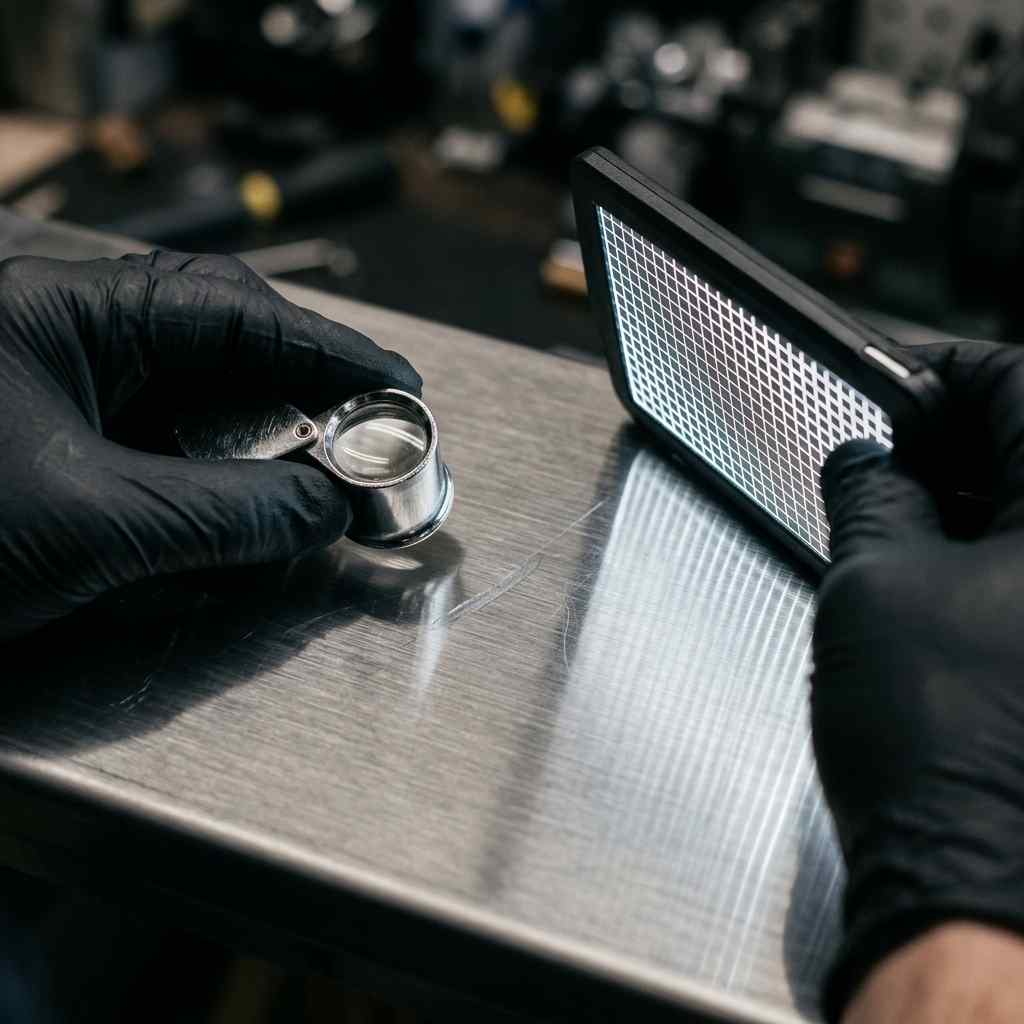
A stainless exterior assessment records
- The exact panel, grain direction and complete affected surface.
- Whether the mark is transfer, scratch, discolouration, dent, crease or kink.
- Edge, hem, attachment and neighbouring-panel condition.
- Previous refinishing or inconsistent appearance nearby.
- The proposed test area and the risk of a wider finish transition.
- The replacement route when deformation is outside the permitted repair.
Creases and kinks change the panel decision
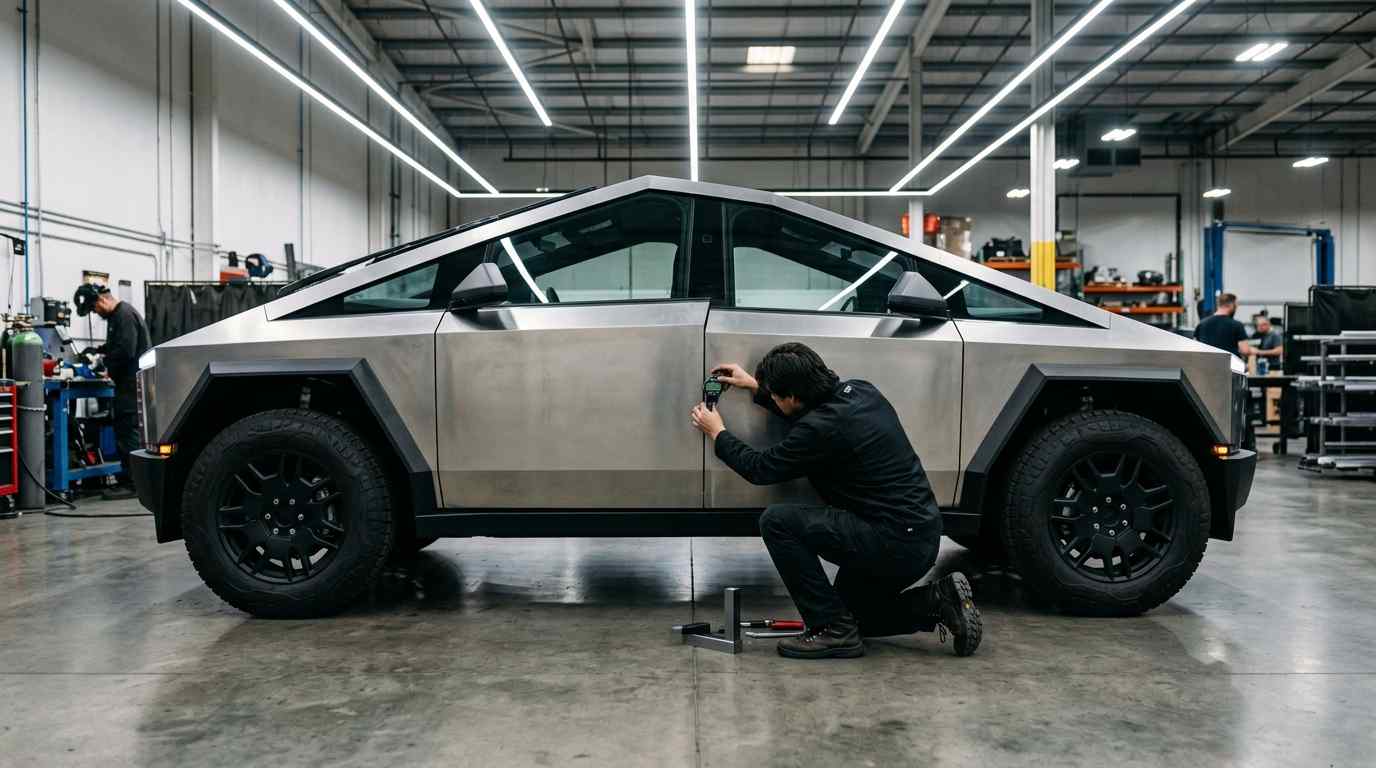
The Cybertruck collision manual distinguishes cosmetic stainless-steel correction from damage that requires replacement. Welding repairs are not permitted on stainless components, and a crease or kink is not treated as an ordinary cold dent. The technician identifies the exact component and current part-repairability rule before attempting heat, pulling, drilling, sectioning or joining.
This boundary should be visible in the quotation. ‘Repair side panel’ is too vague. The estimate states whether the work is cleaning and finish restoration, permitted cosmetic correction, attachment replacement or complete panel replacement. It also includes surrounding dismantling, fasteners, adhesives, sealing, trim, system checks and finish continuity needed to complete that method.
Cybertruck’s strong straight edges make panel relationships easy to compare and unforgiving when one component moves. We inspect the damaged line across adjacent panels and closures rather than correcting a single gap. The front fascia, frunk, fender, door, sail area, bed side and tailgate each need their neighbouring references. An even gap at one end can hide twist or height error elsewhere.
Powered closures are operated only when doing so will not worsen damage. Closing effort, powered travel, latch position, seal contact and obstruction warnings are recorded. The repair restores the body or mounting foundation before latch or sensor adjustments. A closure should not be forced into alignment against a moved opening.
Front impact
Review fascia, frunk relationship, lamps, wheel position, underbody casting zone and camera mounts.
Side impact
Trace door and outer-panel damage into sill, floor, wheel arches, hinges, latches and lower attachments.
Rear or bed impact
Check tailgate, bed-side edges, bumper, mast/sail relationships, lamps and rear underbody evidence.
Cast underbody findings cannot be handled by generic frame pulling
The Cybertruck uses large cast components in the underbody, and Tesla publishes separate cast front and rear underbody repairability guidelines. A visible crack, missing material, deformation, damaged attachment or impact near a casting requires part-specific information. The workshop does not assume that heating, welding or straightening a conventional steel rail is an equivalent method.
Geometry and mechanical evidence are recorded before outer cosmetic work continues. Wheel displacement, tyre contact, changed ride height, steering warnings, suspension noise or a moved recovery/tow point can show that the load travelled into the underbody. Measuring and inspection determine whether the job remains within a verified body-repair scope or requires specialist escalation.
| Finding | Immediate action | Do not assume |
|---|---|---|
| Light stainless scratch | Clean, classify and plan finish continuity | That ordinary paint polishing is suitable |
| Crease or kink in stainless panel | Check the current replacement rule | That welding or routine dent repair is permitted |
| Wheel or casting-zone impact | Measure and inspect mechanical/structural evidence | That the outer scuff defines the full scope |
| Floor or battery-area contact | Set safe movement, lifting and charging controls | That absence of a warning proves no damage |
High-voltage and lower-floor screening comes before cosmetic release
An underbody strike, deep sill impact, puncture, displaced seam, heat, odour, leakage or high-voltage warning changes storage and workshop handling. The battery area is assessed under applicable safety information before charging, lifting or dismantling proceeds. A surface mark does not automatically mean pack damage, but the location and deformation must be understood.
If the evidence is outside normal visual screening, the vehicle is kept in a controlled condition and the required technical assessment is defined. The customer receives a written reason for escalation and the next transport or inspection requirement. Covering lower evidence with fresh coating or completing exterior finish first is not an acceptable shortcut.
Bumper fascia work follows conventional paint rules only where applicable
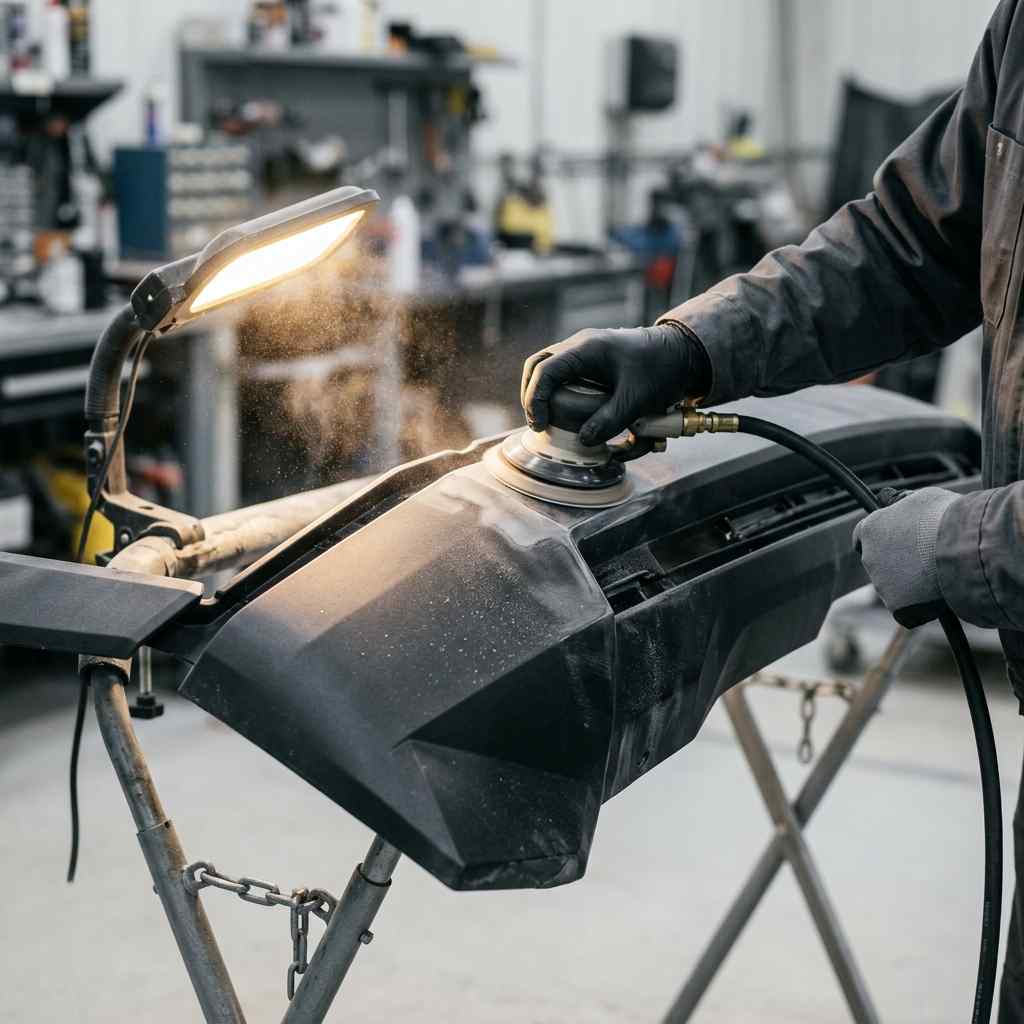
The Cybertruck’s exterior stainless panels are not colour-matched like painted steel or aluminium, but painted or textured bumper and trim components still need material-appropriate repair and refinishing. A fascia scuff, split, torn tab and distorted sensor aperture are assessed separately. Stable plastic may be repairable; weakened mounts or deformed critical apertures can make replacement more reliable.
Paint identification, plastic preparation, adhesion system, texture and colour match apply to the painted component. Masking must protect adjacent stainless surfaces from overspray, compound and sanding contamination. A fascia repair is inspected together with its brackets and camera or sensor mounting plane so the cosmetic result does not hide poor fit.
Electronic closure begins after physical geometry
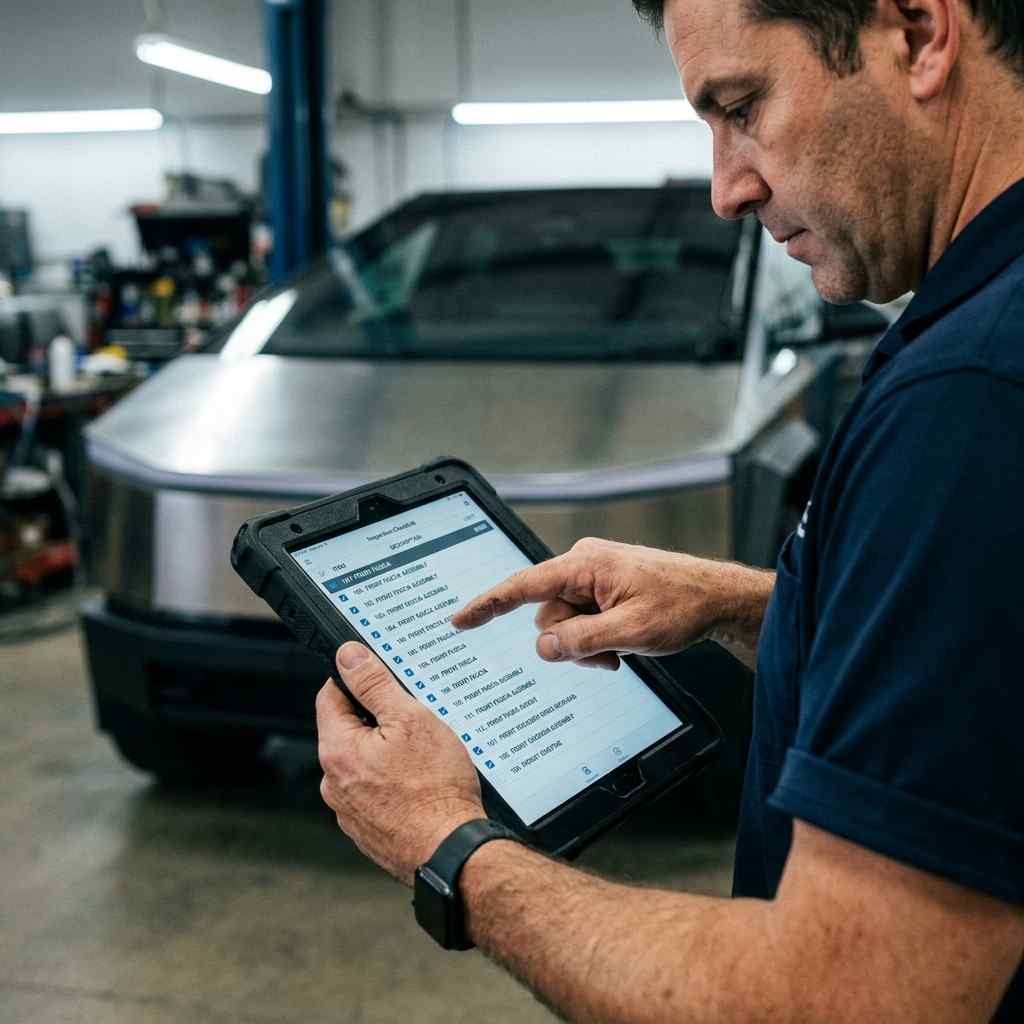
Collision damage can affect cameras, parking functions, powered closures, lighting and steering or suspension-related systems. The estimator records warnings before battery disconnection or dismantling. After panels, brackets and mounting planes are restored, diagnostics and functional checks identify the applicable closure work. Calibration or aiming follows the current procedure for the equipment actually disturbed.
A displayed camera image does not prove correct mounting. A warning cleared by a reset does not prove the impact cause is resolved. The final file should connect each disturbed component to its physical check, diagnostic result and required calibration or specialist decision.
Cybertruck repair costs need narrower descriptions, not false certainty
Generic Dubai body-repair ranges can help classify the likely scale, but stainless appearance work, casting findings, special-order panels and transport requirements can move Cybertruck work far outside ordinary prices. A light surface treatment or small cosmetic correction may begin around AED 299 to 1,000 only after the mark is classified. Painted fascia work may fall around AED 500 to 2,500 depending on mounts, apertures, sensors and replacement needs.
A combined corner repair with fascia, lamp, brackets, adjacent components and diagnostics can enter the AED 2,000 to 6,000+ planning band. Stainless panel replacement, casting or floor involvement, powered-closure damage and high-voltage assessment require a specific quotation; they should not be promised inside that band. The site’s accident repair cost guide explains the underlying categories.
A Cybertruck quotation should separate
- Surface cleaning, test area and stainless finish restoration.
- Permitted cosmetic correction versus complete stainless panel replacement.
- Painted fascia, trim, lamp, bracket and attachment operations.
- Casting, floor, wheel, suspension or mechanical inspection.
- High-voltage screening, storage and specialist assessment.
- Diagnostics, powered-closure checks and calibration requirements.
- Parts supply, transport, supplements and customer approval gates.
A controlled Cybertruck repair sequence
- Stabilise: determine safe movement, charging, lifting, storage and closure operation.
- Classify: separate transfer, scratch, discolouration, dent, crease, kink and hidden impact evidence.
- Identify: confirm VIN, current manual, exact component, material and permitted operation.
- Measure: compare angular gaps, openings, wheels, cast underbody and attachment points.
- Authorise access: remove only the items needed to verify hidden damage.
- Restore foundation: complete permitted body, component, mechanical or escalated work.
- Refinish correctly: control stainless appearance or painted-component colour as separate processes.
- Close systems: test closures, lights, cameras, warnings and required calibration.
- Release: document finish, geometry, functions, parts, supplements and warranty.
Time estimates are tied to those gates. A surface assessment can be quick; panel supply, technical review, specialist transport or casting decisions can take longer than hands-on body work. The customer should see active repair time, waiting time and unresolved approval separately. A deadline does not override a material or safety restriction.
Cybertruck body repair FAQs
Can Cybertruck stainless panels be repaired with ordinary body filler and paint?
No generic painted-panel method should be assumed. The exact mark, panel and current Tesla stainless-steel repairability and refinishing procedure determine whether cosmetic correction, finish restoration or replacement is permitted.
Can a crease in an exterior stainless panel be welded?
Tesla’s published Cybertruck material guidance states that welding repairs cannot be performed on stainless components and treats creases or kinks differently from minor cosmetic damage. The exact component procedure must be checked.
Does a clean dashboard mean the underbody is undamaged?
No. Warning state is one input. Location, deformation, casting and floor evidence, wheel position and applicable inspection criteria still matter after a lower-body impact.
Is BodyShop.AE a Tesla Approved Collision Center?
This page makes no unsupported approval claim. The estimate states the verified scope offered for the job and documents escalation when Tesla-specific equipment, training, parts access or procedures require another route.
Bed, tonneau and tailgate checks are their own repair lane
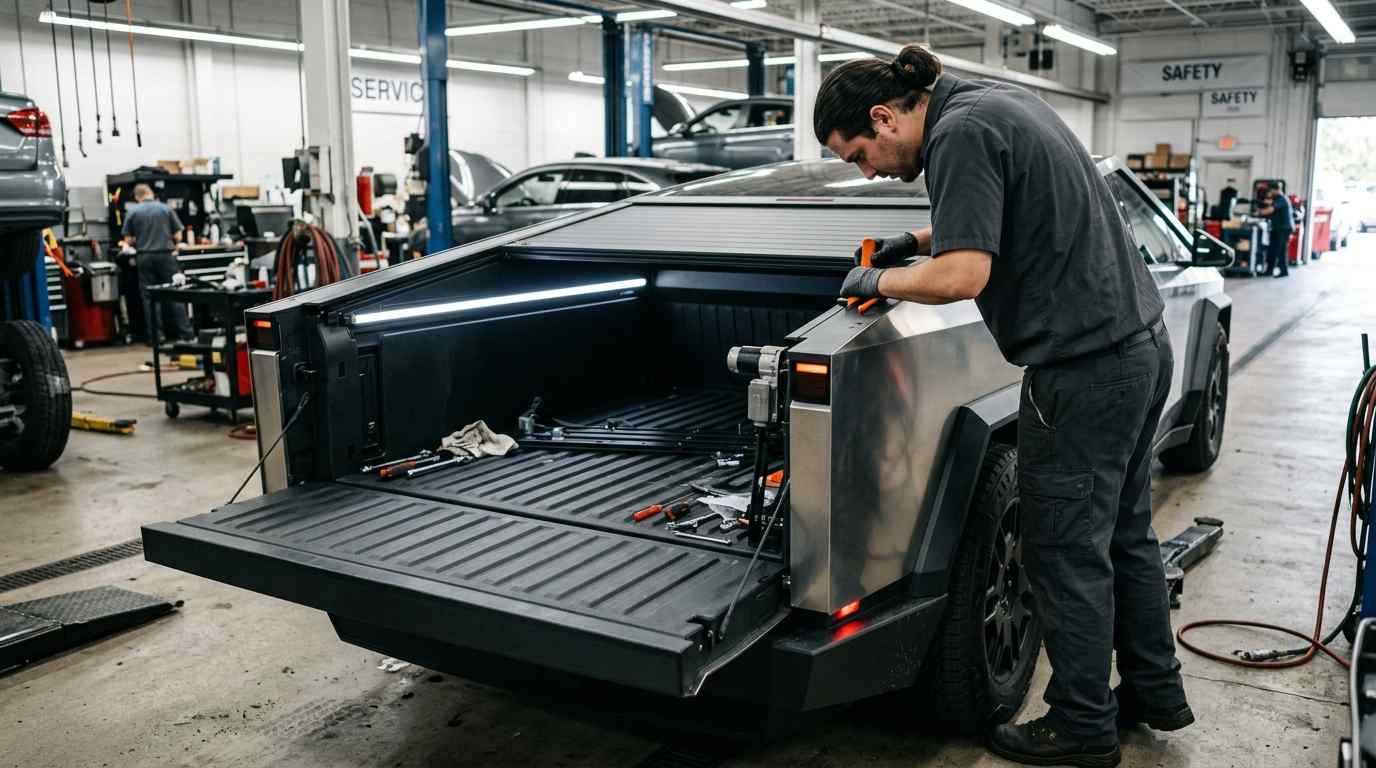
Rear or upper-side damage can affect the bed opening, powered tonneau path, tailgate alignment, seals, drains and sail-area relationships. Before operating a damaged mechanism, the technician checks for obstruction, shifted tracks, bent edges and loose debris. A powered cover should not be cycled simply to see whether it works when doing so could score a surface or worsen a misalignment.
The body foundation and opening geometry are corrected before powered travel, latch or limit checks. Bed drainage remains open, trim and seals sit without pressure points, and the tailgate carries load only after its mounts and surrounding structure pass inspection. Dirt, abrasive metal particles and refinishing residue are removed from tracks and moving interfaces before the final function test.
The quotation separates stainless appearance work from mechanism, trim and structural operations. This prevents a local surface estimate from hiding powered-component replacement or a moved opening, and it gives the customer a clear approval point when access reveals track or attachment damage.
Final quality control returns to the original damage record. Stainless surface direction, panel relationships, repaired openings, bed and tailgate functions, disturbed trim, cameras or warnings, lower-body evidence and every operation named in the estimate are checked or clearly marked as a separate specialist boundary before handover.
For the wider Tesla body repair in Dubai pathway, use the brand hub for shared collision planning, documented repair boundaries and escalation questions. This Cybertruck page stays separate because stainless appearance work, sharp geometry, cast underbody evidence, bed systems and powered closures need their own decision route. Where the impact includes a wheel, restraint warning, lower-body contact or uncertainty about whether the vehicle can be driven, our Dubai accident repair service explains the safe inspection and recovery sequence before cosmetic work is approved. That distinction keeps a surface estimate from masking a structural, mechanical or high-voltage concern.
Send evidence before anyone touches the finish
Provide the complete panel in its grain direction, close views from several angles, adjacent gaps, wheels, lower-body contact and warning state. We will classify surface, panel, casting and system concerns before proposing work.