

Independent EV body and paint repair in Al Quoz 4
Zeekr Body Shop Dubai
A modern electric car can look lightly marked while the path of an impact reaches several body zones. Our approach starts by mapping where the force entered, which panels and fittings sit beside it, and what must be treated cautiously before any cosmetic repair begins.
Openings and exterior fittings
Door gaps can reveal what a small side impact changed
A dent beside a flush handle or close to a door edge should not be priced from the painted surface alone. The handle opening, folded panel edge, nearby trim and gap to the next panel all occupy a small area. If the door was pushed inward or rearward, the evidence may appear as a changed gap, a new contact mark on an edge, a seal that sits differently or a door that needs a different effort to close.
We compare the affected side with useful reference points on the opposite side where practical. Symmetry is not proof that everything is correct, but it can help identify a visible difference. We also ask whether the handle, window or door operation changed at the moment of impact. That report is recorded carefully. A body shop observation should not be presented as an electronic diagnosis.
Repair access also matters. A central door dent may allow a different approach from damage beside reinforcement, a bonded fitting or a tight return edge. Unnecessary removal can create its own risk, while insufficient access can lead to an unstable shape or excessive filler. The method should match the real panel condition and the safe access available after inspection.
A better starting point
EV body repair begins with an impact map
A scratch, dent or cracked bumper is the point you can see. It is not always the full repair boundary. The useful first question is how the contact happened, where the load travelled, and which neighbouring parts may have shifted even if they still look tidy.
For a Zeekr, that wider view matters around broad smooth panels, flush exterior details, bumper corners, door openings, roof edges and low underbody areas. The assessment should stay evidence based. We inspect what is visible and accessible, record uncertainty, and avoid turning a cosmetic estimate into an unsupported diagnosis of electronic or high voltage systems.
Our independent body repair service can address suitable dents, panel damage, bumper repairs and paintwork. Where the condition falls outside body and paint scope, we explain that boundary before proceeding.
Damage classification
Three questions define the first repair conversation
Is it surface damage?
Transfer marks, clear coat scratches and shallow scuffs may remain within the finish. We still check edges and adjacent panels before classifying the work.
Has the shape changed?
A dent, crease or distorted bumper changes reflection flow and may change the relationship between trims, lamps, handles or panel gaps.
Did the impact reach a sensitive zone?
Lower body areas, bumper technology zones, apertures and glass roof edges call for a wider visual review and a carefully limited body repair plan.
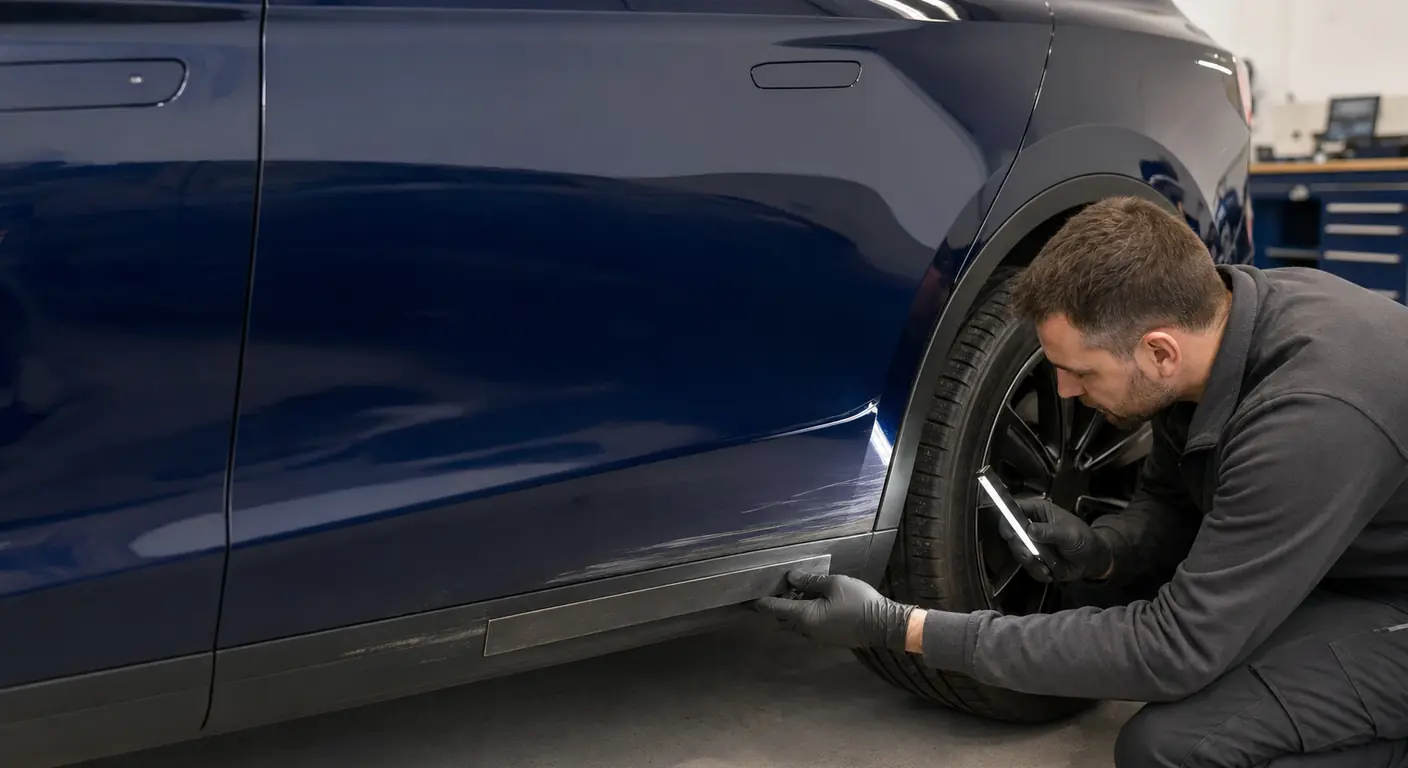
Lower impact caution
Hidden low contact can matter more than its paint mark
Dubai parking ramps, kerbs, wheel stops and debris can contact the lower bumper, sill, jacking area or underbody edge. A scrape may be obvious on painted trim while the lower face is difficult to see from standing height. We ask where the contact happened and visually compare both sides where access permits.
This does not mean every lower scrape involves the traction battery. It means the proximity of an EV underfloor area should change the level of caution. Body repair work should not cover over uncertainty. If there is deformation, fluid, unusual odour, heat, a warning message, or evidence that the underfloor enclosure may have been affected, the vehicle should not be treated as a routine cosmetic job.
We do not claim battery repair or high voltage diagnosis. Our role is to identify the limits of visible body damage, avoid inappropriate work around uncertain areas, and recommend that concerns outside our body and paint scope receive suitable specialist evaluation.
Exterior zones
What a system aware body inspection considers
The exact construction and equipment can vary by model and specification. We therefore inspect the actual vehicle instead of assuming every Zeekr has the same parts or repair route.
Front and rear bumper zones
We look for cracked paint, distorted plastic, opened seams, loose brackets, displaced trims and changed gaps. If cameras, sensors or lighting elements are present, their position is recorded before disassembly. We do not promise calibration or electronic diagnosis as part of a visual body estimate.
Large smooth panels
Broad doors and quarter panels reveal even small waves under long reflections. Dent depth is only one factor. Edge distance, crease sharpness, finish condition and access from behind can change whether shaping is practical.
Flush handle and door edge areas
A dent beside a handle or near a folded door edge can be more complex than a central shallow dent. We check function, fit and the surrounding contour without making claims about internal electronics that have not been tested.
Roof edge and body aperture areas
Contact near a panoramic roof, upper pillar, windscreen edge or hatch opening is reviewed visually for changed gaps, finish fractures and disturbed seals. Glass or structural conclusions require evidence, not guesswork.
Side sill and wheel arch
The visible mark is compared with lower edges, claddings and the wheel opening. A hard crease or displaced trim can suggest a larger affected area than a simple cosmetic scuff.
Lamps, trims and adjoining panels
Modern lamp units and continuous trim lines make small misalignment easier to notice. The repair plan should include how adjacent parts will be protected, removed or refitted where appropriate.
Repair judgement
Repair or replace is a condition based decision
A repairable panel is not defined by brand prestige or by the size of the dent alone. Shape, material, access, edge condition, previous work and the ability to restore a stable finish all matter. A shallow open dent in a central area may respond differently from a sharp crease through a character line or a deformation beside a bonded feature.
Where paint remains intact and access is suitable, dent removal options may reduce the refinishing area. Paintless methods are not automatically suitable for every EV panel. Stretched metal, broken paint, restricted access, sharp edges and previous filler can change the choice.
Replacement may become the clearer route when a part is torn, severely distorted, fractured at critical mounting points, or cannot reasonably hold the intended shape and finish. Parts availability, transfer of reusable fittings and the condition of adjacent mounting areas should be understood before a date is promised.
- We compare contour and reflection, not just dent depth.
- We consider the risk of disturbing nearby trims or fitted equipment.
- We identify previous paint and filler where it is evident.
- We explain visible uncertainty before committing to the scope.
The working sequence
From intake to a controlled handover
Record
Photograph the impact zone, note warnings reported by the owner and record existing marks.
Map
Follow the likely force path across panels, openings, bumper fittings and lower edges.
Define
Separate repairable body and paint work from parts, approvals and specialist concerns.
Repair
Restore suitable panels, prepare surfaces and protect adjacent areas within the agreed scope.
Check
Review gaps, finish, refitted exterior items and the documented body repair areas.
Paint and reflections
Smooth EV surfaces make finish control highly visible
Large uninterrupted panels can make colour, texture and reflection differences easier to see. A successful paint repair is not simply the right colour code from a label. Substrate shade, existing ageing, metallic or pearl orientation, application variables and the relationship with neighbouring panels can all influence the result.
Our car painting process begins with surface condition. The damaged area may need shaping, controlled preparation, primer work and test comparison before colour application. Masking and removal decisions should protect flush fittings, rubber edges, glass borders and adjacent finishes from unnecessary build up.
After refinishing, the panel should be judged under more than one view. Direct inspection light can reveal texture or polishing marks, while longer reflections help show panel shape. The final review also considers edges, masking transitions and how the repaired panel sits beside surrounding surfaces.

Planning and expectations
Parts, insurance and timing should be separated clearly
An honest time estimate distinguishes hands on repair time from waiting time. A bumper repair may be straightforward, yet a required bracket, lamp, trim or approval can control the schedule.
| Planning factor | Why it matters | Useful preparation |
|---|---|---|
| Inspection access | Some damage becomes clearer after safe removal of exterior trim or liners. | Allow the initial estimate to state what is visible and what remains conditional. |
| Parts identification | Model variant, side, finish and fitted equipment can affect the exact part required. | Provide the vehicle details and clear photos, but expect physical confirmation. |
| Insurance approval | The insurer may request photos, an estimate or additional evidence before authorising insured work. | Bring the claim number and available report. Confirm excess and policy terms with your insurer. |
| Paint curing and quality checks | Preparation, application, curing, reassembly and final inspection each need their own time. | Avoid choosing a delivery promise based only on spraying time. |
| Newly revealed damage | Hidden broken mounts or distorted supports can alter the agreed repair after disassembly. | Use an approval process for supplementary work instead of silent scope changes. |
Repair duration and cost depend on the inspected vehicle, approved scope, parts availability and any newly revealed damage. A page cannot provide a binding quotation.
Before you drive in
Use a cautious intake after any lower or significant impact
If the car has a high voltage warning, visible underfloor deformation, fluid leakage, unusual heat, smoke, an electrical smell, severe wheel damage or any safety concern, do not treat it as a normal cosmetic drive in. Follow the vehicle guidance available to you and arrange appropriate recovery or specialist advice.
For a stable cosmetic concern, send wide and close photographs in daylight. Include the full side or end of the car, the direct impact mark, panel gaps, lower edge and any nearby exterior fitting. Photos can help prepare the conversation, but they do not replace a physical inspection.
Remove personal items from the repair area and mention any recent body work. Share whether a door, hatch, handle or charging door behaves differently. We record what you report without claiming the body mark caused every symptom.
Accident repair scope
Zeekr accident repair begins with the impact path and EV-system boundaries
After a collision, visible bumper, door, quarter-panel or sill damage is checked together with nearby gaps, trim, underbody evidence and fitted equipment. Where the repair area is close to battery, high-voltage, cooling or powered exterior components, the body-work plan must respect the applicable isolation and inspection requirements rather than assume the damage is purely cosmetic.
Impact direction, contact height, warning messages, underbody marks and any camera, sensor, lamp or handle changes help determine whether controlled access or specialist checks are required before the body and paint scope is finalised.
Handover standard
The final check returns to the original impact map
Before handover, the useful question is not simply whether the fresh paint shines. The repaired zone should be reviewed against the observations made at intake. We look at panel contour, accessible gaps, refitted exterior trim, paint texture, visible colour relationship and cleanliness of the repaired area.
Where the agreed body work involved parts beside cameras, sensors, handles, lamps or other powered features, the handover should state what exterior refitting was completed and what is outside the body shop scope. No visual check should be represented as electronic calibration or specialist system validation.
The owner should also be told about reasonable care after refinishing and any documented follow up. Clear records help separate the work completed from unrelated pre-existing marks or future concerns.
Shape
Review reflections and the relationship with adjoining panels.
Finish
Check colour relationship, texture, edges and visible polishing marks.
Scope
Confirm repaired items, replaced items and any unresolved specialist concern.
Price the body zone before drawing conclusions about systems
A Zeekr body estimate should map the physical impact first. Surface damage, panel shape, lower zones and camera or sensor adjacent areas are separate questions. Body pricing does not replace technical diagnosis after a warning or meaningful impact.
Paint intact dent
AED 150 to AED 700
Small PDR is about AED 150 to AED 350. Medium dent repair is about AED 350 to AED 700 when access, paint and panel condition suit the method.
Dent plus finish
AED 700 to AED 1,200 or more
This is the planning band for a larger conventional dent with paint. Panel painting starts from AED 450. Smooth surfaces can make colour and texture control highly visible.
Bumper route
AED 150 to AED 1,500
Light polishing or transfer removal can start near AED 150. Plastic repair plus paint is about AED 500 to AED 1,200. Complete bumper repainting is about AED 600 to AED 1,500.
Part or deeper impact
Inspect before approval
Bumper replacement is about AED 1,200 to AED 6,000 or more. Confirmed structural or chassis work is broadly AED 2,000 to AED 5,000 or more.
For an SUV size full refinish that is genuinely appropriate, the broad starting point is AED 3,500. This should not replace a local repair estimate. The quotation should keep body repair, part supply and any separate technical checks clearly divided. It should name the affected zone, planned access, finish scope and any provisional item.
Indicative only: inspection is required. Zeekr make and model, material, parts, finish, hidden damage and current market conditions affect the final quote. A bodywork band cannot confirm battery, high voltage, sensor or camera condition.
Common questions
Zeekr body repair FAQs
Can you repair a dent on a Zeekr without repainting?
Possibly. Paintless dent repair depends on paint condition, dent shape, panel edge distance, access and previous repair. We inspect the actual panel before recommending it.
Does every bumper impact require replacement?
No. Some bumper covers can be repaired, while tears, severe distortion, damaged mounting areas or an unsuitable finish condition may support replacement. Adjacent brackets and fitted exterior equipment also need consideration.
Can you repair damage near parking sensors or cameras?
We can assess the body and paint damage around those areas. The estimate should identify fitted equipment and protect it during body work. Electronic diagnosis or calibration is not implied by a visual body assessment.
Do you repair Zeekr batteries?
No battery repair is claimed on this page. If a lower impact raises concern about the battery enclosure or high voltage system, the concern should receive appropriate specialist evaluation before routine cosmetic work.
What should I do after the underside hits a kerb or object?
If there is a warning, leakage, heat, smoke, unusual odour, severe deformation or any safety concern, avoid treating it as a normal drive in repair. Follow suitable vehicle guidance and arrange recovery or specialist advice. A light mark still benefits from a careful lower body inspection.
Can a scratch be polished instead of painted?
That depends on its depth. Some transfer or shallow clear coat marks may improve with controlled polishing. A scratch through the colour or into the substrate normally needs a different repair route.
Why are large smooth panels difficult to match?
Long reflections can reveal subtle waves, texture differences and colour variation. Panel shaping, preparation, spray control and the relationship with neighbouring panels all influence the visible result.
Can you assess damage from photographs?
Photos help with triage and preparation, especially when they include wide, close and low views. They cannot reliably show every broken mount, previous repair, underfloor concern or restricted access point, so the final scope follows physical inspection.
How long does Zeekr body repair take in Dubai?
Timing depends on damage depth, disassembly, repair method, paint work, parts availability, approvals and any hidden damage found. We separate active repair time from waiting time after inspection.
Can you help with an insurance repair?
We can document visible body damage and prepare a repair estimate. Approval, excess, coverage, required reports and settlement remain subject to your insurer and policy terms.
Can you repair damage beside a panoramic roof?
We can inspect visible body and paint damage near the roof edge or body aperture. Changed gaps, finish fractures, disturbed seals or possible glass involvement can alter the route. Conclusions about glass or structure require evidence from the individual vehicle.
Are you affiliated with Zeekr or an authorised repairer?
No. Bodyshop.ae is an independent body and paint repair business. This page does not claim manufacturer affiliation, endorsement or authorised repairer status.
Start with the real damage boundary
Arrange a Zeekr body repair assessment in Dubai
Send clear photos and a short description of the impact. We will use them to prepare for an inspection, then define the body and paint scope from the vehicle itself.
Independent service notice: Bodyshop.ae is an independent body and paint repair business in Dubai. It is not affiliated with, endorsed by or presented as an authorised repairer for Zeekr. Vehicle construction and equipment can vary by model and specification. Recommendations follow inspection of the individual vehicle.