
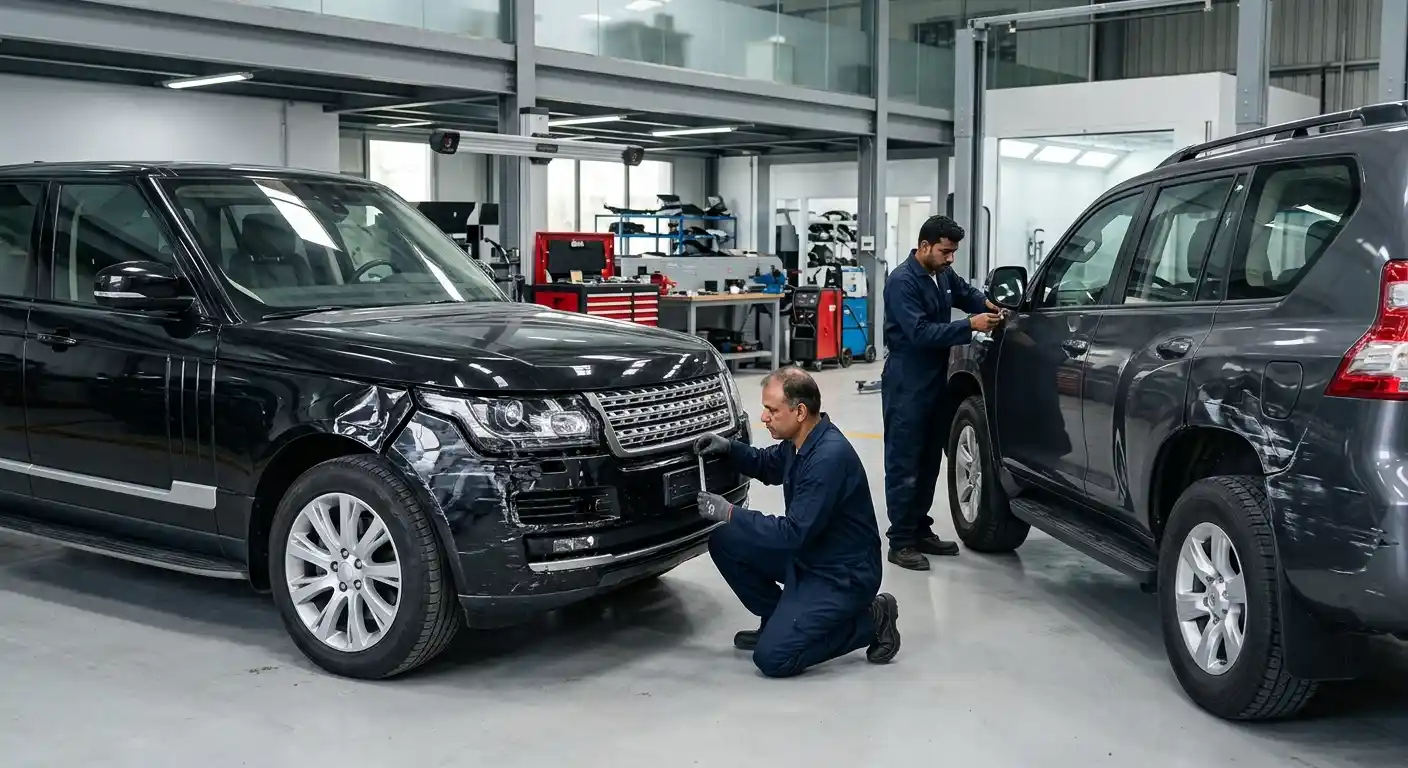
Independent Toyota body and paint assessment in Al Quoz 4
Toyota Body Shop in Dubai
BodyShop.AE assesses Toyota accident damage, dents, cracked bumpers, shifted panels and paintwork before deciding what should be repaired, replaced or refinished. The inspection follows the impact into nearby mountings, wheel and underbody areas, fitted cameras or sensors and hybrid systems where relevant to the exact Toyota.
Independent workshop notice
BodyShop.AE is an independent body repair workshop. We are not a Toyota-authorised dealer or Toyota service centre.
Toyota collision triage
The visible mark does not show how far the impact travelled
A bumper scuff can stop at the painted cover, or the contact can continue into guides, reinforcement, lamps, cooling pieces and driver-assistance hardware. A side dent can be limited to an outer skin, or the force can alter the door opening, sill, wheel corner or pillar relationship.
That difference matters on everything from a Corolla to a Land Cruiser. The useful inspection question is where the load entered, what sits behind that area and what changed after the incident.
Arrange inspection or recovery if a wheel is displaced, a tyre rubs, steering or braking has changed, fluid is leaking, an airbag has deployed or a warning remains on after the impact.
Front corner
Inspect the bumper, side guides, grille, lamps, reinforcement, cooling area, wheel position and fitted camera or radar hardware. A deeper contact belongs in a front-end collision assessment, not only a paint estimate.
Side and opening
Check the doors, hinges, latch, sill, pillars, wheel arch, seals and roof relationship. A long crease or changed closure effort can indicate a different repair decision from a shallow open-panel dent.
Rear body and pickup bed
Review bumper guides, tailgate or boot fit, rear body, floor and parking hardware. On Hilux, the bed, rear body and cab relationship are also part of the evidence. Hidden deformation is considered during a rear-end collision inspection.
Wheel and underbody
Inspect the tyre, wheel, hub, steering, suspension, subframe, mounting points and underbody. On applicable hybrid models, floor or underbody contact also changes the safety screen before ordinary body work begins.
One Toyota badge does not mean one repair route
Body shape, grade and powertrain change the inspection
Toyota UAE currently sells everything from sedans and crossovers to body-on-frame SUVs, pickups and hybrid models. Exterior equipment also changes by grade. We identify the exact vehicle before parts, paint or electronic checks are written into the scope.
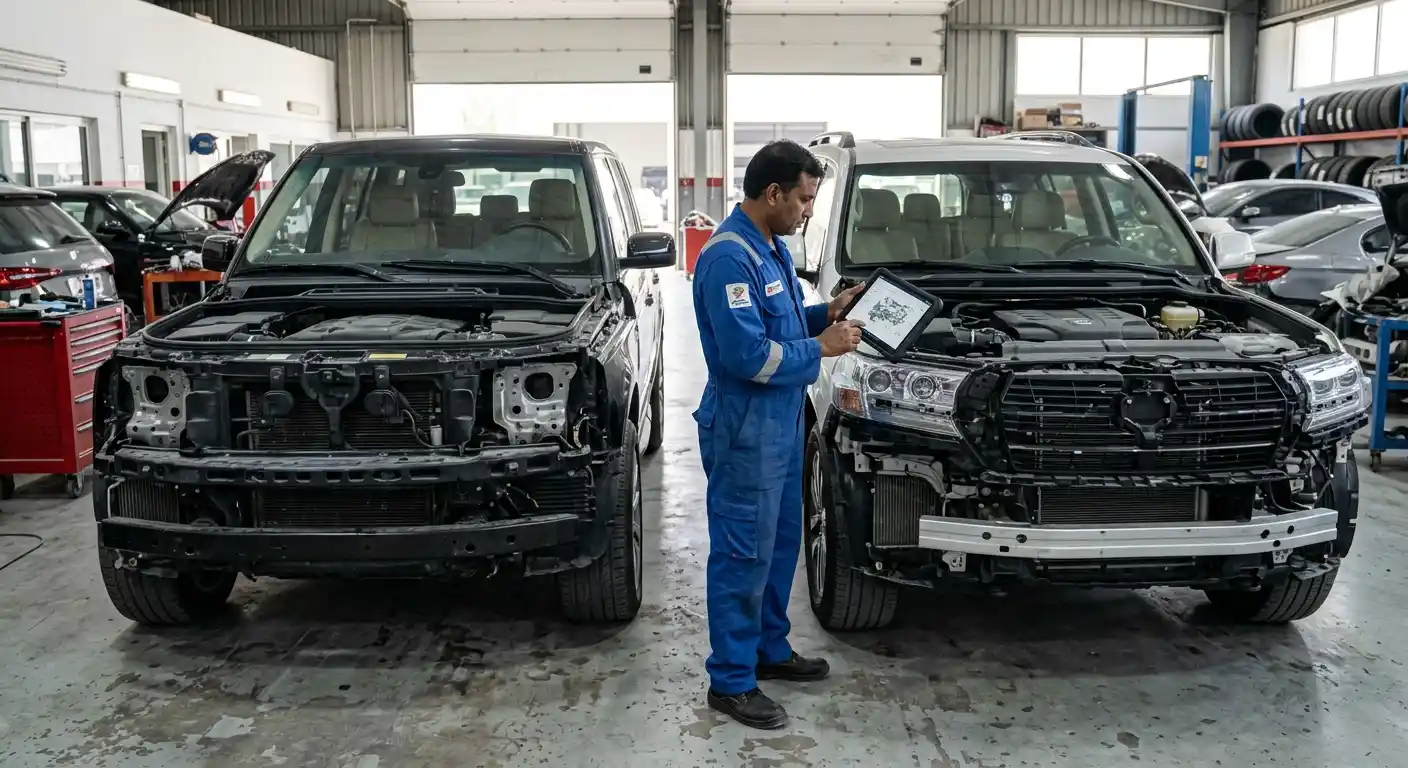
Land Cruiser and Prado
Large bumper, grille and lamp assemblies, wheel-corner contact, underbody marks and fitted safety hardware can expand the inspection beyond the visible panel. Generation and grade are confirmed before the parts route is chosen.
Hilux
Front-corner and underbody damage can sit beside a separate rear-body question involving the pickup bed, tail lamps, tailgate, rear panel and cab relationship. Single and double-cab configurations also change parts identification.
Camry and Corolla
Long door and quarter reflections, bumper-to-lamp fit, bonnet or boot gaps and metallic or pearl colour matching often matter more than the size of one visible scratch. Hybrid variants add a separate powertrain safety consideration when the impact area is relevant.
RAV4, Corolla Cross and Highlander
Cladding, large rear openings, parking hardware, cameras and hybrid availability mean a parking or wheel-corner impact can combine cosmetic, fitment, electronic and underbody questions on the same vehicle.
Repair method before cosmetic promises
Choose the method from the confirmed damage
The Toyota model identifies the correct vehicle data. The condition of the damaged component decides whether the sensible route is paintless dent correction, plastic repair, panel correction, replacement, refinishing or structural measurement.
| What you can see | First repair decision | What must be checked |
|---|---|---|
| Dent with intact paint | Assess whether the original finish can be preserved without conventional repainting. | Paint condition, metal stretch, body-line or edge position, access behind the panel and previous filler or refinishing. |
| Cracked or displaced bumper | Separate plastic repair from cover, guide, bracket, reinforcement or adjacent-part replacement. | Plastic condition, split location, tabs, absorber, lamps, sensor openings, reinforcement and neighbouring gaps. |
| Door or wing no longer aligns | Identify whether the issue is the outer panel, hinge and latch relationship or the opening itself. | Panel gaps, closure effort, seals, inner panels, sill or pillar condition and previous repair. |
| Wheel sits differently | Measure before treating wheel alignment as the complete answer. | Wheel, tyre, hub, arms, steering, subframe, mounting points and relevant body references. |
| Paint break or colour damage | Choose local correction, panel refinishing or a wider blend from the actual finish condition. | Damage depth, substrate, previous paint, colour variant, metallic or pearl behaviour and the blend boundary. |
When the original paint remains suitable
A qualifying dent may avoid conventional refinishing. Our paintless dent removal guide explains the access, paint and metal conditions that control that choice.
When gaps or panel relationships changed
Closure effort and mounting points can matter more than the visible crease. The body repair service covers panel correction and alignment when the problem extends beyond a small dent.
When a structural reference may have moved
If a rail, sill, floor or mounting point is involved, the next decision belongs to a measured structural repair assessment, not simply paint and wheel alignment.
Toyota Safety Sense and hybrid equipment where fitted
Exterior repair can change the checks required before handover
Toyota equipment varies by model, year and grade. On equipped vehicles, bumper, grille, mirror, tailgate and wheel-corner work can disturb the physical relationships used by parking and driver-assistance systems. Hybrid models add another reason to identify the exact vehicle before work around the floor, underbody or cooling path.
Do not assume every Toyota carries the same sensor package
Current Toyota UAE specifications show substantial grade differences. Land Cruiser and Prado can carry Toyota Safety Sense, while Hilux and RAV4 derivatives list different camera, parking and blind-spot equipment. Inspection starts with what is actually fitted.
Hybrid collision screening applies only where relevant
Toyota UAE currently lists hybrid versions across Corolla, Camry, Corolla Cross, RAV4, Highlander and Land Cruiser. An impact near a hybrid vehicle’s floor, underbody or cooling route is therefore not treated as an ordinary cosmetic assumption.
A clear dashboard is useful but not the whole verification
Where a scan, alignment, aiming or calibration is required by the fitted system and repair method, it should remain visible in the repair record. A warning-free dashboard alone does not prove physical position or geometry.
Toyota UAE’s current Land Cruiser, Prado, Hilux and RAV4 pages show why equipment must be confirmed by model and grade rather than assumed from the badge. See the official Toyota UAE model range.
If an impact creates a new warning or system complaint, our guide to diagnostic scanning after collision damage explains what fault memory can add to the physical inspection.
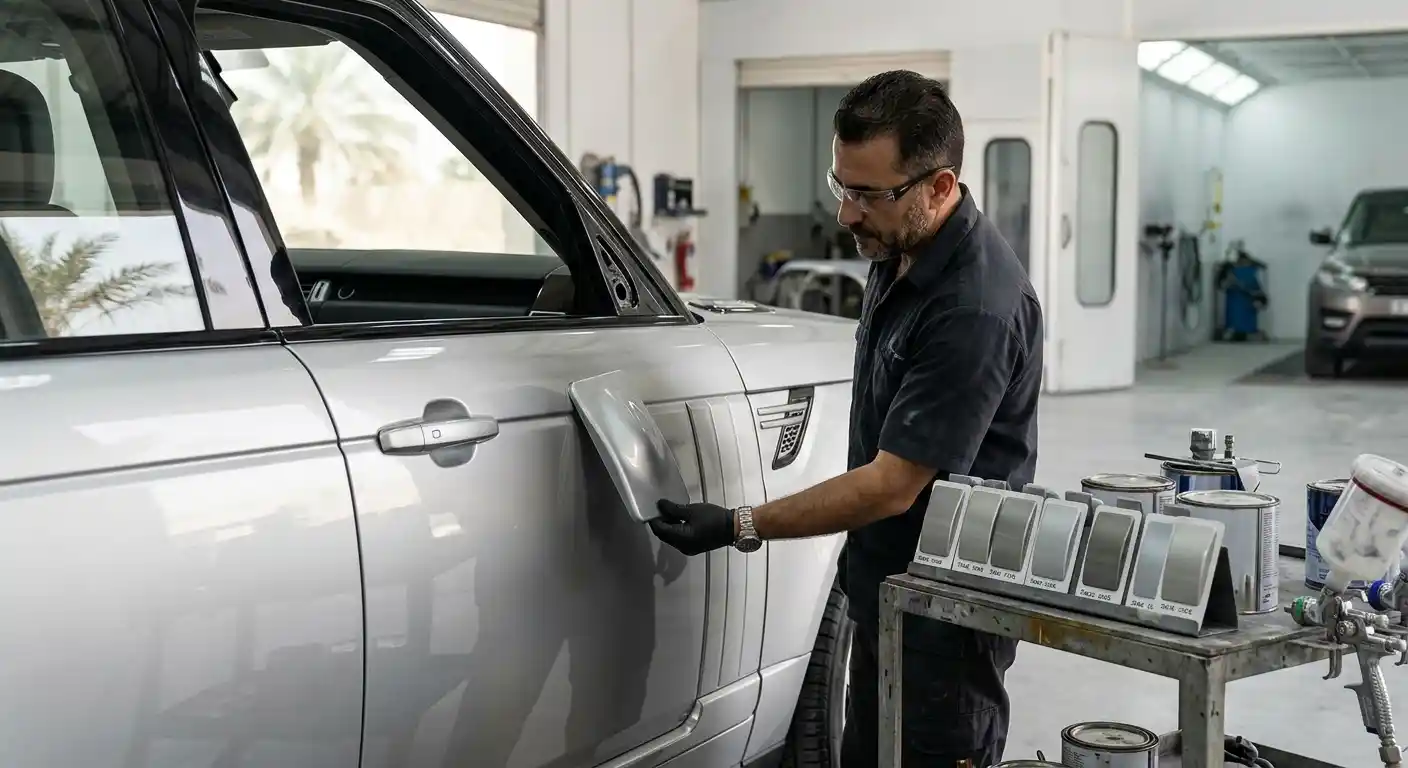
Colour belongs to the complete repair
Toyota paint matching needs more than the code label
A paint code is a starting point, not a guarantee that fresh material will visually disappear beside an aged or previously repaired panel. Substrate colour, earlier refinishing, metallic or pearl orientation and viewing angle can all change the result.
The painter should establish a reliable reference area, identify the likely blend boundary and test the selected formula before committing the repaired panel. Trim, mouldings and fitted hardware should be removed or protected according to the agreed scope rather than painted around casually.
- 01Confirm the substrate and previous paint condition before preparation.
- 02Use colour measurement as a tool, then compare a physical spray-out where required.
- 03Control metallic or pearl orientation through application and viewing angle.
- 04Inspect colour movement, texture, edges and neighbouring-panel consistency before handover.
For the complete sequence, see the car paint matching and spray-out process.
Parts, approvals and timing without blanket promises
The written scope should identify what is confirmed and what remains conditional
A Toyota badge alone does not identify the exact bumper, grille, lamp, moulding or electronic hardware required. Model year, grade, exterior package and fitted equipment can change the part route. The quotation should also separate visible work from damage that requires authorised access to confirm.
Part identification
The estimate should state whether an item will be repaired or replaced and identify the proposed part type and condition. New genuine, aftermarket, used or reconditioned options should not be presented as interchangeable without approval.
- Confirm VIN, model year and grade where part variation matters.
- Inspect guides, clips, brackets, absorbers and sensor holders separately from the visible cover.
- Record any alternative parts route before installation.
Insurance route
An insurer controls policy coverage and approval, while dismantling can reveal supplementary damage that was not visible in the first photographs. That difference should be documented instead of silently absorbed into the first estimate.
- Keep the police report, claim reference and initial damage photographs together.
- Ask how additional damage will be photographed and approved.
- Review the insurance accident repair process in Dubai when the repair is claim-based.
Completion timing
Minor cosmetic work and deeper collision repair should not share one promised turnaround. Timing depends on inspection, access, parts, paint operations, structural work and any electronic or alignment checks included in the approved scope.
- Confirm the repair method before promising a collection date.
- Separate active labour from parts or approval waiting time.
- Update the owner if dismantling changes the route.
Repair evidence should close the original questions
Handover is more than checking fresh paint
The final review returns to what changed after the impact. A clean finish matters, but so do panel position, closure operation, fitted trim, wheel clearance and any electronic or geometry checks that formed part of the repair.
Review panel gaps, door, bonnet, boot or tailgate effort, lamp seating and trim retention.
Check colour movement, texture, repaired edges, masking cleanliness and adjacent-panel consistency.
Recheck clearance and the alignment or geometry evidence included in the approved work.
Confirm the documented result of any scan, aiming or calibration required for equipment disturbed by the repair.
Start with evidence rather than a guessed package
Send the information that changes the Toyota repair decision
Clear photographs help us prepare the right inspection, but they do not prove hidden structure, suspension geometry or sensor position. Send the model, year, impact area and any changed vehicle behaviour so the workshop can decide what must be checked in person.
Send the Toyota damage brief on WhatsApp or call +971 50 233 7180.
- Toyota model, model year and grade where known
- One wide photograph of the affected side or corner
- Close photographs of cracks, gaps, lamps and paint damage
- Wheel and underbody photos if the impact reached that area
- Any new warning, camera, parking, steering or braking change
- Insurance or private repair route, police report status and vehicle location