
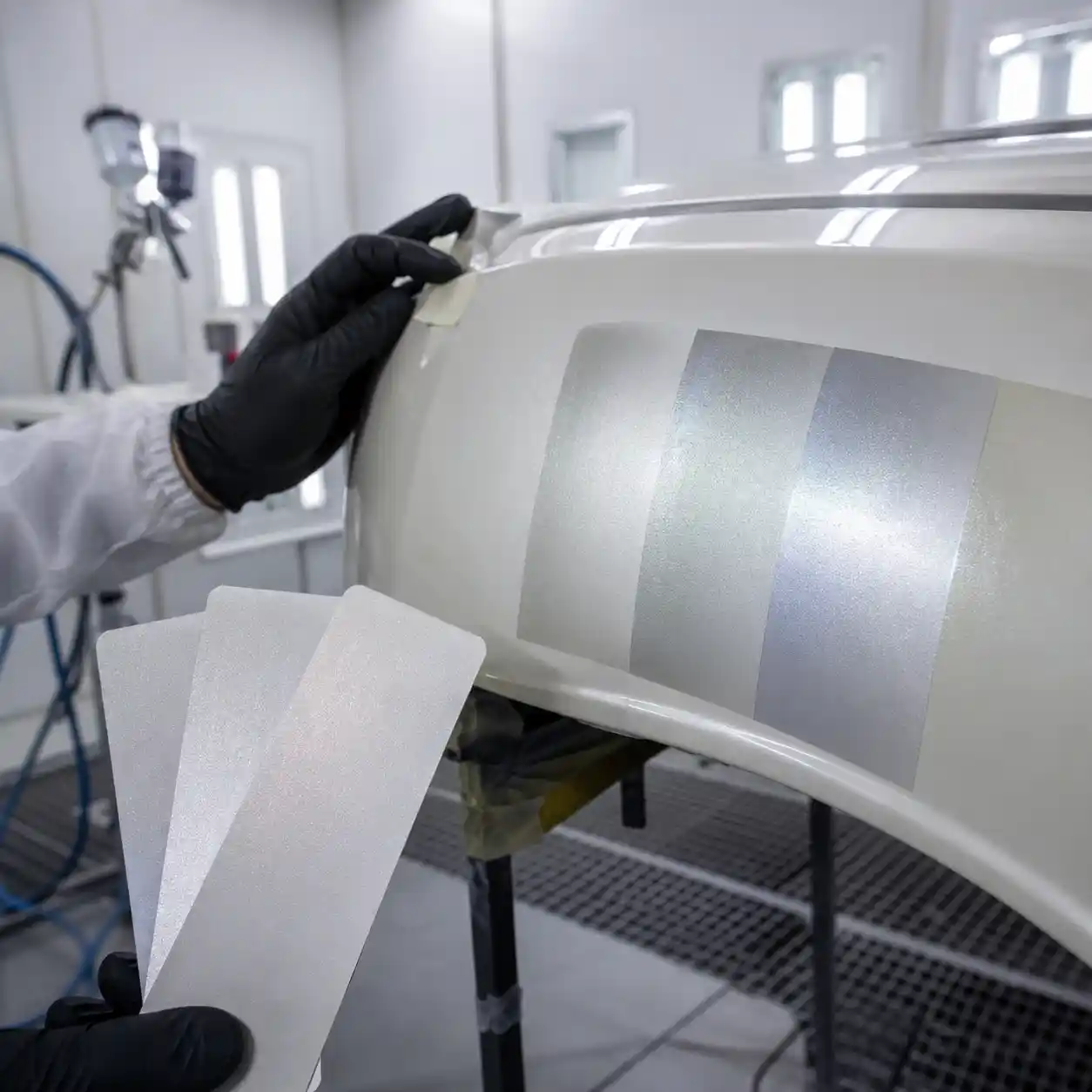
Ground colour, pearl effect and clear coat must agree
Pearl Paint Repair Dubai
Pearl paint can shift with layer count, ground colour, viewing angle and light. A small scratch may need a carefully planned blend because the effect cannot be matched by paint code alone.
Bodyshop.ae identifies two-stage or three-stage construction, prepares stepped spray-outs and controls each layer before the repair reaches the vehicle.
Read the coating stack
Pearl describes an effect, not one universal formula
Pearl finishes sit within automotive paint types explained, but their layer structure controls the repair. The first task is to identify which layer is damaged and how the original effect was built.
Pearl effect within the base colour
Colour and effect are mixed within the basecoat, followed by clear. Formula variant and particle orientation remain important, but there is no separate translucent midcoat.
Ground colour plus pearl midcoat
An opaque or near-opaque ground establishes the hue. A translucent pearl layer changes depth and effect, then clear coat protects the system.
Colour can continue through another layer
Some finishes use tinted clear, effect layers or special OEM processes. Product and vehicle information must define the repair rather than a generic pearl recipe.
Why one extra pass matters
The effect layer changes colour without hiding the ground
In a three-stage system, the ground coat first creates the foundation. If that ground is too yellow, grey, dark or light, adding more pearl rarely solves the match. The translucent midcoat allows the ground to continue influencing the final colour.
Each pearl pass can change face colour, side tone, brightness and depth. The film must remain even across the repair and blend. Unequal overlap or a heavy wet area can create a visible band that only appears from one angle.
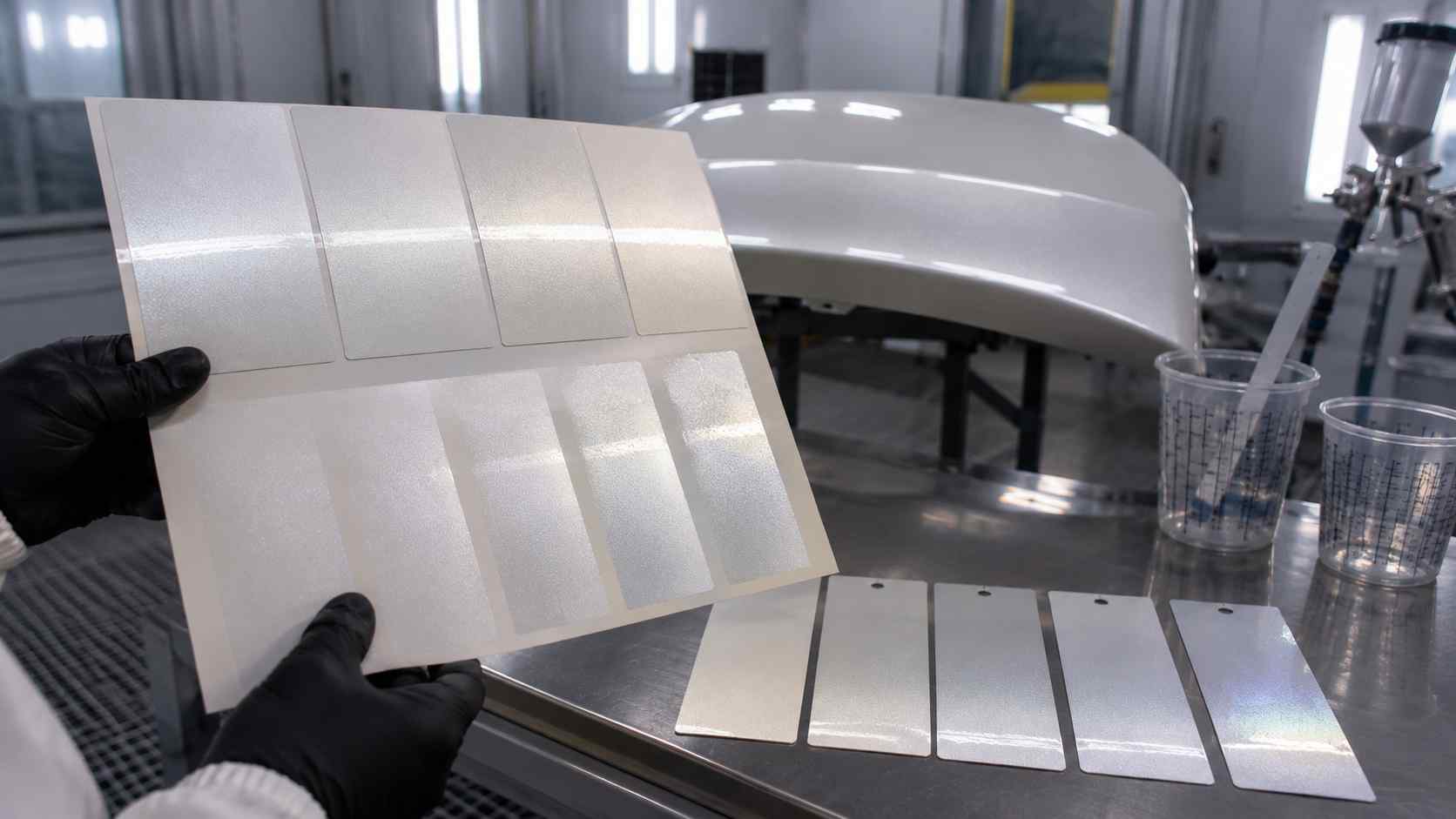
Digital colour tools and the automotive paint matching methods help shortlist a formula, but a stepped spray-out is the decisive proof. The painter applies the same ground to several labelled sections, then adds increasing pearl passes. After clearing and curing, the closest step can be compared beside the vehicle.
White pearl is especially unforgiving because a small shift in ground tone or midcoat count can appear yellow, grey, clean or dirty against the adjacent panel. Dark and coloured pearls introduce their own flop and sparkle changes. No colour name removes the need for testing.
Repair decision map
The damaged layer determines the minimum defensible repair
| Damage | What may be affected | Decision |
|---|---|---|
| Surface contamination | Clear-coat surface only | Use a coating-safe decontamination assessment before abrasive correction |
| Light clear-coat scratch | Clear coat with colour stack intact | Measure and inspect whether controlled clear correction is safe |
| Scratch into pearl or base | Effect layer and possibly ground colour | Rebuild the colour stack and plan a suitable colour blend |
| Chip to primer or metal | All coating layers and substrate protection | Repair substrate, prime, reproduce ground and pearl, then clear |
| Dent with cracked pearl paint | Panel shape plus fractured coating | Correct shape first, then refinish across a boundary that supports the effect |
| Mismatch from an earlier repair | Formula, ground, pass count, application or clear texture | Diagnose each layer before deciding whether local correction or wider refinishing is required |
Polishing can only affect the clear-coat surface. It cannot correct a wrong pearl pass count or ground colour below it.
Stepped sample to final blend
Pearl matching follows a counted process
The technician needs a repeatable layer record so the vehicle is not used as the first experiment.
-
Stage 01
Confirm the reference
Clean the adjacent panel, identify previous repairs and choose a representative viewing area near the damage.
-
Stage 02
Prepare the ground options
Retrieve the likely formula and variant, then spray the proposed ground to opacity on labelled samples.
-
Stage 03
Count pearl passes
Mask or uncover stepped sections so each receives a known number of effect coats using the intended gun setup.
-
Stage 04
Clear and cure the sample
Apply the proposed clear coat because gloss, depth and final film can change how the pearl is perceived.
-
Stage 05
Compare several angles
Review straight-on colour, oblique colour, sparkle, brightness and depth in controlled light, shade and useful daylight.
-
Stage 06
Plan the colour transition
Select a blend area with enough distance to fade the ground and pearl naturally without crowding an edge or handle.
-
Stage 07
Reproduce the approved stack
Follow the recorded ground, pearl pass count, overlap and flash times. Keep the blend controlled rather than extending it without reason.
-
Stage 08
Inspect the cleared panels
Check colour, effect, texture, gloss, dust, blend visibility and reassembled trims before the vehicle is released.
Blend width is a repair variable
Panel geometry can make a small repair visually large
A short scratch near the centre of a broad door may leave useful blend space. The same scratch near a door edge, handle, sharp crease or adjacent repair can restrict the transition. Pearl passes need distance to reduce gradually, and the clear-coat boundary must follow the paint system.
The adjoining panel must also be suitable. Oxidised, scratched or previously mismatched paint can become a poor reference or an unstable blend surface. The estimate should identify any pre-existing condition that affects the expected match.
When the damage spans several panels, our car painting service in Dubai assessment maps the colour relationship across the full side or end of the vehicle. Painting panels independently without a shared sample can create alternating light and dark sections.
A replacement plastic bumper can present pearl differently from nearby metal because shape, substrate and viewing angle change the reading. The objective is a convincing relationship across the assembled vehicle, not an isolated booth sample.
The useful uncertainty point
Request a pearl layer assessment before authorising paint
Send the paint code, vehicle model and year, a complete side or end view, close damage photos and oblique angles in shade and daylight. We will explain the likely coating stack, sample need and blend boundary.
Tri-coat layer discipline
A let-down panel converts pearl pass count into visible evidence
A three-stage pearl finish succeeds only when the ground colour, translucent pearl layer and clearcoat are controlled separately. The stepped sample provides visible proof before the approved layer sequence is reproduced on the vehicle.
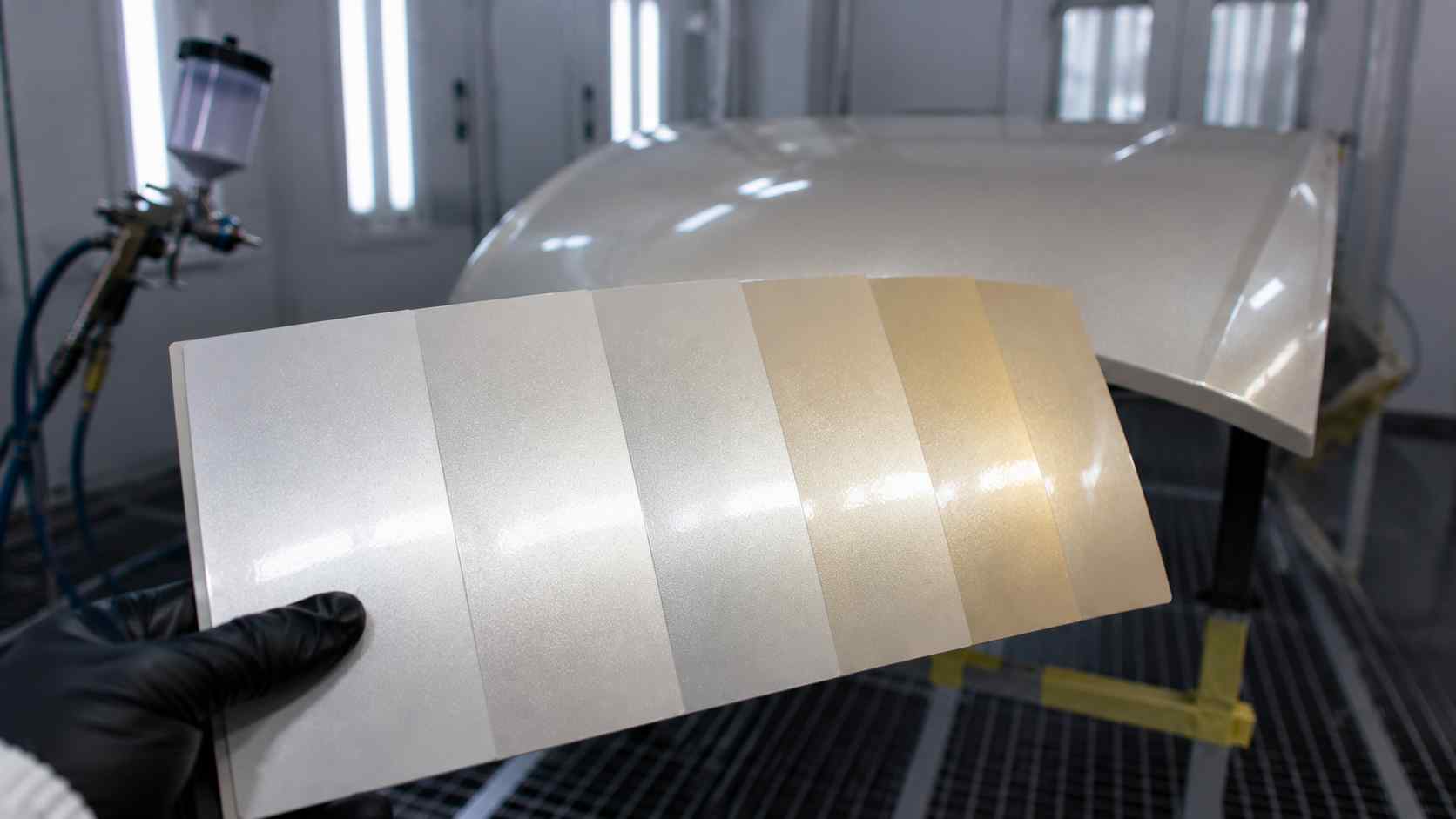
Build the colour stack in order
The ground coat establishes the colour foundation. The pearl mid-coat changes hue, depth and effect without fully hiding it. A wrong ground shade should not be disguised with additional pearl passes.
Turn pass count into visible proof
Each stepped section receives the same ground and an increasing number of pearl passes. After clearcoat and curing, the painter compares colour travel, sparkle and depth beside the vehicle.
Repeat the approved application
Gun distance, overlap, travel speed, air pressure, flash time and wetness affect pearl distribution. The repair record should retain both the selected sample and the application sequence used to reproduce it.
Plan enough transition space
Damage near a handle, crease, edge or previous repair may restrict the pearl fade. Adjacent-panel refinishing is not automatic, but it should be considered when a reliable transition cannot fit inside the damaged panel.
Inspect several angles and retain the layer record
A mismatch visible at every angle can indicate the ground or overall value, while an oblique-only change can point to pearl concentration or orientation. The invoice should identify repaired panels, the ground and pearl system, blend area, spray-out reference, dismantling and any clearcoat or texture correction.
Pearl quality gates
The match must survive more than one light
Colour stack
- Ground colour reaches the approved foundation
- Pearl pass count matches the selected sample
- No ground patch or heavy pearl band shows through
- Blend transition is gradual
Viewing angles
- Face colour agrees from normal viewing distance
- Side tone remains related at an oblique angle
- Sparkle and depth do not change abruptly
- Plastic and metal parts read convincingly together
Surface finish
- Clear-coat gloss and texture are consistent
- No sanding marks or repair outline appears
- Edges and openings are clean
- Dust or polishing correction remains within the agreed standard
Handover record
- Painted and blended panels are listed
- Formula and sample route are retained
- Aftercare and curing guidance is supplied
- Any limitation from aged or previous paint is written
Pearl quotation layers
A useful estimate separates body work from effect matching
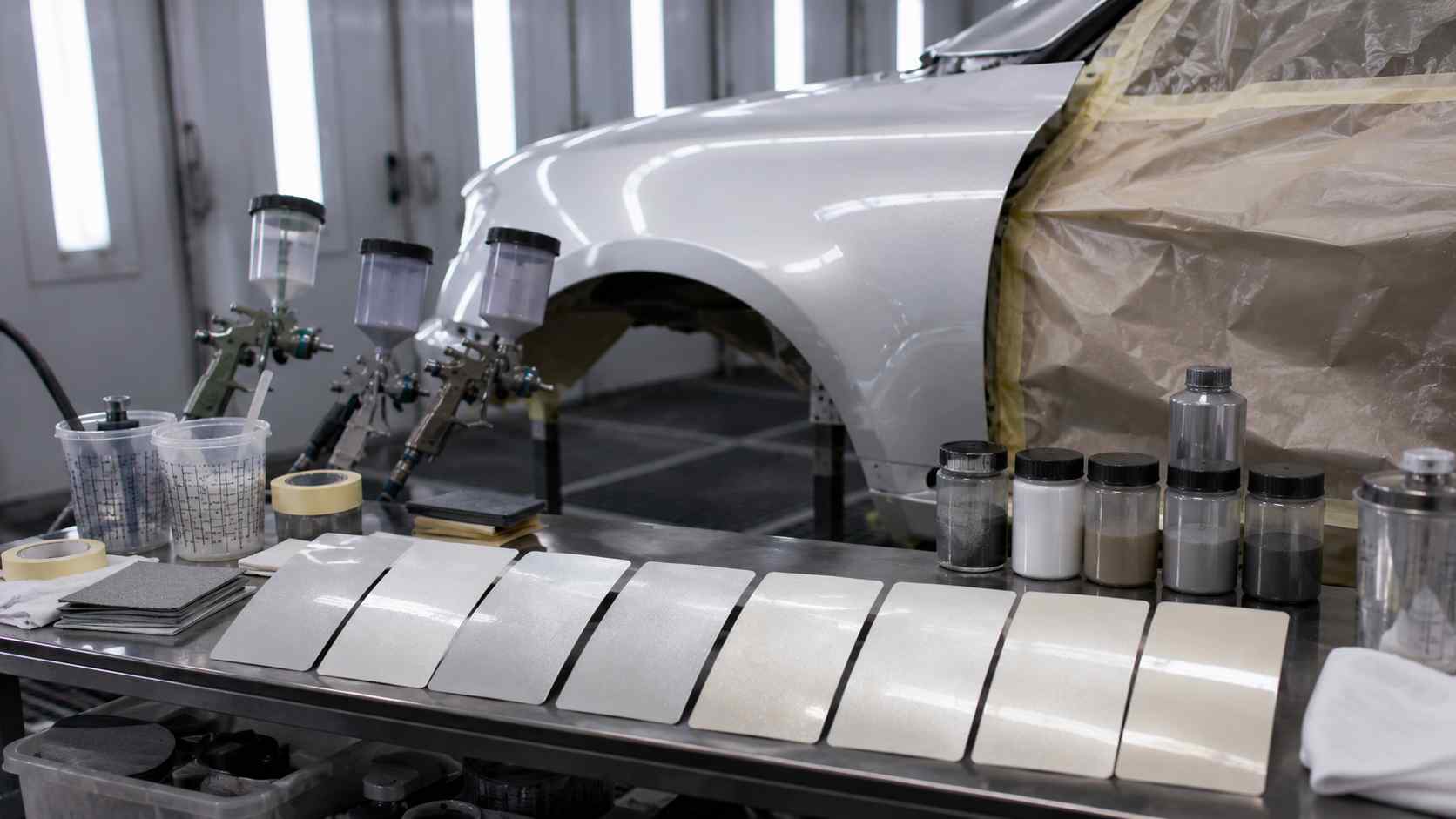
The repair begins with substrate operations such as dent correction, crack repair, chip excavation, corrosion treatment and primer. Those tasks are priced by damage and material, not by the pearl name. The colour process then adds formula research, spray-out samples, ground application, effect-layer control and blend work.
Dismantling is another independent layer. Handles, mouldings, lamps, badges, sensors and seals can interrupt a pearl transition or clear-coat boundary. Removing them can improve access, but clips, one-time fasteners, coding or calibration responsibility must remain visible in the estimate.
The quotation should identify every panel receiving ground colour, pearl effect, colour blend or clear coat. A statement such as paint left side is too vague for a tri-coat repair because the material and labour differ between a local substrate repair, a basecoat blend and a fully cleared adjacent panel.
Previous repainting can increase sampling and correction. If neighbouring panels carry different pearl counts or ground shades, one new repair cannot match several conflicting references at once. The workshop should map the colour relationship, choose the controlling reference and explain the limitation before painting.
No fixed pearl surcharge is quoted here. The final amount depends on the vehicle, damage, layer construction, sample iterations, blend space, dismantling, previous coatings, parts and selected paint system.
Pearl repair decisions
Pearl paint repair questions
Why is pearl paint harder to match than solid paint?
Pearl appearance can depend on a separate translucent effect layer, its pass count, the ground colour below it, viewing angle and application technique. Colour code alone does not control all of those variables.
Can only the scratched spot be painted?
The substrate can be repaired locally, but the colour and clear-coat boundaries may need to extend across a larger area or complete panel so the pearl transition is not visible.
What is a three-stage pearl paint?
It commonly uses a ground colour, a translucent pearl midcoat and a clear coat. Some special systems differ, so the selected paint information must define the exact stack.
Why does pearl white look yellow after repair?
Possible causes include ground colour, pearl formula, effect-layer count, film build, neighbouring ageing and lighting. The coating layers must be diagnosed rather than corrected by polishing.
Pearl matching is a counted coating process, not a colour-code promise.
If the vehicle already has a mismatch, use the car paint defect guide to record texture or clear-coat concerns separately from colour and effect.
The repair can stop with confidence when the approved sample, layer record, blend panels and handover lighting all point to the same result.