
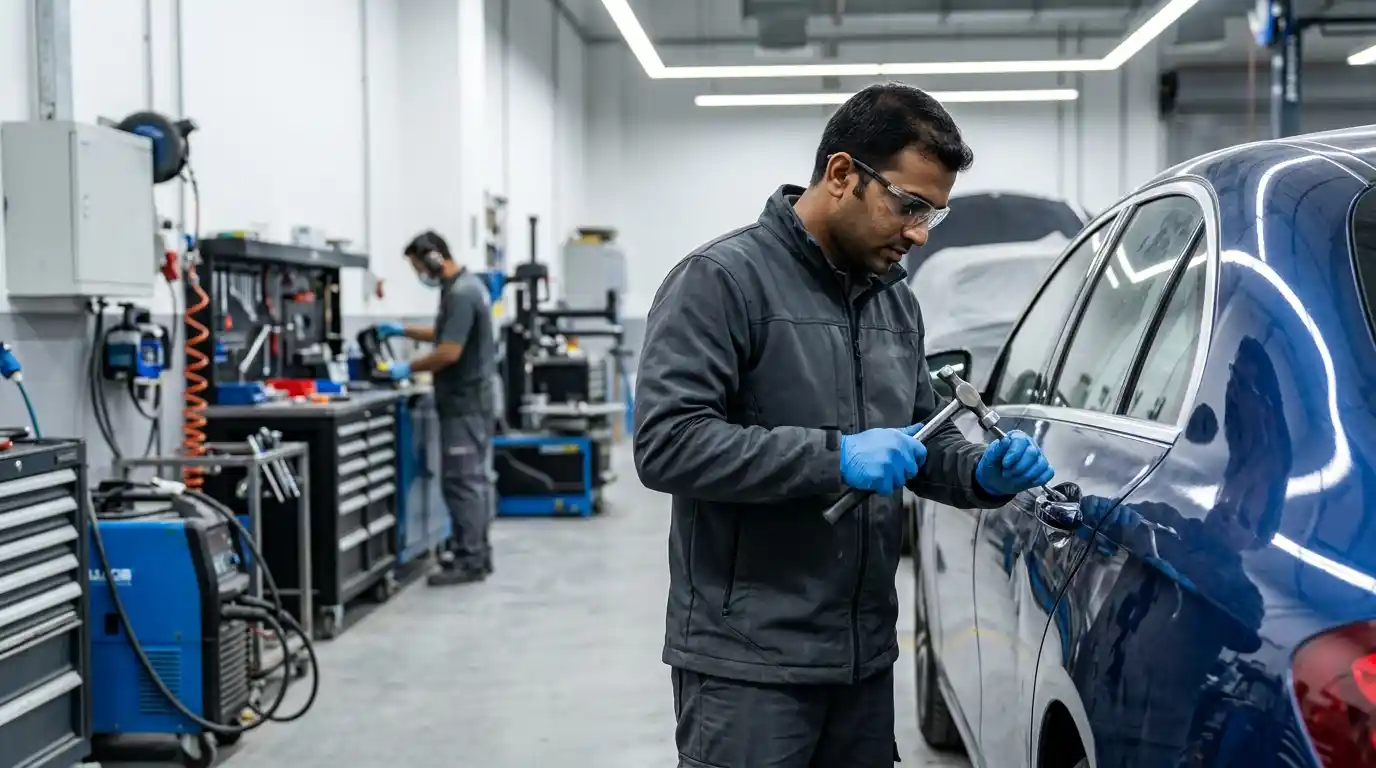
A repair is a chain of accountable decisions
Body Repair Technicians Dubai
Our body repair technicians work across assessment, panel repair, structural measurement, preparation, refinishing, reassembly and quality control. No single person should hide the damage, choose every method, paint every surface and approve their own work without a recorded handoff.
BodyShop.AE organises the job so each specialist receives clear evidence, performs a defined operation and leaves the next technician something that can be checked.
The handoff map
Six roles keep the repair connected
Records vehicle identity, damage, prior condition, warnings, claim details and the first repair hypothesis.
Confirms access, material, repairability, part removal and the actual extent found after dismantling.
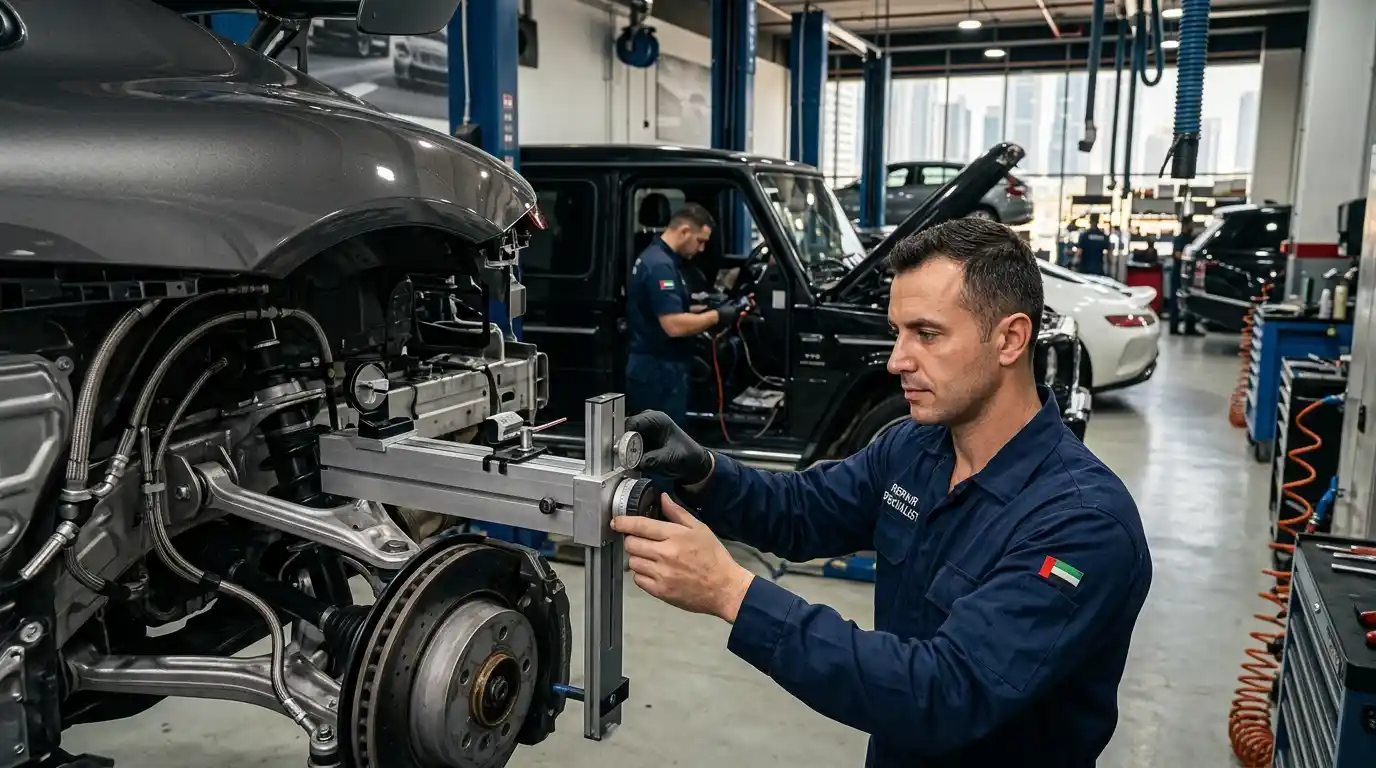
Measures reference points and follows the permitted repair or replacement method when load-bearing areas are involved.
Refines shape, substrate transitions, corrosion protection, primer and sanding readiness before colour.
Controls colour selection, spray-out, blending, application, curing, texture and finish inspection.
Checks scope, fit, finish, functions, scan or calibration records and handover evidence without relying on memory.
A smaller repair may combine roles, but the decisions remain separate. The person completing an operation should know its acceptance check, and the next person should be able to stop the job when the evidence does not support progression.
Assessment technician
Translate visible damage into inspection questions
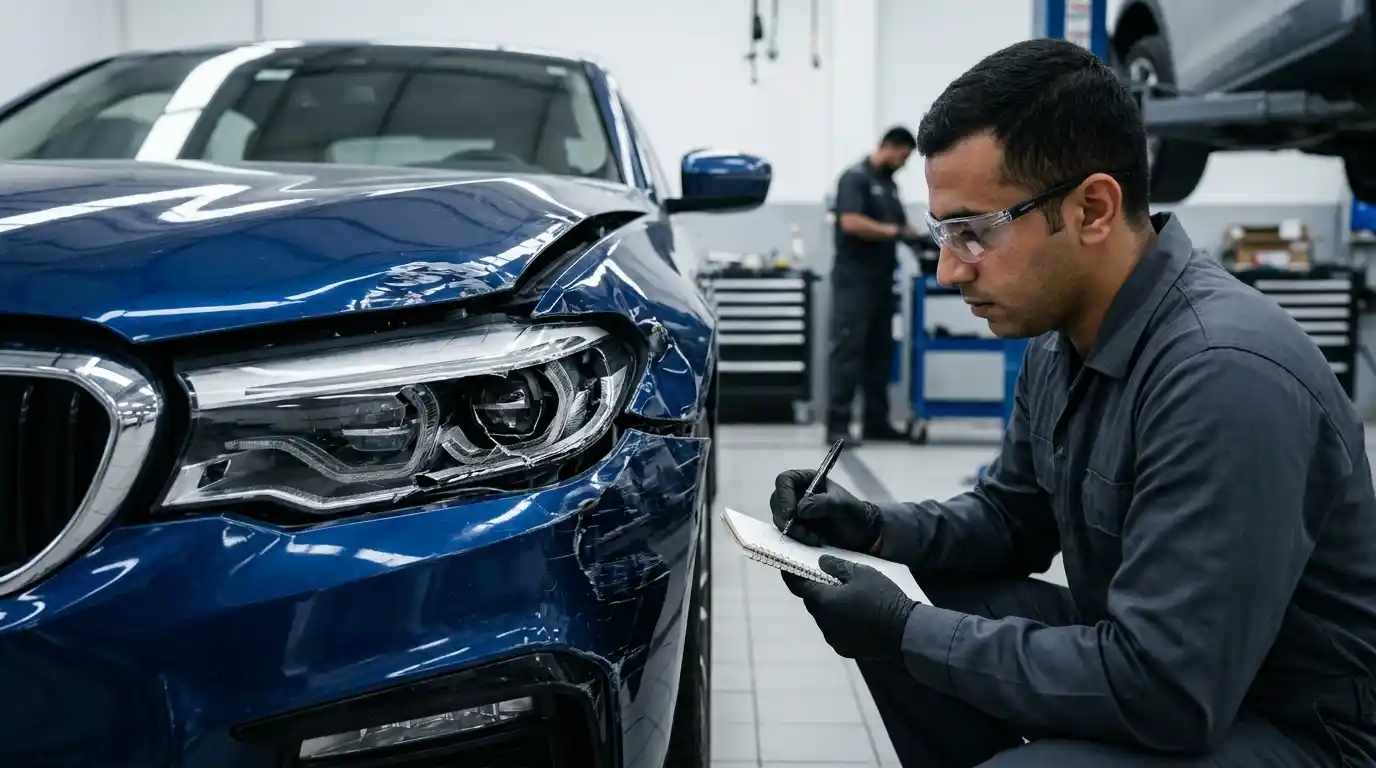
The estimator or damage assessor begins with the make, model, year, VIN where needed, impact direction, warning lights, police or insurance status and customer concern. Photographs document the starting condition before cleaning or dismantling changes it.
The assessor does not decide structural safety from a bumper photograph. The initial plan identifies possible hidden damage, measuring needs, scan requirements, paint operations, parts questions and approval dependencies. Supplemental damage is recorded when dismantling reveals something that could not reasonably be confirmed at intake.
For collision work, our accident repair service in Dubai connects this technical plan to insurer estimates, approvals, supplements and collection evidence.
Panel and structural work
Material identification controls the method
Steel panel repair
The technician evaluates dent depth, stretch, body lines, edges, access, coatings and the position of reinforcements. Heat, pulling and welding cannot be applied as universal shortcuts.
Aluminium repair
Aluminium needs material-aware tools, contamination control and a repair decision suited to the alloy, location and manufacturer information. Some damaged parts require replacement.
Plastic repair
Bumper material, crack position, moulded tabs, sensor apertures and reinforcement determine whether welding, adhesive repair or replacement is appropriate.
Structural technicians distinguish outer cosmetic skins from rails, pillars, sills, crossmembers, floors, subframes and separate ladder-frame sections. Measurement should answer whether geometry moved, not merely make panel gaps look even. High-strength and ultra-high-strength steels can have specific limits on heating, sectioning and straightening.
Preparation decides what paint will reveal
The paint team should not inherit unresolved body work
Body filler is a shaping material within a controlled repair, not a substitute for bringing the panel close to its intended form. The preparation technician checks metal or plastic stability, feathered paint edges, corrosion protection, pinholes, sanding scratches, primer cure and the surface transition across the repair.
A guide coat and reflected inspection light can reveal low spots, waves and scratches before colour. Edges, apertures, moulding areas and blend panels need their own preparation. Dust from dry work must be controlled before the vehicle reaches the automotive paint process.
Panel contour and body lines are reviewed from more than one angle before primer hides the metal transition.
Bare metal, old coating, filler, primer and sealer must form a compatible and stable system.
Door edges, wheel arches, bumper returns and masking boundaries receive deliberate preparation.
Dust, oil, silicone, wax, water and adhesive residue are treated as defect causes, not polishing problems.
Refinishing technician
Colour matching combines data with repeatable application
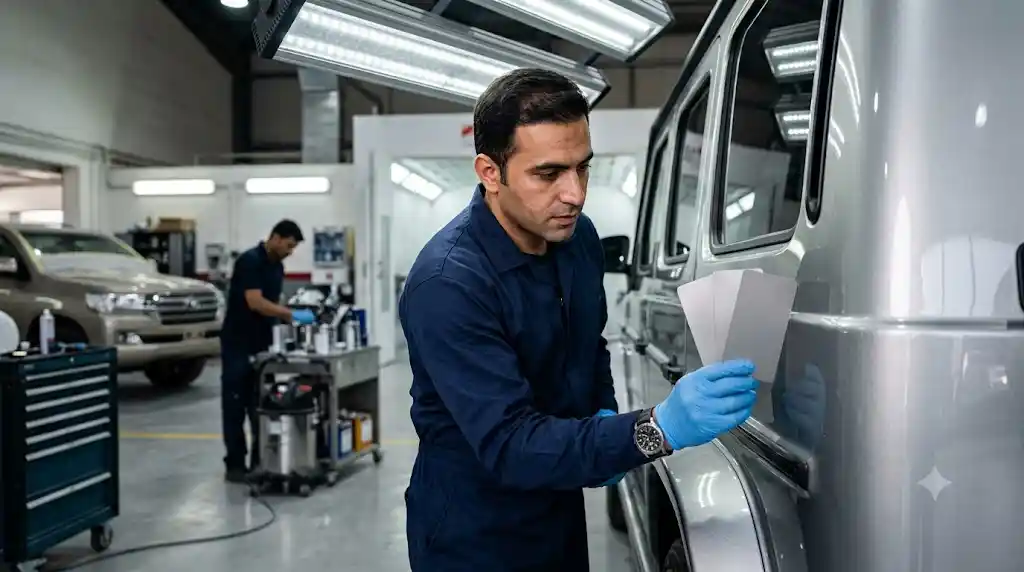
The painter confirms the code and variant, examines adjacent panels, checks previous refinishing and uses colour measurement where appropriate. Candidate formulas are applied to spray-out cards because instrument data alone cannot reproduce film build, metallic orientation or pearl travel.
The technician records ground shade, coat sequence, gun setup, flash and effect-control technique so an accepted sample can be repeated on the vehicle. A blend is used only when the transition plan and adjacent panel condition support it.
After clear coat and curing, colour, gloss, texture, dust correction, edges and blend transitions are inspected. A panel can be the right colour and still look wrong because the texture is too flat, too coarse, cloudy or poorly polished.
Reassembly and systems
The repair is not finished when the clear coat shines
Reassembly technicians restore lamps, handles, mouldings, seals, liners, brackets, clips, wiring and sensor mounts according to the work order. Reusing a distorted guide or broken moulded tab can make a painted bumper corner pop out later. Tight panel gaps are not automatically correct if the latch, hinge or weather seal is under stress.
Vehicles with cameras, radar, ultrasonic sensors, airbag systems, seatbelt pretensioners or high-voltage components need the relevant diagnostic and safety path. Scanning does not replace visual inspection, and clearing a fault does not prove calibration. Required calibration depends on the exact equipment and repair event.
The technician records unresolved faults, unavailable parts and external calibration evidence instead of passing them silently to the customer.
Quality ownership
Each stage signs off what the next stage will hide
| Gate | Technician evidence | Reason to stop |
|---|---|---|
| After dismantling | Damage map, parts list, hidden findings and updated scope | Unapproved structural, safety, parts or insurer change |
| After body repair | Shape, measurements, attachment method and corrosion protection | Geometry, material or repair-method uncertainty |
| Before paint | Substrate, sanding, masking, colour plan and spray-out approval | Pinholes, poor edges, contamination or unresolved mismatch |
| After paint | Colour, effect, gloss, texture, coverage and correction record | Defect requiring rework before reassembly |
| After reassembly | Panel fit, functions, lamps, trim, scans and calibration record | Warning, fit, leak, noise or missing operation |
| At handover | Scope review, photos, documents, aftercare and customer explanation | Evidence does not match the invoice or approved job |
The planned body shop quality control checklist expands these gates into a stage-by-stage record. The technician page owns the people, roles and handoffs that make those checks credible.
Training and competence
Verify the skill required for the actual job
Competence is task-specific. A skilled painter is not automatically qualified to isolate a high-voltage vehicle. A dent technician is not automatically authorised to section an ultra-high-strength pillar. A scanner operator is not automatically able to perform every static or dynamic calibration.
Ask whether the technician has current training for the material, equipment and procedure involved. The workshop should be able to identify who owns structural measurement, aluminium work, welding, paint mixing, diagnostics and quality control. Certificates can support a claim, but the repair record must still show that the correct method was followed.
BodyShop.AE does not invent staff biographies or claim manufacturer approval without written proof. Technician profiles and credentials should be published only when names, roles, training and permission are verified.
Your repair conversation
Bring the symptom to the correct specialist
Send the vehicle make, model, year, damage area, warning lights and clear photos. Tell us whether the problem followed a collision, parking impact, previous repair or paint failure. The first assessor can then involve the panel, structural, paint or systems technician who owns the next decision.
Our body repair technicians should leave you with more than a finished surface. The job record should explain what was found, what was repaired or replaced, which checks were completed, what remains limited and how to care for the result.
Tools do not replace judgement
Equipment must answer a defined repair question
Measuring systems
Three-dimensional or point-to-point measurement can compare relevant reference locations. The technician decides which points are accessible, which data applies and whether suspension movement affects the reading.
Welding and joining equipment
Resistance spot welding, MIG or MAG processes, aluminium joining, riveting and bonding each have controlled applications. The operator must match equipment, consumables and settings to the material and procedure.
Paint and colour tools
Mixing software, scales, spectrophotometers, spray guns and inspection lights support a repeatable finish. Spray-out testing and painter technique remain necessary.
Tool ownership is not proof of competence. Maintenance, calibration, consumables, technician training and a recorded method determine whether the equipment contributes reliable evidence.
Repairable versus replaceable
The technician should explain the limit, not only the option
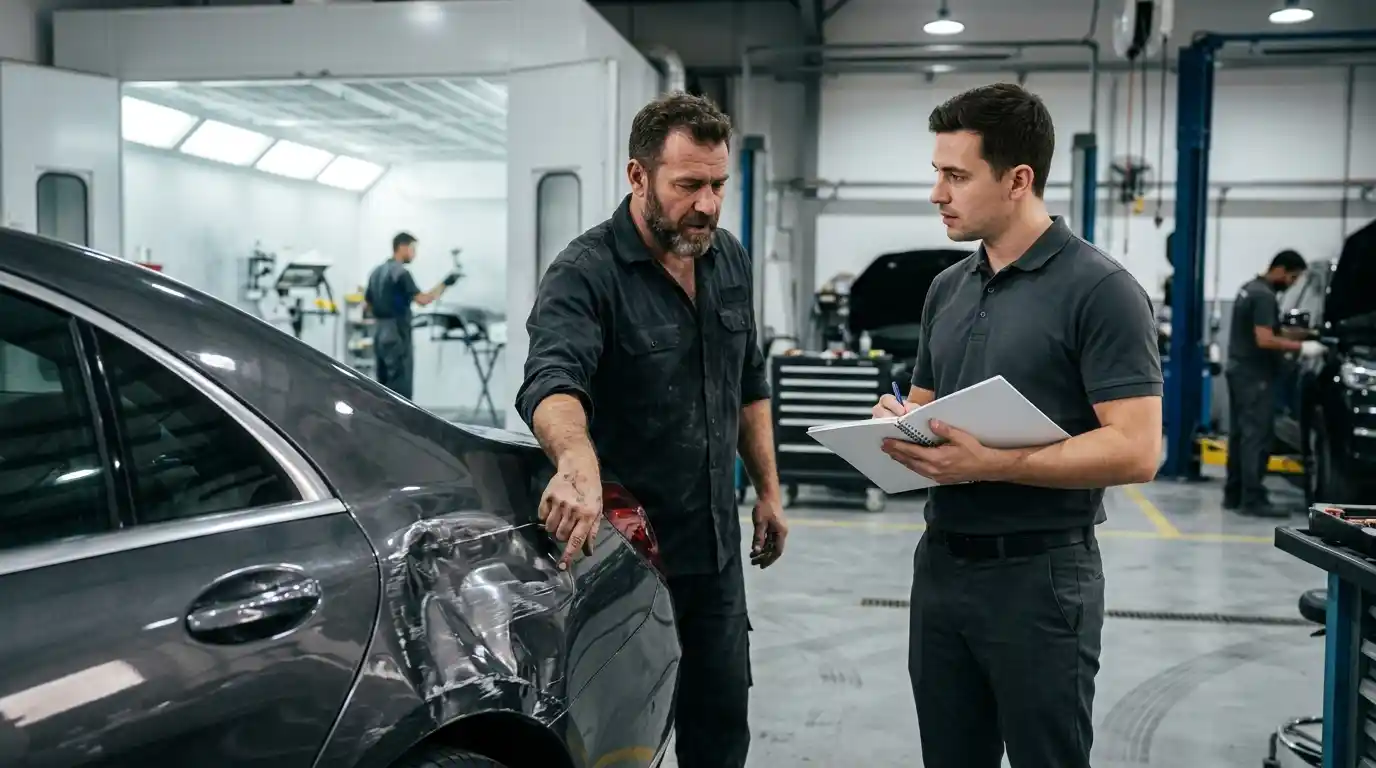
A panel can be technically repairable but commercially unwise if labour, access, corrosion protection, finish risk or calibration exceeds a correct replacement. A part can also be replaceable but unnecessary when controlled repair preserves fit and original joints.
The body technician considers material, damage depth, stretch, edge location, reinforcement, previous repair and finish. The estimator adds parts price, availability, dismantling and insurer approval. The painter considers colour transition and additional panels. The quality controller considers whether the finished method can be verified.
This joint decision prevents one department from shifting risk to the next. It also gives the customer a useful reason for the selected method and any limitation.
Customer-facing technician evidence
What you should receive without entering the workshop floor
Wide and close images, prior condition, warnings and agreed panels.
Photographs and explanation before supplemental work changes the approved scope.
Relevant measurements, joining, corrosion protection, substrate or spray-out evidence.
Scan, alignment and calibration results where the vehicle and repair require them.
Panel fit, finish, functions and repaired-area review tied to the invoice.
Written instructions, coverage terms, exclusions and the route for reporting a concern.
Our body repair technicians use these records to explain the job at the customer’s altitude. You do not need to interpret weld nugget dimensions or paint chemistry, but you should be able to see which decision was made, why it was made and who checked the result.
Workshop communication
One contact should connect the specialists without hiding them
Customers should not have to chase a painter, panel technician and estimator separately to understand one job. A named service contact can coordinate updates, but technical answers should come from the person or record that owns the decision.
Before work, agree how hidden damage, parts delays, insurer supplements and completion changes will be communicated. During production, an update should say what stage the vehicle reached, what new evidence appeared and what approval is needed. A photograph without explanation is not a progress report.
At handover, the customer-facing person should be able to trace the work from intake to final quality control. If a question needs the body, paint or systems technician, it should be escalated rather than guessed. This communication discipline is part of technician quality because it keeps the written scope aligned with the physical repair.
For a warranty concern, the same pathway should retrieve the original technician record before anyone polishes, dismantles or rejects the complaint.
Continuous improvement
Completed repairs should improve the next repair
Technician review after handover can identify recurring parts delays, fitment problems, paint variants, calibration triggers and quality defects. Recording those lessons helps the next estimator ask better questions and the next technician prepare the right method. Improvement should come from verified repair evidence, not from turning one unusual job into a universal rule.