
LONG-BODY ALIGNMENT, HATCH AND MATERIAL-AWARE REPAIR
Tesla Model S Body Repair Dubai
Tesla Model S body repair in Dubai must preserve the relationships across a long, low body. A modest door impact can disturb the sill, frameless glass and adjacent gaps. Rear damage can travel from the bumper into the liftgate opening, lamps and quarter edges. Front-corner contact can involve the bonnet, wing, lamp, wheel position and camera or sensor mounts. We map those connections before deciding whether the job is cosmetic, body-and-paint, structural or specialist-led.
Before movement
Record warnings, wheel position, fluid loss, heat, odour, steering change and whether any closure is trapped.
Before dismantling
Capture complete-side photographs, gaps, glass position, lamp seating and the underside contact zone.
Before approval
Identify the model generation and current procedure, then separate confirmed work from conditional findings.
The first decision is not repair versus replacement
The first decision is whether the vehicle is safe to move and inspect normally. A surface scuff with stable gaps and no warning state follows a different route from a sill strike, wheel displacement, restraint deployment, floor deformation or high-voltage concern. If the impact affects safe lifting, storage, charging or dismantling, those controls are set before the workshop discusses cosmetic finish.
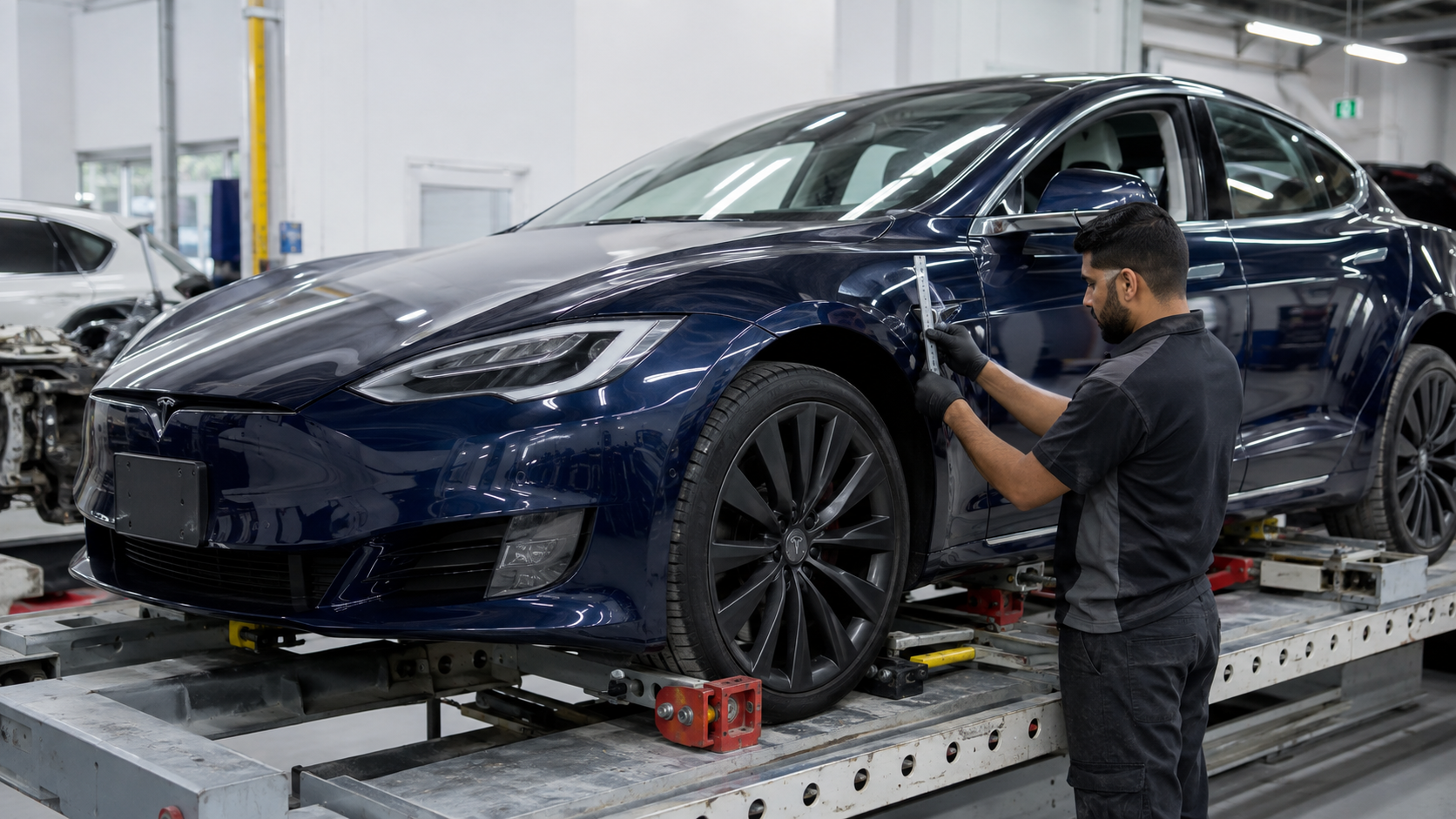
A useful intake also records the direction and height of the impact, whether the car was stationary, any previous repair in the area and new wind, water or road-noise complaints. The Model S has wide uninterrupted surfaces, so a moved opening or shallow crown can become visible far beyond the dent. Comparing the undamaged side helps distinguish design from impact change.
Three reasons a Model S quotation may remain provisional
- Access: the bumper cover, liner, trim or interior panel must be removed to see attachments.
- Generation: the correct part, body map and procedure depend on the vehicle identification details.
- System state: diagnostics, alignment, calibration or high-voltage assessment may be required after physical inspection.
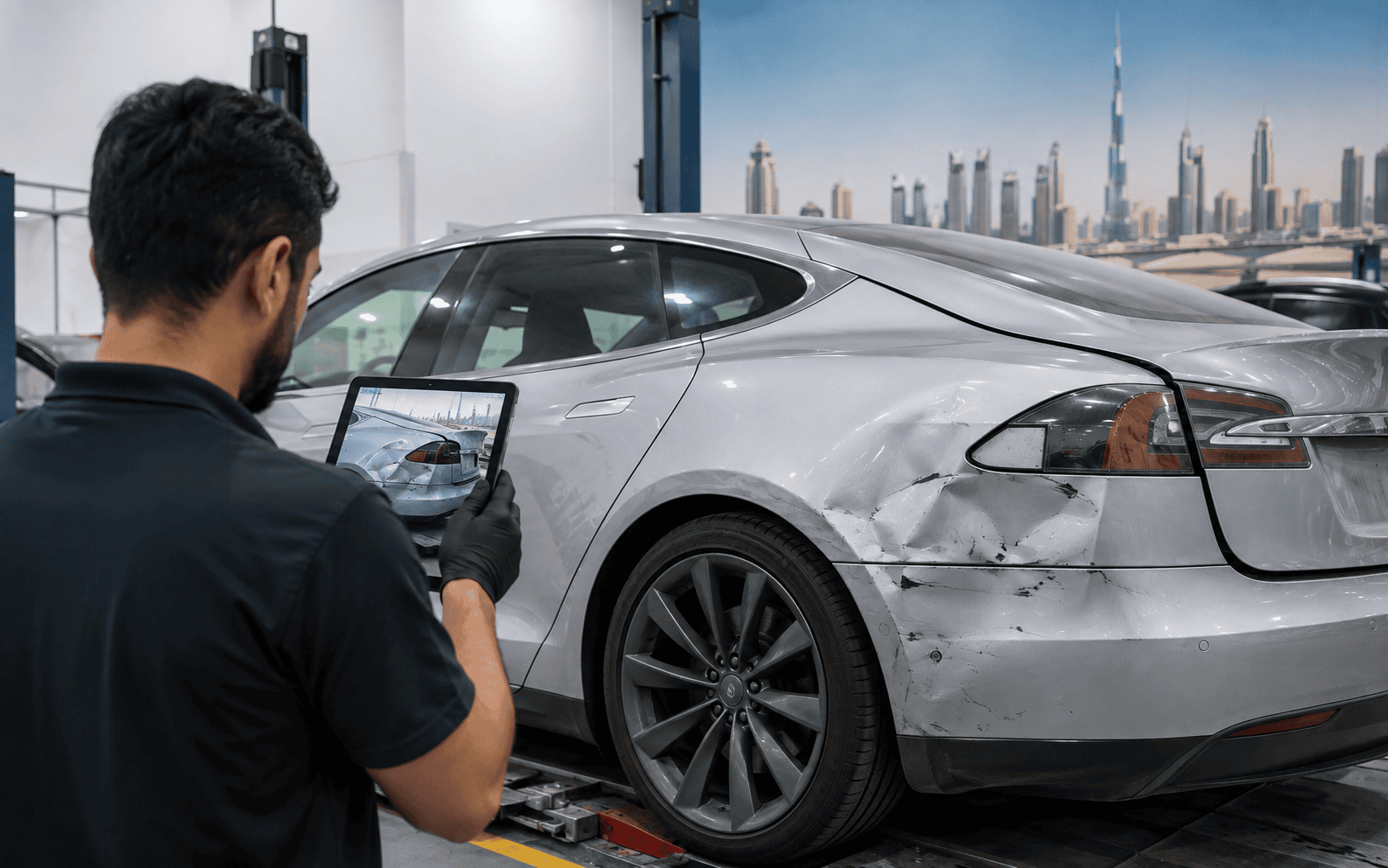
Model S generations require separate repair information
A 2012 to 2020 Model S and a 2021-onward Model S do not share one complete collision-repair manual. Tesla publishes separate procedures, material maps, dimensional information and part-repairability guidance. The estimator therefore records the VIN and production details before choosing a method. The current 2021+ Model S collision manual is one example of the generation-specific information that must govern structural work.
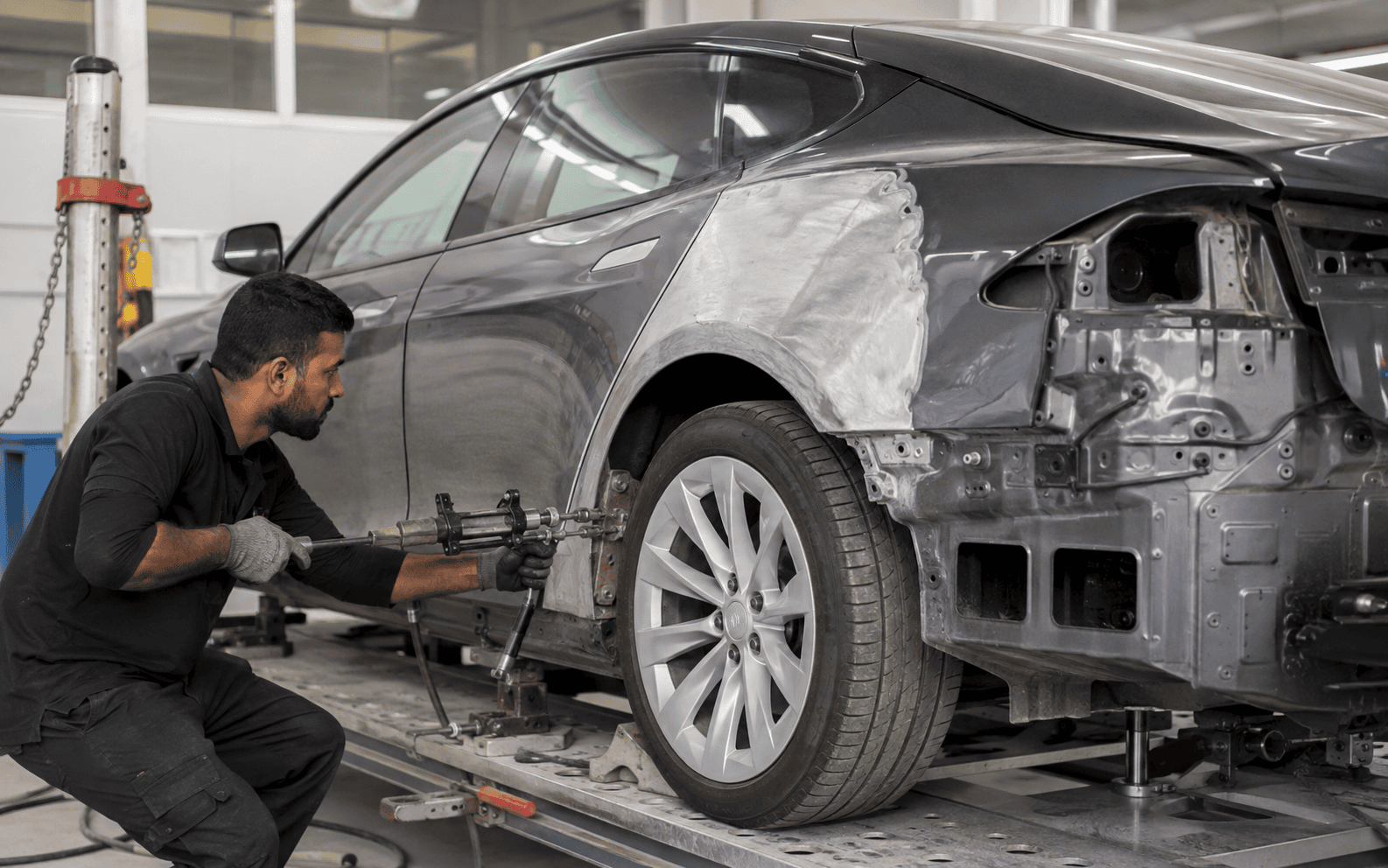
The body contains components with different material and strength classifications. Heat, straightening, sectioning and joining are not assumed to be permitted because they worked on another panel or an earlier car. A repairable outer dent, a kink in a restricted component and damage at an attachment flange require different decisions. The written plan should name the component and permitted operation rather than use vague phrases such as ‘pull chassis’ or ‘fix aluminium’.
Long-panel repair is judged in moving reflection
A Model S door or quarter panel can feel smooth while still showing a crown, flat area or waviness outdoors. The technician establishes reference lines beyond the damaged footprint, then evaluates the surface from several heights. Broad shallow distortion may be recoverable with controlled metal correction. A sharp crease through an edge, stretched material, damaged reinforcement or restricted access can change the method.
Paintless dent repair is considered when the finish is intact, the material and access allow it, and correction will not disturb a protected or bonded area. Conventional repair may be more predictable when paint is broken or the surface needs controlled reshaping and refinishing. Replacement is evaluated as a full operation: glass and trim removal, joining, adhesive or fasteners, corrosion protection, sealing, paint, reassembly and final checks.
Frameless glass cannot compensate for a moved door
Before door trim is removed, we record closing effort, window indexing, seal contact, mirror position, wind noise and water entry. A technician first restores the door shell, hinges, latch and opening geometry. Glass adjustment follows that foundation. Moving the glass to hide a misaligned door can create excessive edge pressure, leakage or noise and does not correct the impact path.
Handover checks cycle every disturbed door repeatedly. The window lowers and raises correctly, the glass meets its seal evenly, the handle and latch function, and the panel gaps remain stable. If fixed glass or roof glass was removed, the file should record surface preparation, adhesive system, setting position and cure requirements.
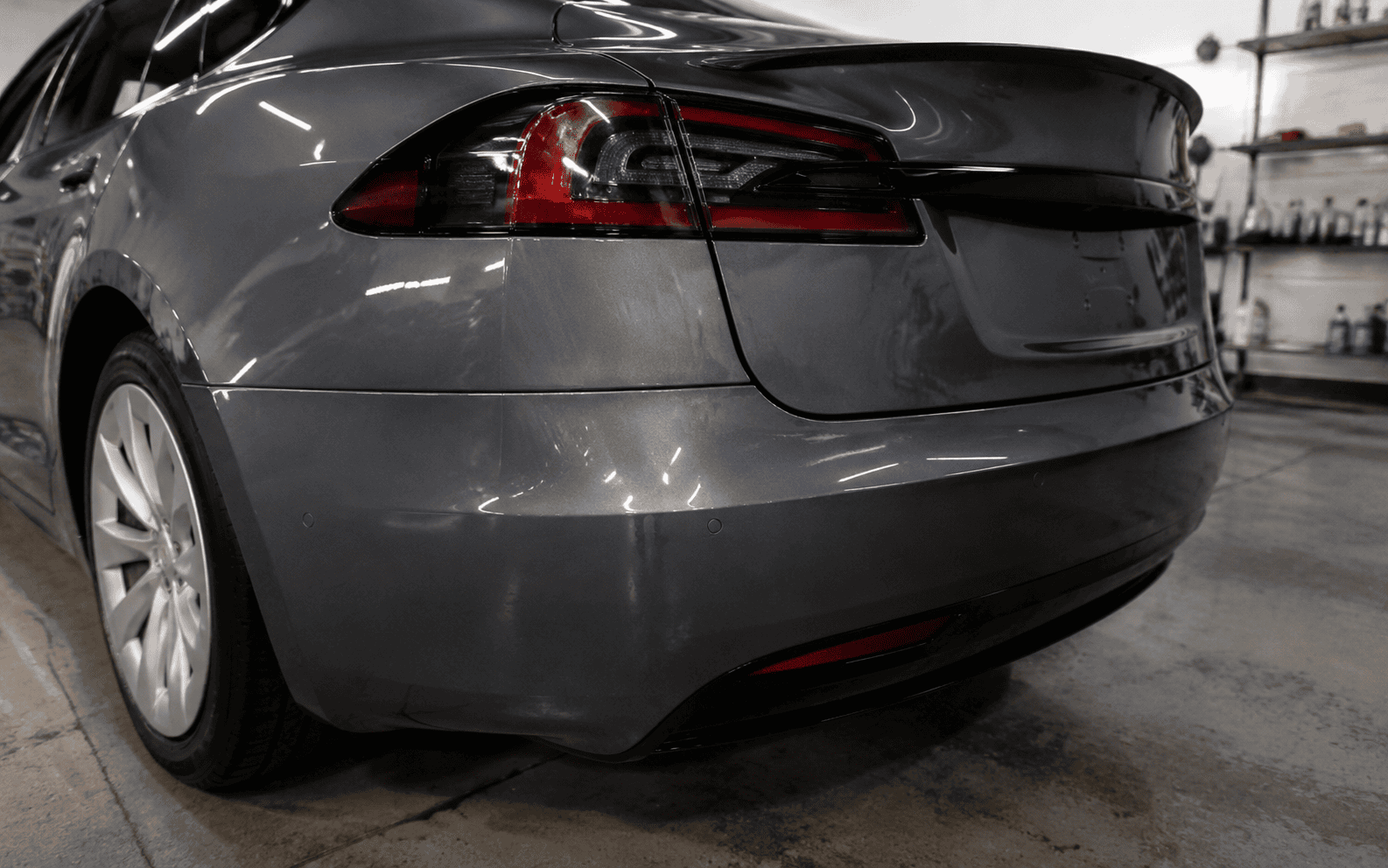
The Model S liftgate creates a large rear opening. A bumper impact can affect the rear panel, lamp pockets, quarter-panel edges, latch position, seals or lower floor even when the liftgate skin looks undamaged. We compare the opening at several points, inspect lamp seating, check latch effort and review the seal land before pricing a local bumper repair.
A gap that looks even at one corner may widen elsewhere. The liftgate is opened and closed without forcing it, and power operation is tested where fitted and safe. Water management matters after rear-panel or glass work: drains, seams, grommets and seals must remain clear. Any leak test follows visual geometry and sealing inspection, not the other way around.
Low sill and battery-floor evidence changes workshop handling
A kerb, ramp, debris or side impact can mark the rocker cover or lower floor zone. We distinguish removable trim damage from deformation near a structural or high-voltage boundary. The exact location, depth, direction, warning state and underside evidence decide whether normal body work can continue. A scrape alone does not prove battery damage, but it should not be painted over before the boundary is understood.
Correct lift points are used, and an impacted car is not raised until the lower-body condition permits it. High-voltage warnings, heat, odour, smoke, leakage, floor deformation or charging concerns trigger controlled storage and specialist assessment. The estimate records whether that assessment is included, required before dismantling or outside the workshop’s verified scope.
Pause cosmetic work when
- The sill or floor has a deep fold, puncture, displaced seam or upward deformation.
- The vehicle reports a high-voltage, restraint, braking or stability fault after impact.
- A wheel is no longer centred, the tyre rubs or the car sits differently.
- There is heat, odour, smoke, leakage or unusual noise.
- The charge-port area or rear power-component zone was struck.
- Safe lift points cannot be confirmed.
Suspension stance is recorded before panel-gap diagnosis
Some Model S vehicles use adjustable air suspension. Vehicle height, loading and system state can change how a long body appears relative to its wheels and openings. Before calling a gap structural, the technician records suspension warnings, ride-height state, tyre pressures and obvious wheel displacement. A car that sits lower at one corner after impact needs mechanical and structural screening, not a cosmetic panel adjustment.
After the body foundation is restored, wheel alignment or suspension work is completed where the impact evidence requires it. The final road test, if safe and authorised, checks steering centre, noise, vibration and braking behaviour. These findings are recorded separately from paint quality so one passed check does not hide a failure in another discipline.
Camera and sensor checks follow bracket and panel correction
Front, rear and side body work can disturb camera views, sensor apertures or mounting brackets. The first closure task is physical: restore the bumper contour, lamp fit, grille or trim seating and the mounting plane. Diagnostics then identify faults, followed by functional tests and calibration or aiming only where the fitted equipment and current procedure require it.
A clean scan is useful but not conclusive on its own. A component can communicate while sitting in a bent bracket. The final file should state what was disturbed, what was inspected, which diagnostic or functional checks were completed and whether calibration was required, performed or escalated.
Model S paint matching needs a full-panel viewing plan
The Model S has long surfaces that reveal hue, metallic orientation and clear-coat texture changes. Paint identification starts the process; a spray-out verifies the variant and application against the car. Prior paint, Dubai sun exposure and adjacent-panel condition influence whether blending is needed. Blending should solve a visible transition, not become an automatic charge.
Black trims, flush handles, glass edges, lamps, cameras, seals and charging components are protected from sanding residue and overspray. After curing, the repair is inspected from front to rear under daylight and workshop lighting. For the broader method, see our published paint matching guide.
Indicative Tesla Model S repair costs
| Typical planning scope | Indicative range | Main variables |
|---|---|---|
| Small dent or scratch | AED 299 to 1,000 | Access, paint condition, panel material and finish |
| Bumper-area repair | AED 500 to 2,500 | Fascia, mounts, apertures, sensors and paint |
| Door or wing work | AED 1,000 to 3,000 | Crease, glass/trim removal, body line and blending |
| Combined corner repair | AED 2,000 to 6,000+ | Lamp, brackets, several panels and diagnostics |
These are planning ranges based on the site’s published Dubai accident repair cost guide, not fixed Model S menu prices. Structural work, high-voltage assessment, roof or fixed-glass operations, suspension damage, restricted procedures and special-order parts require inspection. The quotation should separate labour, parts, paint, diagnostics, calibration and provisional access.
A credible Model S quotation answers nine questions
- Which model generation and exact damaged components were identified?
- Is the vehicle safe to move, charge, lift and store normally?
- What work is confirmed from visible evidence?
- What dismantling is needed to inspect hidden attachments or structure?
- Which repair-versus-replace decisions depend on current procedures?
- Are glass, seals, suspension or high-voltage areas involved?
- Which paint panels require repair, refinish or blending, and why?
- Which diagnostics, functional tests or calibration tasks close the job?
- What supplement approval, time forecast and warranty terms apply?
The estimate is updated when evidence changes. A removed bumper may reveal a torn retainer; interior access may show a moved reinforcement; a scan may identify a collision-related fault. Each supplement should carry a photograph, explanation, price and time effect. This keeps the customer in control and prevents hidden work from being bundled into a vague final invoice.
Collection follows four independent passes
Body
Compare stance, wheel position, gaps, openings, lamp seating and lower attachments.
Finish
Inspect colour, metallic flop, texture, edges, dust and blend visibility in daylight.
Functions
Cycle closures, glass, handles, lamps, cameras and affected driver-assistance functions.
Records
Collect parts, paint, diagnostics, calibration, supplements and warranty documentation.
A beautiful paint match cannot compensate for an unresolved warning, and a clean diagnostic report cannot compensate for a visible gap or leak. The Model S leaves the workshop only when the applicable body, finish, mechanical and electronic checks are complete. Any item outside the verified repair scope remains documented and escalated rather than silently omitted.
Front luggage area and bonnet closure checks
A front impact is reviewed through the bumper, lamps, bonnet, latch support, front luggage-area opening, wings and wheel position. The bonnet is not adjusted until the surrounding foundation is measured. We record closing effort, latch engagement, seal contact and any sign that the storage tub, covers or drainage paths have shifted. A bonnet that clicks shut can still sit too high at one rear corner or load the latch unevenly.
After repair, the bonnet is released and closed repeatedly without slamming. Gaps are compared along both wings and at the lamps, the safety catch functions, seals remain continuous and water paths are clear. Any component removed for access is refitted without trapped wiring or loose trim. This front-opening check is documented separately from bumper paint and camera functions.
For shared Tesla collision-planning guidance, repair records and brand-level repair boundaries, visit our Tesla body repair in Dubai hub. This Model S page remains focused on the long panels, frameless glass, liftgate opening, suspension stance and front luggage-area relationships that can change the scope on this model.
Build the Model S estimate from connected evidence
Send the whole damaged side, reflection views, gaps, lower-body contact, wheels and dashboard state. We will identify the model-generation information and inspection access needed for a defensible repair plan.