

Match the colour face, side tone and flake behaviour
Metallic Paint Matching Dubai
A metallic formula can be numerically close and still look dark, coarse, cloudy or striped beside the original panel. Metallic paint matching controls colour and the way aluminium or effect particles sit in the film.
Bodyshop.ae combines paint-code research, surface reading, variant selection, spray-out comparison, painter technique and an appropriate blend plan.
Three views of one colour
A metallic match must work while the viewer moves
Metallic colour is not a flat chip. The same panel can present a different tone when viewed straight on, at an oblique angle and through the sparkle or coarseness of its effect.
| Dimension | What the painter observes | What can make it wrong |
|---|---|---|
| Face colour | The colour seen near a direct viewing angle | Incorrect variant, tint balance, opacity or ground colour |
| Side tone or flop | The colour shift seen at an oblique angle | Flake orientation, formula variant, wetness and application distance |
| Coarseness | Whether the metallic effect looks fine, medium or large | Wrong aluminium toner or an effect distribution unlike the vehicle |
| Brightness and sparkle | How strongly particles catch light | Gun setup, coat thickness, orientation coat and lighting |
| Uniformity | Whether the panel looks even rather than striped or cloudy | Overlap, speed, air pressure, distance, flash-off and panel access |
| Texture and gloss | How the clear-coated surface reflects beside adjoining panels | Clear application, curing and polishing that differ from the surrounding finish |
The code starts the search
Vehicle history decides whether the code is enough
The manufacturer paint code narrows the formula family, but it does not prove the correct variant for the vehicle today. Production plants, paint suppliers and running colour changes can create several approved variants. Exposure, polishing and earlier repairs then move the visible surface further from the original formula.
A digital reading from a prepared area can rank candidate formulas. The spectrophotometer paint matching article explains the instrument’s role, while the automotive paint matching methods guide covers the wider methods. A scanner measures the surface presented to it; it does not identify hidden factory colour below oxidation, film, contamination or previous repainting.
The best reference is usually a clean, representative area close to the repair. Curves, sharp edges, scratches, wax, ceramic coating, dirt and repaired panels can distort comparison. Multiple readings and vehicle history help the painter decide whether to trust, adjust or reject a candidate formula.
PPG’s PaintManager colour platform describes digital formula retrieval and mixing support. The platform helps manage colour data; it does not replace spray-out testing or the painter’s control of effect orientation.
The spray-out ladder
Do not choose the final formula from a screen
Labelled spray-out cards turn colour selection into a repeatable comparison and preserve a record of the approved route.
-
Stage 01
Prepare the reference panel
Clean and, where appropriate, lightly correct a sound adjacent area. Record whether it appears original or previously painted.
-
Stage 02
Retrieve likely variants
Use the paint code, digital readings, vehicle details and paint-system database to shortlist formulas rather than accepting the first result.
-
Stage 03
Mix by accurate weight
Follow the selected formula, stir toners correctly and record any authorised tint movement. Small weighing errors can move a light metallic visibly.
-
Stage 04
Spray the proposed process
Use the intended sealer or ground, basecoat application, orientation coat and clear on labelled samples. A brushed colour dab cannot show metallic behaviour.
-
Stage 05
Allow the sample to settle
Judge the dried and cleared sample, not only the wet basecoat. Solvent release and clear coat can change the final presentation.
-
Stage 06
Compare in several lights
Review face, side tone, sparkle, coarseness and brightness under booth light, inspection light, open shade and useful daylight.
-
Stage 07
Adjust one variable at a time
If required, change the formula or application method deliberately and create another labelled sample. Random tinting destroys the comparison trail.
-
Stage 08
Approve colour and blend plan
Select the sample and decide whether the repair can be edge-to-edge or needs a controlled colour blend into an adjacent panel.
Effect-colour control
Metallic flake orientation changes the colour the eye receives
The formula selects the effect particles. The spray process decides how those particles settle, reflect light and relate to the original vehicle.

Why one colour changes by angle
Metallic paint contains aluminium or other effect particles that reflect light according to their size, shape and orientation. The same nominal colour can appear lighter at face view, darker at an oblique flop angle, coarser in sunlight or cloudier under broad workshop light.
Formula retrieval is therefore a starting point. Variant selection, sample application and visual comparison decide whether the repair will relate correctly to the aged vehicle.
Measurement ranks candidates, not truth
A spectrophotometer can measure a clean surface and help rank available variants, but it cannot see through contamination, fading, an old blend or a poor previous repaint.
Readings must be interpreted with the vehicle colour code, production information, repair history and visual inspection. The painter then prepares a spray-out using the actual basecoat system, gun setup and application technique planned for the vehicle.
Application controls particle position
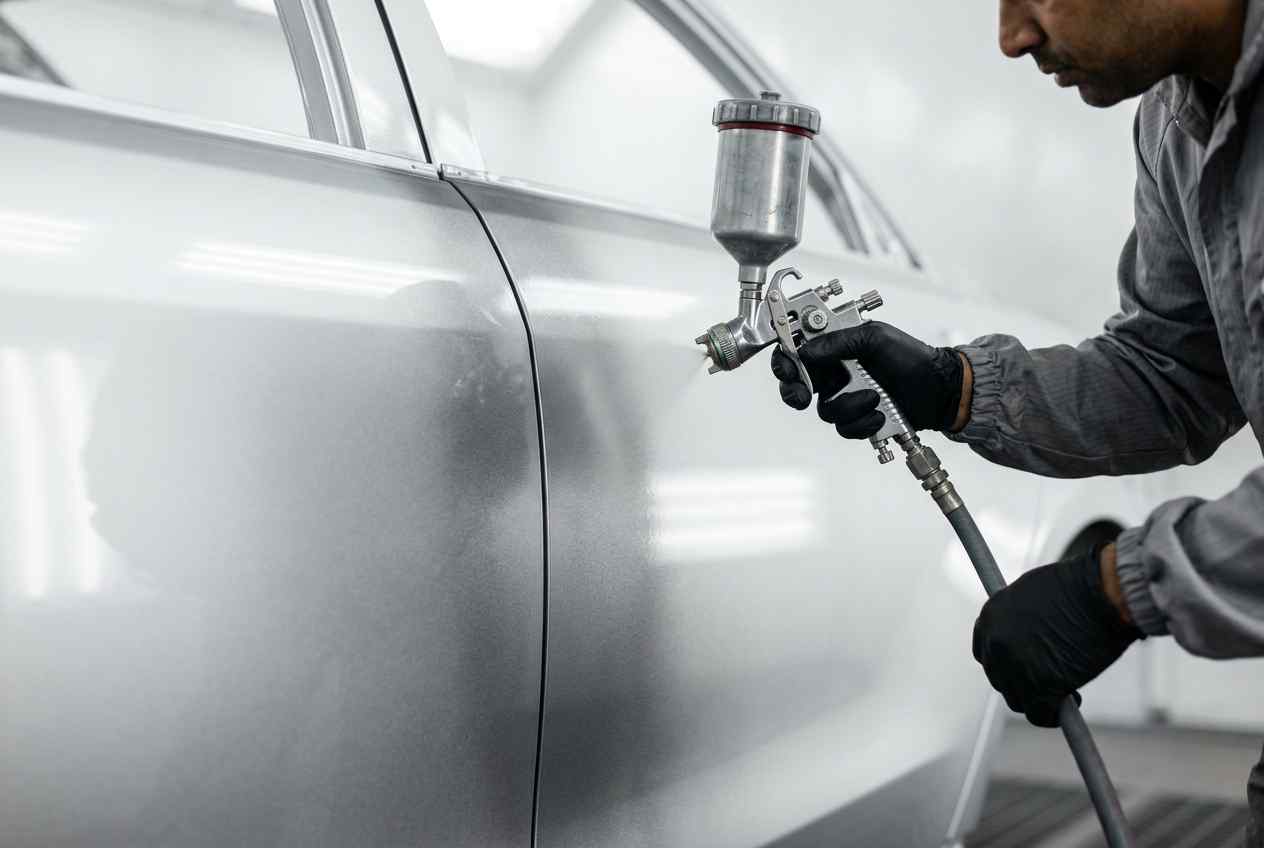
Gun distance, air pressure, overlap, travel speed, reducer, flash time and the final control coat can all move metallic orientation. Too-wet application can create dark areas or mottling; dry application can look coarse and light.
Curved panels can exaggerate striping, while a repair near a sharp edge may provide too little space for a gradual blend. Technique must remain consistent from the approved spray-out through the repair panel.
Blend only after the formula is sound
Blending manages the relationship between repaired colour and the existing finish. It does not hide an incorrect formula. The basecoat transition needs enough clean, prepared space for colour and effect to reduce gradually.
Clearcoat follows the approved full-panel or product-system boundary. Handles, mouldings, creases and adjoining repairs can restrict the available space and change the dismantling or panel plan.
Broad diffused light
Reveals mottling, striping and uneven effect distribution across the repaired area.
Direct inspection light
Exposes sparkle, particle coarseness, texture and local brightness differences.
Face-to-flop movement
Shows whether side tone and orientation remain related as the viewer changes angle.
Name the failed layer before correction
Wrong hue or value points toward formula, ground shade or film build. Mottling and striping point toward application and orientation. Coarse texture or low gloss may sit in clearcoat. Sanding every layer without diagnosis can remove a correct basecoat and expand the repair unnecessarily.
The foundation must remain uniform
Ground shade and substrate preparation matter on repaired bumpers and mixed-material panels. A transparent metallic basecoat can allow primer colour, sealer shade or uneven coverage to influence the final value. Extra metallic coats should not be used to hide sanding marks, repair edges or inconsistent primer.
When the repaired panel changes colour at an angle
Ask for a colour and effect diagnosis
Send one straight-on photo, two oblique angles and images in shade and daylight. We can identify whether the concern is formula, flake orientation, clouding, texture, gloss or the chosen blend boundary before recommending correction.
Read the symptom
Visible metallic defects point to different causes
One correction method does not solve every mismatch. The coating must be inspected before sanding or repainting.
Light and dark patches
Uneven wetness, overlap, gun distance, flash-off or orientation can make metallic particles group irregularly. Polishing clear coat cannot realign the basecoat below it.
Bands following gun passes
Inconsistent overlap or access can reveal the application path, especially on long bonnets, roofs and doors. The basecoat usually needs controlled correction.
Effect looks too large or sparkly
The aluminium or effect toner may not represent the vehicle, even when the basic hue is close. Formula and variant selection must be revisited.
Panel turns too dark from the side
Particle orientation and film wetness can change side tone. A formula-only adjustment may worsen the face colour if technique is the real cause.
Match changes at the panel gap
An edge-to-edge decision can expose a small formula difference. A controlled colour blend may provide a more natural transition when appropriate.
Colour is close but reflection differs
Clear-coat texture, gloss or polishing can make the panel read differently. The colour layer may be acceptable while the surface finish needs correction.
Blend for transition, not concealment
The adjacent panel must be suitable for blending
A colour blend distributes a controlled amount of basecoat into an adjoining panel so the eye sees a gradual transition. It does not mean spraying every nearby panel automatically. The blend panel must have sound paint, adequate area, suitable geometry and no unrelated damage that would make the result unstable.
Clear coat boundaries follow the selected paint system and panel design. A basecoat blend can sit within a fully cleared panel, while a hard clear edge in the wrong place may remain visible. Handles, mouldings and styling lines influence access and the final boundary.
If the adjoining panel is already a different colour because of an older repair, the painter must decide which surface becomes the reference. Matching a mismatched neighbour can carry the problem around the vehicle. The inspection should map all nearby panels before approving a formula.
Metallic matching is one part of the car painting service in Dubai. Dent correction, primer colour, sealer coverage, panel shape and booth cleanliness also affect the final reading. A smooth colour transition over a visible repair outline is not a complete result.
Metallic handover
Move around the vehicle before accepting the match
Straight-on view
- Basic hue and brightness agree
- No obvious hard colour boundary
- Repair shape is not visible below the paint
- Clear-coat gloss is even
Oblique view
- Side tone does not turn unexpectedly dark or light
- Flake coarseness remains related
- No banding or mottling appears
- Body-line transitions stay continuous
Light changes
- Inspect under controlled white light
- Check open shade for hue
- Use useful daylight for effect
- Avoid judging a dirty or wet panel
Process record
- Approved formula or variant is recorded
- Blend panels are listed on the invoice
- Disturbed trims and functions are checked
- Aftercare and rectification route are clear
Foundation colour and final reflection
Primer and sealer can move a translucent metallic result
Some metallic basecoats reach full hiding quickly, while others remain influenced by the substrate or sealer below. A dark repair patch under a light, weak-hiding metallic can alter brightness even when the mixed formula is correct. The preparation plan should create a consistent foundation across the colour area.
Sanded-through edges, filler, primer spots and old paint can absorb or reflect material differently. Sealer selection and coverage help control that variation, but they must follow the paint system and approved sample. Applying extra basecoat only over the primer patch can create a local build and different flake orientation.
Panel shape adds another variable. A flat door, crowned wing, sharp bonnet line and plastic bumper present the same metallic at different angles. The painter compares the assembled view and plans the blend around geometry rather than assuming every panel should look identical when held separately.
At correction, diagnose the layer before sanding. A colour or flop problem usually sits in basecoat, while a texture or gloss problem may sit in clear coat. Removing a correct basecoat because the clear is rough adds risk without solving the original cause.
The closest metallic formula becomes a convincing repair only when the application makes its particles behave like the vehicle.
If a prior repair looks different, photograph it in clean, dry conditions before any correction. A mismatch can come from colour, effect, texture or several layers together.
The next useful step is not another guess at the paint code. It is a controlled comparison that separates those variables.