
Scratch paint matching in Al Quoz 4
Scratch Paint Matching Dubai
Once a scratch breaks through the clear coat and removes colour, the repair becomes a paint-matching job. The paint code identifies the original colour family, but the final formula and blend plan must reflect the vehicle in front of us, including age, previous repainting, metallic or pearl effect and the panel beside the repair.
Direct answer
When does a scratch actually need paint matching?
A transferred mark or shallow clear-coat scratch may need cleaning or correction, not new colour. Paint matching becomes relevant when colour has been removed, primer or substrate is visible, a previous repair has failed, or the repair area is large enough that a sprayed colour transition is required.
The deepest damaged layer matters more than the apparent length of the line. One key scratch can stay in clear coat for part of its path and cut into colour elsewhere, so the repair route follows the deepest section and the finish standard expected at handover.

The match is developed before spraying
A paint code narrows the family; the vehicle decides the final match
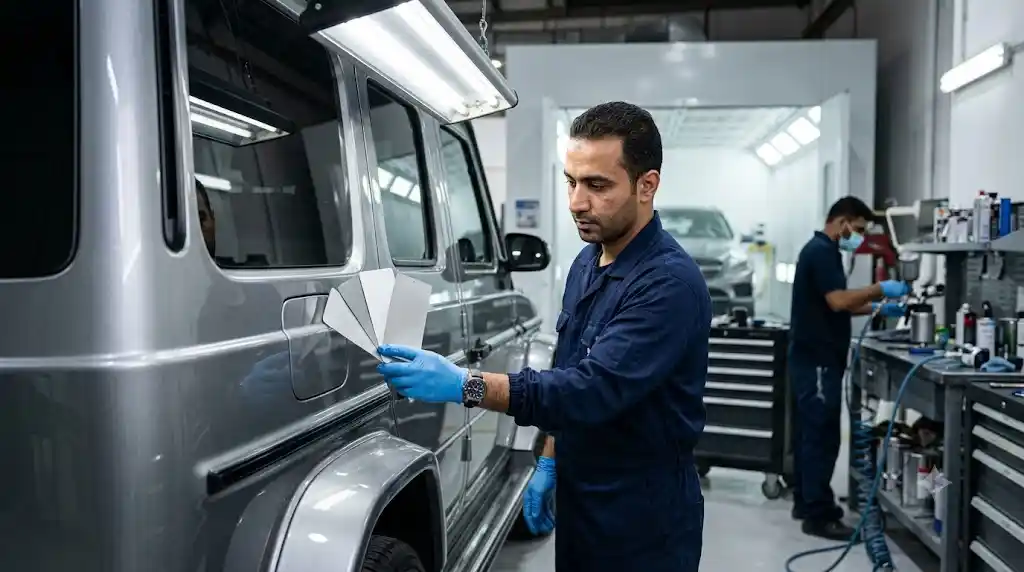
Colour matching combines manufacturer data with evidence from the current panel. A spectrophotometer can measure reflected colour and suggest formula variants, but it does not remove the need to verify how the mixed paint behaves after spraying.
Our wider car paint matching process explains paint codes, variant databases, spray-out cards, blending and multi-light inspection in more detail. For a scratch repair, the same logic is applied to a smaller repair decision.
Confirm the code and repair history
Identify the colour family and ask whether the panel or adjacent panel has been refinished before.
Read the current panel
Compare colour, brightness, effect and fade on a clean representative area rather than relying only on the original factory formula.
Mix a candidate formula
Select the best variant and adjust only from evidence, not from repeated guesswork at the spray gun.
Spray a test card
Apply the candidate using the intended reducer, pressure, distance and application method so the test reflects the repair process.
Compare and refine
Judge the card beside the vehicle from useful angles and lighting, then approve the formula and blend plan before painting the car.
Repair boundary
Scratch length does not decide how much of the panel must be painted
A narrow line may need only controlled touch-up when protection matters more than invisibility. Another scratch of similar size may need sprayed colour and a wider transition because the finish, position or customer expectation makes a hard local edge too visible.
Correction only
Use when the defect remains in stable clear coat and enough coating remains for responsible refinement.
Controlled touch-up
Useful for narrow deeper marks where sealing the exposed area and reducing visibility is the agreed objective.
Local paint or panel refinish
Suitable when colour is missing and the repair boundary can be prepared and sprayed without creating a conspicuous transition.
Blend when the finish requires it
Some colours and repair locations need a broader colour transition before clear coat so the repaired area relates naturally to the surrounding vehicle.
When a sprayed repair is the correct route, the car painting and panel refinishing service covers substrate preparation, primer, basecoat, clear coat, curing and final finish control. When the damage may still be correctable without new colour, our repaint versus paint correction guide explains that boundary.
Finish behaviour
Solid, metallic, pearl and matte scratches do not share one matching strategy
Two formulas can look close face-on and separate when the panel is viewed from the side. The finish type changes what must be controlled beyond basic hue.
Solid colours
Hue, value and saturation dominate the comparison, but age, previous paint and the surrounding panel can still move the acceptable formula away from the code-book starting point.
Metallic colours
Flake orientation affects face tone and side tone. Air pressure, gun distance, reducer choice and final control coats can change the appearance, so the process matters as much as the formula. See how we handle metallic paint matching.
Pearl and tri-coat colours
The ground coat and effect layer interact, so a small change in pearl-layer application can shift the visual result. A let-down or spray-out sequence helps establish the correct number of effect passes. Our pearl paint repair guide explains that workflow.
Matte and satin finishes
Sheen is part of the colour impression. Polishing is not a normal way to hide a mismatch because it can permanently change gloss, so the repair scope must be planned before spraying.
Blend strategy
The cleanest repair is the one with the most defensible colour transition
Blending is not a badge of quality and it is not required on every scratch. It is a controlled way to manage a difficult colour relationship when stopping new colour at a hard boundary would make a small formula difference easier to see.
Keep the repair contained when the evidence supports it
A limited repair can be appropriate when the colour match is stable, the finish is forgiving, the damaged area is well positioned and the transition can be hidden within a sound panel area.
- Preserves more original finish
- Reduces unnecessary disassembly
- Keeps the painted area proportional to the damage
Expand the colour transition when a hard edge would expose the mismatch
Metallic, pearl, aged paint, large flat panels and repairs close to an adjacent panel can make a minor difference easier to see. The blend plan should be agreed before spraying, not improvised after the panel is already painted.
- Compare adjoining panels first
- Protect body lines and panel edges
- Clear coat only over properly prepared areas
Quality control
A convincing scratch repaint must survive more than one viewing angle
Colour is only one part of the result. The repaired panel must also carry the right effect, gloss, texture and edge quality when it is compared with the surrounding vehicle.
Useful first evidence
Send enough of the vehicle for us to judge the scratch and the colour around it
A close-up alone can hide the panel shape and surrounding colour. Send the vehicle details and a small photo set so we can decide what still needs workshop inspection before promising a paint route.
- Make, model and year
- Full-panel photo
- Close scratch photo
- Reflection-angle photo
- Paint-code label if accessible
- Any known repaint history